The Nuclear Power Plant — How it Works
5 min read · Energy Atlas Editorial
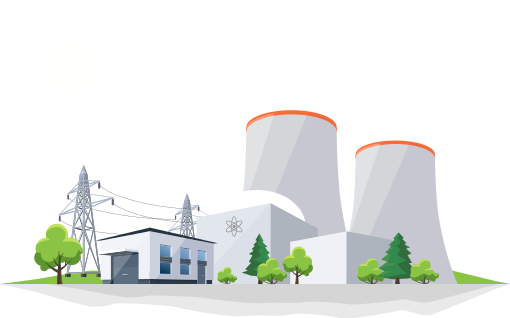
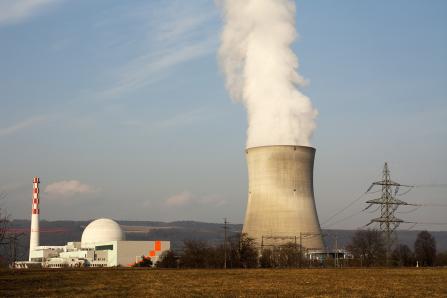
Inside the nuclear power plant reactor, a controlled fission reaction takes place. Heat removed by coolant is used to produce steam to propel the turbine.
A nuclear power plant is basically a thermal power plant in which the heat source is an ongoing nuclear fission reaction. In the most common type, a pressurised water reactor, a coolant removes the released heat and transfers it in a steam generator to water in a secondary circuit, where steam is generated. This steam powers a steam turbine that drives a generator to generate electricity.
The Reactor Core
Video: Schematic diagram of a nuclear power plant.
Heat is generated in a nuclear power plant by the fission of atomic nuclei contained in the nuclear fuel loaded into the so-called reactor core. Natural or enriched uranium or MOX, a mixture of uranium and plutonium oxides, is usually used to produce nuclear fuel. The reactor core may also contain a moderator used to slow down neutrons and absorber rods used to control the course of the fission reaction.
The Reactor
Under normal operating conditions, fully under the control of the power plant operators and its control systems, a controlled fission reaction takes place inside the reactor core. During this reaction, energy is released by the fission of atomic nuclei, primarily in the form of heat. This heat is removed from the fuel rods by a coolant. Water is the most commonly used coolant. Less frequently, gas, liquid metal or molten salt may also be used. The coolant temperature in many commercial power reactors is around 300 °C when it exits the reactor. The reactor itself may consist of a steel pressure vessel, a concrete vessel or a set of pressure channels housing the nuclear fuel. A reactor must be able to withstand high temperatures, pressures where applicable, and an intense neutron flux. Modern nuclear power plants are typically designed for an operating life of 60 years or more.
Primary Circuit and Steam Generator
Video: 3D model of the VVER 1000 reactor primary circuit.
Coolant exiting the reactor circulates in a closed circuit known as the primary circuit. The coolant transfers its heat in a heat exchanger known as the steam generator. Water in the other circuit, known as the secondary circuit, heats up in the steam generator, starts to boil and produces steam. This steam is then dried and supplied to a turbine. In a two-circuit power plant, the radioactive primary coolant remains separated from the secondary circuit and does not come into direct contact with the turbine or other conventional components of the power plant.
Some types of nuclear power plants are based on a single circuit. In boiling water reactors (BWRs), boiling occurs directly in the reactor core and the generated steam is separated from water, dried and supplied directly to a turbine. The advantage of a single-circuit arrangement is its simpler design and the elimination of steam generators. However, because the steam passes directly from the reactor to the turbine, it contains short-lived radioactive isotopes and the turbine and associated steam systems must therefore be treated as part of the radiologically controlled area.
Containment
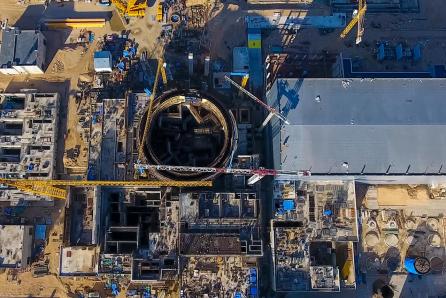
The so-called nuclear side of a nuclear power plant comprises the reactor, the primary circuit and related nuclear systems. These components are usually enclosed within a robust structure known as the containment. It protects safety-critical equipment from external hazards and, at the same time, prevents or limits the release of radioactive substances in the event of a serious accident. Modern containments are designed to withstand severe internal pressures and external hazards, which may include aircraft impact. They are commonly constructed of reinforced or prestressed concrete, often with a steel liner to ensure leak-tightness.
4 pictures 4 pictures
Secondary Circuit, Turbine and Generator
Video: Model of a low-pressure turbine rotor of a nuclear power plant.
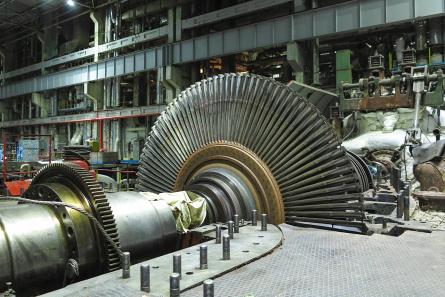
The secondary circuit and other related components are not part of the nuclear side of a nuclear power plant. Their function is similar to that of other thermal power plants. Steam generated in the secondary circuit is supplied to a turbine that may be tens of metres long and contain several stages. The first is the high-pressure stage, which is driven directly by steam from the steam generators. After passing through the high-pressure stage, the steam is dried and reheated before being supplied to the low-pressure stages, which have progressively longer blades. Depending on the turbine design, the shaft typically rotates at 1,500 or 3,000 rpm in a 50 Hz grid and drives a generator that produces electricity.
The Arabelle is the world's most powerful steam turbine in operation. Designed specifically for nuclear power plants, its largest versions can reach outputs of up to 1,900 MW.
7 pictures 7 pictures
Cooling
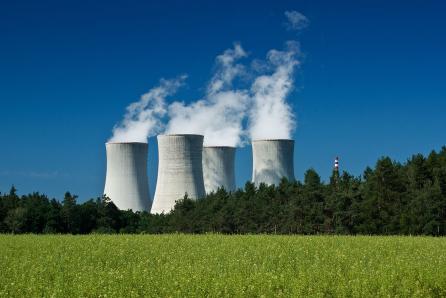
In order to maximise the efficiency of energy conversion, the steam must be condensed after leaving the steam turbine. This is achieved in a condenser cooled by a separate cooling-water system, sometimes referred to as the tertiary circuit. The cooling water may release heat directly to the sea, a river or another large body of water, or it may be cooled in cooling towers. Lower cooling towers may use forced or induced airflow through sprayed or distributed water. Part of the water evaporates, removing heat from the remaining water.
The second type of cooling tower, often a dominant feature of a thermal power plant, is a large concrete shell in the shape of a hyperboloid, typically more than 100 metres tall. Warm water is distributed inside the tower and flows down through the fill towards a basin at its base. Natural draught draws air upwards through the tower, cooling the water primarily by evaporation before it is returned to the condenser.
Most of the visible plume above a nuclear power plant's cooling towers is simply water vapour condensed into tiny droplets, not smoke or radioactive gas.
Power Plant Power Output
There are three different ways to express the power output of a nuclear power plant:
- Thermal power, expressed in MWt, indicates how much heat is generated by the reactor.
- Gross electrical power output, expressed in MWe, indicates how much electricity is generated by the generator.
- Net electrical power output, expressed in MWe, indicates how much electricity is supplied to the grid after the plant's own electricity consumption has been deducted. The achievable electrical output may vary with cooling-water and ambient conditions and can therefore differ between summer and winter.
4 pictures 4 pictures
Nuclear Power Plant — PWR On-line interactive 3D model
Keep reading
Articles
The First Reactor
The first fission reactor was Chicago Pile No. 1, constructed by Enrico Fermi (2.12.1942). The first experimental nuclear power plant was the EBR-1.
3 min read
Pressurized Water Reactor (PWR)
The pressurized water reactor (PWR) uses light water at a pressure of 15.7 MPa as a coolant. Steam in the secondary circuit propels the turbine.
3 min read
Boiling Water Reactor (BWR)
In a boiling water reactor (BWR), the water boils directly inside the reactor. Dried steam propels the turbogenerator. It is a single-circuit power plant.
3 min read
Heavy Water Reactor (PHWR)
The pressurized heavy water reactor (PHWR) uses natural uranium as fuel and heavy water as coolant and moderator. Most of them are of the CANDU type.
3 min read
Gas-cooled Reactor (GCR) and Advanced Gas-cooled Reactor (AGR)
Gas cooled reactors (GCR), used in Japan and the UK, use graphite as a moderator and pressurized CO2 as a coolant. It is a double-circuit power plant.
3 min read
RBMK Type Reactor
The Soviet RBMK reactor uses graphite as a moderator and light water, that boils in the channels, as a coolant. Chernobyl reactor was of RBMK type.
3 min read
High Temperature Reactor (HTGR)
In a High Temperature Gas-cooled Reactor (HTGR), the highly enriched uranium spheres are dispersed in graphite (moderator) balls. Helium is a coolant.
3 min read
Reactor Using Fast Neutrons (FR)
A reactor using fast neutron (FR) burns a mixture of uranium and plutonium. Fast breeder reactors (FBR) produce more plutonium than they consume.
3 min read
Small Modular Reactors
Inside a nuclear reactor, a fission reaction takes place. Released energy is removed by coolant and used to generate electricity. A common reactor is PWR.
16 min read
The Future of Fission Reactors
Several types of Generation IV reactors are under development: fast reactors cooled by lead, molten salts, or sodium; HTGR, or supercritical water reactor.
4 min read