The First Reactor
3 min read · Energy Atlas Editorial
The first fission reactor was Chicago Pile No. 1, constructed by Enrico Fermi (2.12.1942). The first experimental nuclear power plant was the EBR-1.
In 1938, Enrico Fermi (29 September 1901 — 28 November 1954) was awarded the Nobel Prize in Physics for his demonstrations of the existence of new radioactive elements produced by neutron radiation and for his related discovery of nuclear reactions brought about by slow neutron. After receiving the prize in Stockholm, Fermi and his family left Fascist Italy for the United States, where he later became part of the Manhattan Project. Its primary goal was the development of nuclear weapons.
Chicago Pile No. 1
![A drawing of the first nuclear reactor constructed at the University of Chicago, where a group of scientists succeeded in initiating and maintaining the first controlled, self-sustaining nuclear fission chain reaction.(Archival Photographic File, [apf2-00501r], Special Collections Research Center, University of Chicago Library.)](/assets/nuclear/reactors/nuclear-energy-the-nuclear-reactors-the-first-reactor-apf2-00501r.fitbox.x446.y2-d45b7894009e.jpg)
The first controlled, self-sustaining nuclear fission chain reaction was initiated on 2 December 1942 at 15:25 beneath Stagg Field at the University of Chicago. Fermi and his collaborators had built a graphite-moderated nuclear reactor known as Chicago Pile-1. It was a pile about four metres high and 7.5 metres wide, constructed of graphite blocks containing natural uranium metal and uranium oxide. The reactor core was shaped approximately as a flattened ellipsoid. The original intention was to construct a spherical reactor core, but according to Fermi's calculations, a smaller structure was sufficient. The pile contained about 350 tonnes of graphite, 36 tonnes of uranium oxide and 5.6 tonnes of uranium metal. Its construction cost about one million US dollars.
The reactor power was controlled manually by inserting or withdrawing cadmium control rods, which absorbed neutrons. Several independent emergency measures were available, including safety rods that could be rapidly inserted into the pile. As a last resort, a team nicknamed the "suicide squad" stood ready to pour a cadmium salt solution over the reactor to stop the chain reaction. However, there was no need to intervene: the reactor functioned as expected.
The historic experiment was witnessed by several dozen scientists using relatively simple measuring instruments. At 15:25 the reactor became self-sustaining and remained critical for about half an hour before Fermi ordered it to be shut down. Its power during the first critical operation was only about 0.5 W, although it was later operated at substantially higher power.
4 pictures 4 pictures
Chicago Pile-1 had no radiation shielding or cooling system and was built beneath the stands of a university football stadium.
The First Power Plant
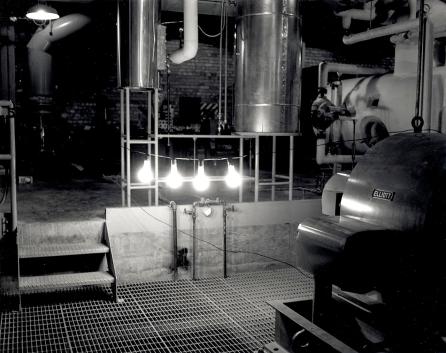
The first nuclear reactor to generate usable electricity was Experimental Breeder Reactor I (EBR-I) in Idaho. On 20 December 1951, electricity generated from nuclear fission powered four 200-watt light bulbs. The following day, the reactor produced enough electricity to power the entire building. The primary goal of its creators was not electricity generation, but to demonstrate whether a nuclear reactor could produce more fissile fuel than it consumed. EBR-I was a fast breeder reactor, in which fission is sustained by fast, unmoderated neutrons and plutonium-239 can be produced from uranium-238. This plutonium can then be used as nuclear fuel. The world's first nuclear power plant to supply electricity to a public grid began operation on 27 June 1954 near Obninsk in the Soviet Union. Its AM-1 reactor had an electrical output of 5 MW and a thermal output of about 30 MW. It was a graphite-moderated, water-cooled channel-type reactor and represented an important step in the development of Soviet nuclear power technology.
3 pictures 3 pictures
EBR-I was initially known as Chicago Pile No. 4 (CP-4) and was sometimes nicknamed "Zinn's Infernal Pile" after its project leader, Walter H. Zinn. The world's first nuclear-powered submarine, USS Nautilus, was launched in 1954 and first went to sea under nuclear power in January 1955.
Keep reading
Articles
The Nuclear Power Plant — How it Works
Inside the nuclear power plant reactor, a controlled fission reaction takes place. Heat removed by coolant is used to produce steam to propel the turbine.
5 min read
Pressurized Water Reactor (PWR)
The pressurized water reactor (PWR) uses light water at a pressure of 15.7 MPa as a coolant. Steam in the secondary circuit propels the turbine.
3 min read
Boiling Water Reactor (BWR)
In a boiling water reactor (BWR), the water boils directly inside the reactor. Dried steam propels the turbogenerator. It is a single-circuit power plant.
3 min read
Heavy Water Reactor (PHWR)
The pressurized heavy water reactor (PHWR) uses natural uranium as fuel and heavy water as coolant and moderator. Most of them are of the CANDU type.
3 min read
Gas-cooled Reactor (GCR) and Advanced Gas-cooled Reactor (AGR)
Gas cooled reactors (GCR), used in Japan and the UK, use graphite as a moderator and pressurized CO2 as a coolant. It is a double-circuit power plant.
3 min read
RBMK Type Reactor
The Soviet RBMK reactor uses graphite as a moderator and light water, that boils in the channels, as a coolant. Chernobyl reactor was of RBMK type.
3 min read
High Temperature Reactor (HTGR)
In a High Temperature Gas-cooled Reactor (HTGR), the highly enriched uranium spheres are dispersed in graphite (moderator) balls. Helium is a coolant.
3 min read
Reactor Using Fast Neutrons (FR)
A reactor using fast neutron (FR) burns a mixture of uranium and plutonium. Fast breeder reactors (FBR) produce more plutonium than they consume.
3 min read
Small Modular Reactors
Inside a nuclear reactor, a fission reaction takes place. Released energy is removed by coolant and used to generate electricity. A common reactor is PWR.
16 min read
The Future of Fission Reactors
Several types of Generation IV reactors are under development: fast reactors cooled by lead, molten salts, or sodium; HTGR, or supercritical water reactor.
4 min read