Fission Products
3 min read · Energy Atlas Editorial
After fission, the uranium nucleus decays into two approximately equal halves. Typical products are iodine and cesium, but other ways of decay exist.
When a 235U nucleus absorbs a neutron and undergoes fission, it usually splits asymmetrically into two lighter nuclei known as fission fragments. One fragment typically has a mass number around 90—100 and the other around 130—145. Fission can produce many different combinations of fragments, resulting in hundreds of different radioactive fission-product nuclides. Important fission products include isotopes of iodine, cesium, strontium, xenon, krypton, barium, zirconium and many other elements. Most primary fission fragments are radioactive and undergo a series of beta decays towards more stable nuclei.
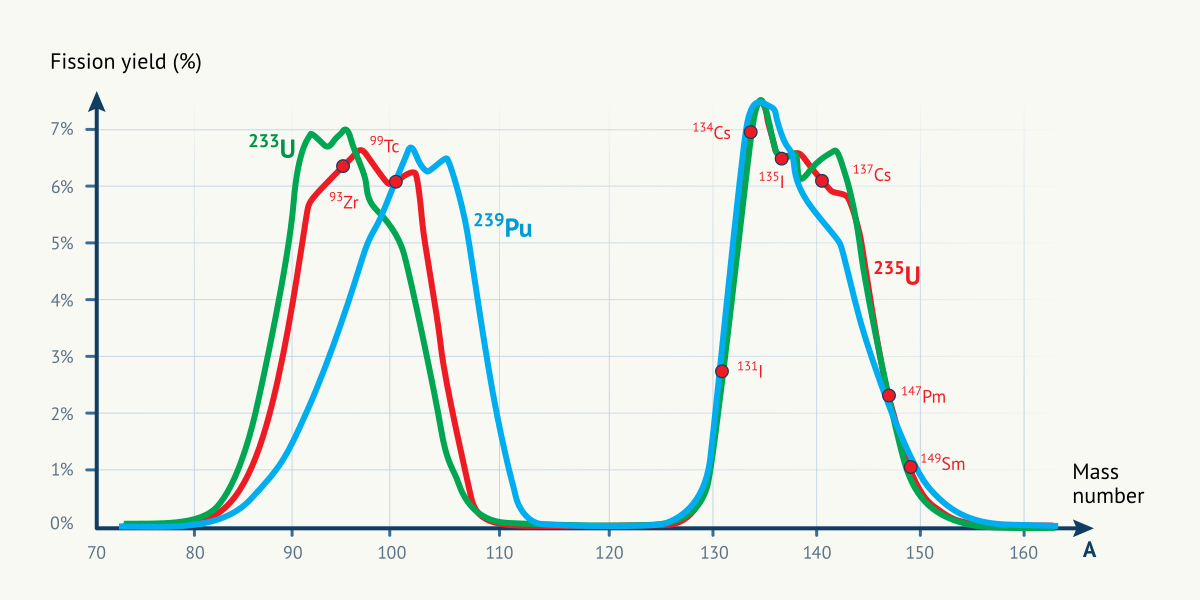
Fission product yield distributions as a function of mass number for thermal-neutron-induced fission of 235U, 239Pu and 233U.
238U can capture a neutron to form 239U, which undergoes two successive beta decays to form fissile 239Pu. Some of this plutonium subsequently undergoes fission in the reactor and contributes significantly to energy production, producing another range of radioactive fission products.
A tonne of spent light water reactor fuel typically contains around 30—40 kg of fission products, depending mainly on the fuel burnup.
Neutron capture also produces heavier isotopes and transuranic elements in reactor fuel. Successive neutron captures and radioactive decays can form isotopes of plutonium, neptunium, americium and curium. For example, neutron capture can ultimately produce 241Pu, which undergoes beta decay to 241Am.
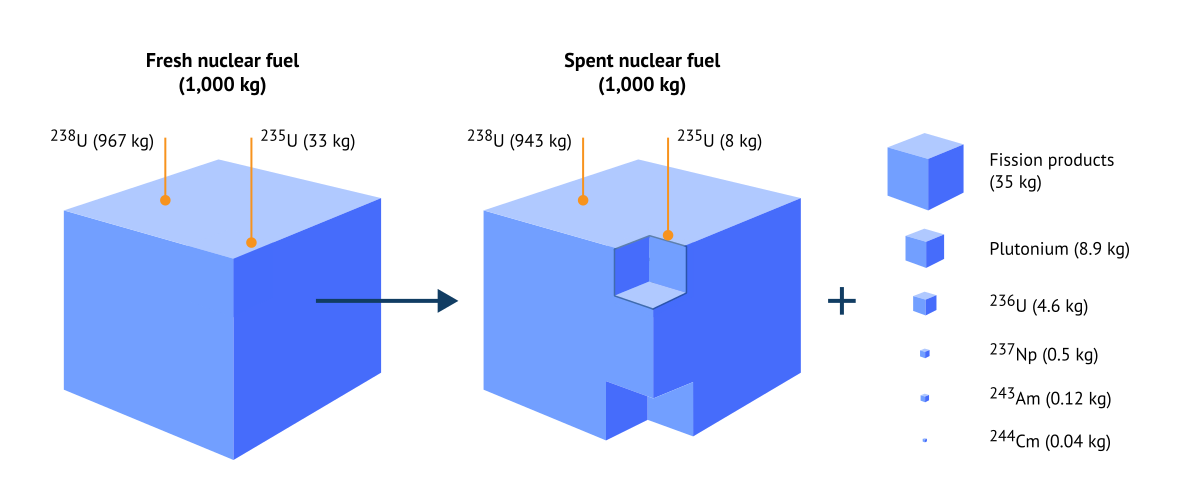
After several years in a reactor, nuclear fuel contains a complex mixture of uranium, plutonium, other actinides and numerous fission products. The exact composition of spent fuel depends on its initial enrichment, burnup and irradiation history. Typical spent light water reactor fuel consists of about 95—96% uranium, around 1% plutonium, approximately 3—4% fission products and a smaller fraction of minor actinides such as neptunium, americium and curium.
Fission and the subsequent radioactive decay of fission products produce hundreds of different radionuclides, many of which have very short half-lives.
Keep reading
Articles
Principle of Operation
The binding energy that holds nucleons together is different for each isotope. When fusing light nuclei or splitting heavy nuclei, energy is released.
3 min read
Types of Nuclear Reactions
Nuclear reactions can lead to scattering, capture, or splitting depending on neutron velocity. So-called "slow" neutrons (0.02 eV) can split 235U nuclei.
3 min read
Fission Chain Reaction
When a neutron splits the 235U nucleus, 2-3 neutrons are released. The fission chain reaction occurs when they split other nuclei, releasing more neutrons.
3 min read
Control and Reaction States
The chain fission reaction in a nuclear reactor is controlled by the neutron absorber content. The reactor can be subcritical, critical, or supercritical.
3 min read
Moderator
To increase the chance of fission, the moderator slows down neutrons by collisions. The usual moderators are water, heavy water, and graphite.
3 min read
Absorber
The absorber (boron, cadmium) captures the neutrons and thus regulates the nuclear reactor output. It can be part of the coolant or control rods.
3 min read
Coolant
The coolant removes heat from the fission reaction. The most commonly used is water, but also helium, CO2, molten sodium, lead, or fluoride salts are used.
3 min read
The Largest Nuclear Power Plants
In 2012, there were 436 reactors in use worldwide. The largest nuclear power plant is Japan's Kashiwazaki Kariwa with 7,965 MW of installed power output.
3 min read
Questions
How does a nuclear reactor generate electricity?
Fission heat raises steam. A turbine-generator does what it does in any thermal plant.