Fission Chain Reaction
3 min read · Energy Atlas Editorial
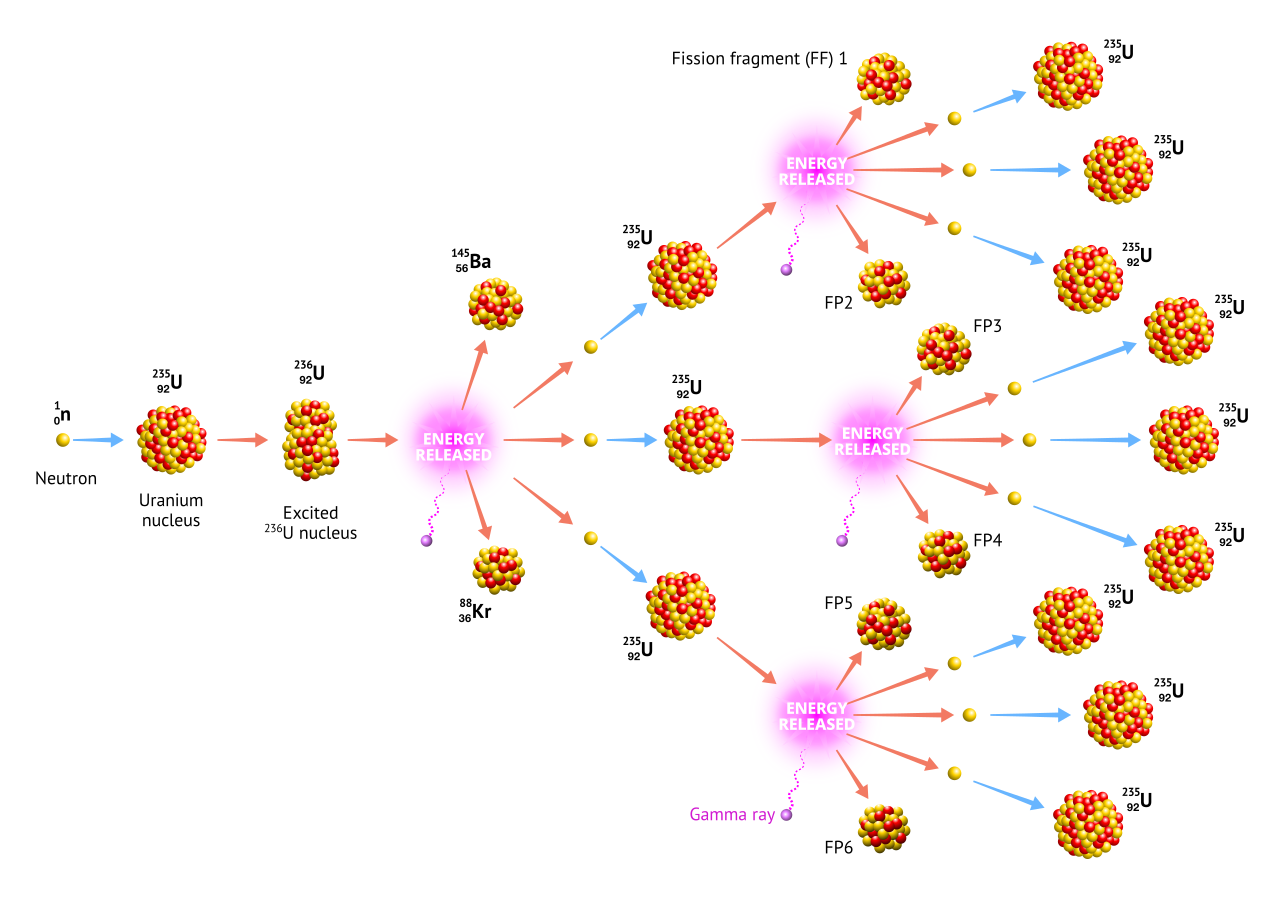
When a neutron splits the 235U nucleus, 2-3 neutrons are released. The fission chain reaction occurs when they split other nuclei, releasing more neutrons.
If a slow neutron is absorbed by a 235U nucleus, the nucleus may undergo fission, splitting into two fission fragments and releasing two or three fast neutrons. These neutrons may in turn be absorbed by other 235U nuclei and cause further fissions, each releasing additional neutrons. In an idealised case in which each fission causes two further fissions, four nuclei undergo fission in the second generation, eight in the third, and so on. By the 30th generation, more than one billion nuclei would undergo fission. This rapidly multiplying process is known as a fission chain reaction.
Natural uranium contains about 0.7% 235U, while conventional light water reactor fuel is typically enriched to several percent 235U.
Chain Reaction Conditions
A self-sustaining chain reaction can occur only if, on average, at least one neutron from each fission causes another fission. In practice, many neutrons are lost by leakage from the core or by absorption without causing fission. Several conditions therefore influence whether a chain reaction can be sustained.
Critical mass
If there is too little fissile material, or if its concentration and geometrical arrangement are unsuitable, too many neutrons escape or are absorbed without causing further fission. The minimum amount of fissile material required to sustain a chain reaction under specified conditions is known as the critical mass. Its value depends not only on the material itself, but also on its concentration, geometry and surrounding materials.
Absorber
Many atomic nuclei can absorb neutrons without undergoing fission. Neutrons lost in this way can no longer propagate the chain reaction. If too many neutrons are absorbed, a self-sustaining chain reaction cannot be maintained. Isotopes of boron and cadmium are strong neutron absorbers and are therefore widely used to control nuclear reactors. 238U can also absorb neutrons, particularly through radiative capture.
Moderator
Fast neutrons can cause fission in 235U, but the probability of fission is much greater for slow, or thermal, neutrons. In thermal reactors, a moderator is therefore used to slow down the fast neutrons produced by fission and increase the probability that they will cause further fissions.
The effective neutron multiplication factor (k_eff) describes the change in the neutron population from one generation to the next. When k_eff = 1, the chain reaction is self-sustaining and the reactor is critical; when k_eff < 1 it is subcritical, and when k_eff > 1 it is supercritical.
The Discovery of Chain Reactions
In 1934, Enrico Fermi and his colleagues bombarded uranium and other elements with neutrons and observed the formation of unexpected radioactive products. The nature of the process remained unclear until December 1938, when Otto Hahn and Fritz Strassmann identified barium among the products of neutron-bombarded uranium. Lise Meitner and Otto Frisch subsequently explained that the uranium nucleus had split into lighter nuclei, releasing a large amount of energy, and Frisch named the process nuclear fission. The possibility of a nuclear chain reaction had already been proposed by Leó Szilárd in 1933. Once it was established that additional neutrons are released during uranium fission, the possibility of a self-sustaining fission chain reaction became clear. In 1942, a team led by Fermi achieved the world's first controlled, self-sustaining nuclear chain reaction in Chicago Pile-1.
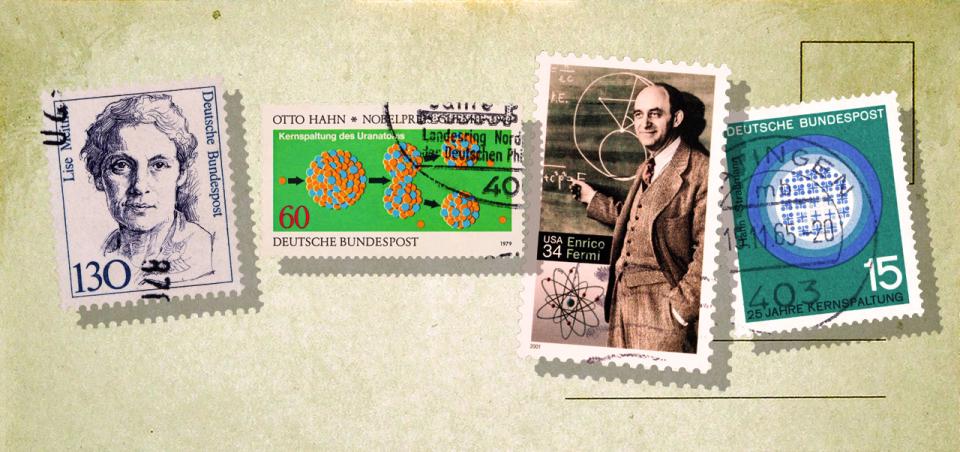
Fermi and his colleagues discovered in 1934 that slowing neutrons down could greatly increase the probability of certain neutron-induced nuclear reactions. They experimented with hydrogen-rich materials such as paraffin and water, laying important foundations for the later development of neutron moderators.
Keep reading
Articles
Principle of Operation
The binding energy that holds nucleons together is different for each isotope. When fusing light nuclei or splitting heavy nuclei, energy is released.
3 min read
Types of Nuclear Reactions
Nuclear reactions can lead to scattering, capture, or splitting depending on neutron velocity. So-called "slow" neutrons (0.02 eV) can split 235U nuclei.
3 min read
Control and Reaction States
The chain fission reaction in a nuclear reactor is controlled by the neutron absorber content. The reactor can be subcritical, critical, or supercritical.
3 min read
Moderator
To increase the chance of fission, the moderator slows down neutrons by collisions. The usual moderators are water, heavy water, and graphite.
3 min read
Absorber
The absorber (boron, cadmium) captures the neutrons and thus regulates the nuclear reactor output. It can be part of the coolant or control rods.
3 min read
Coolant
The coolant removes heat from the fission reaction. The most commonly used is water, but also helium, CO2, molten sodium, lead, or fluoride salts are used.
3 min read
Fission Products
After fission, the uranium nucleus decays into two approximately equal halves. Typical products are iodine and cesium, but other ways of decay exist.
3 min read
The Largest Nuclear Power Plants
In 2012, there were 436 reactors in use worldwide. The largest nuclear power plant is Japan's Kashiwazaki Kariwa with 7,965 MW of installed power output.
3 min read
Questions
How does a nuclear reactor generate electricity?
Fission heat raises steam. A turbine-generator does what it does in any thermal plant.
What is the difference between fusion and fission?
Fission splits heavy nuclei. Fusion joins light ones. Both can release binding energy; only fission is commercial electricity today.