Principle of Operation
3 min read · Energy Atlas Editorial
The binding energy that holds nucleons together is different for each isotope. When fusing light nuclei or splitting heavy nuclei, energy is released.
The nucleus of an atom is composed of neutrons and protons, collectively known as nucleons. Neutrons have no electric charge, while protons are positively charged and therefore repel each other. If electrostatic repulsion were the only force acting within the nucleus, atomic nuclei containing more than one proton could not remain bound together. Gravity cannot bind the protons together because the gravitational attraction between them is about 1036 times weaker than their electrostatic repulsion. The nucleus is bound together by the strong nuclear force. This force is extremely strong over very short distances but rapidly becomes negligible beyond the dimensions of an atomic nucleus. It acts between neighbouring nucleons and is largely independent of their electric charge.
Video: Model of a uranium-235 atom. Positively charged protons are depicted in red, while electrically neutral neutrons are depicted in yellow.
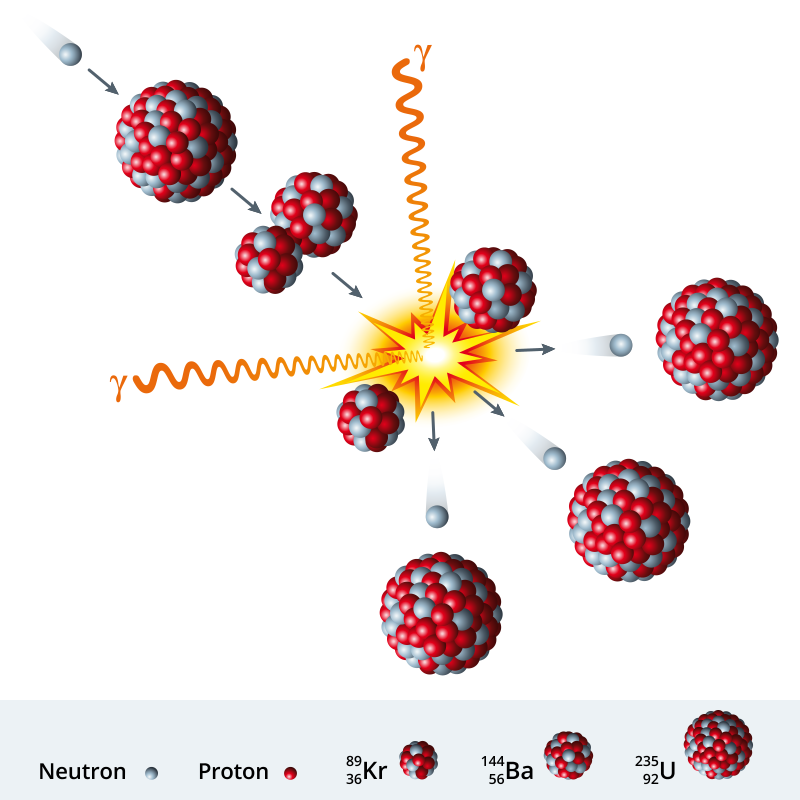
Video: Fission of uranium. The fundamental nuclear reaction used in nuclear power plants occurs when a neutron is absorbed by a fissile uranium nucleus, causing it to undergo fission.
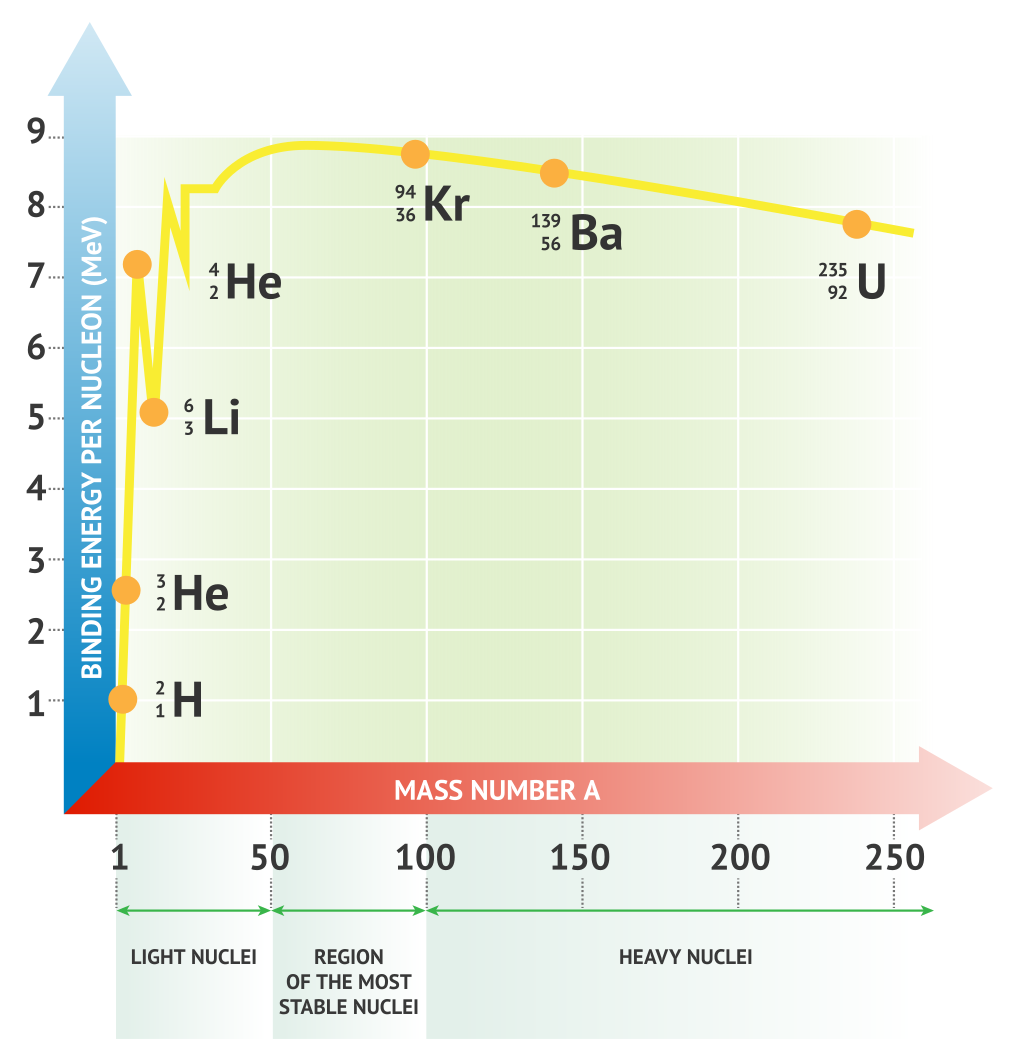
To separate a nucleus completely into its individual protons and neutrons, energy must be supplied. This energy is known as the nuclear binding energy. Dividing it by the number of nucleons gives the binding energy per nucleon, usually expressed in megaelectron volts (MeV). The binding energy of the 1H nucleus is zero because it consists of a single proton. For the 4He nucleus, the binding energy is about 7.1 MeV per nucleon. For light nuclei, the binding energy per nucleon generally increases with increasing mass number. It reaches a maximum of about 8.8 MeV for nuclei in the iron-nickel region and then gradually decreases, reaching about 7.6 MeV per nucleon for uranium.
One electron volt (eV) is the energy gained by an electron when it moves through an electric potential difference of one volt.
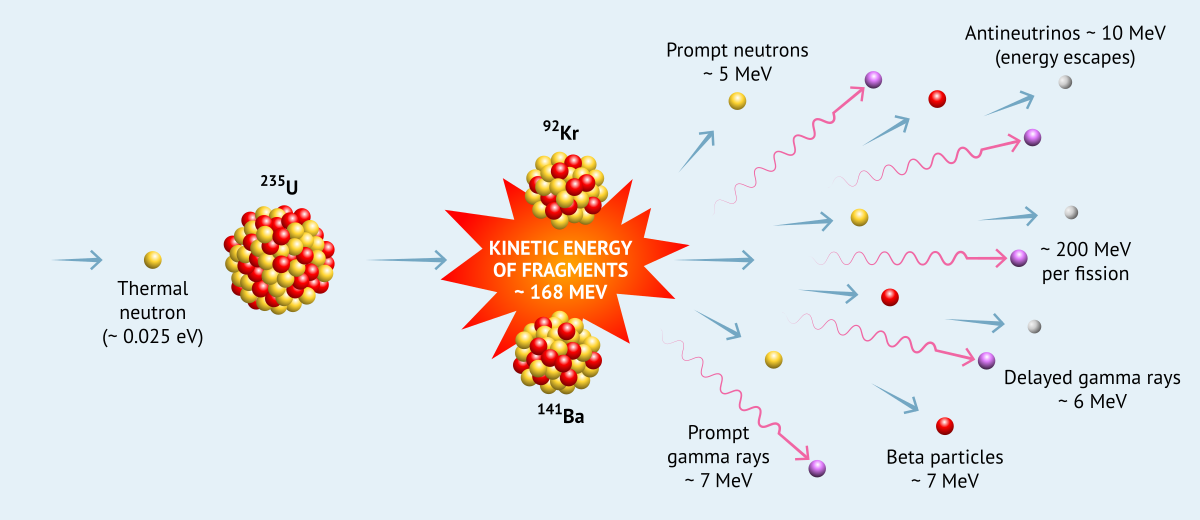
Schematic representation of the energy released in the fission of a 235U nucleus. Approximately 200 MeV of energy is released per fission.
If light nuclei combine to form a more tightly bound nucleus, the difference in binding energy is released. For example, when a deuterium nucleus and a tritium nucleus fuse, they form a helium-4 nucleus and a neutron, releasing 17.6 MeV of energy.
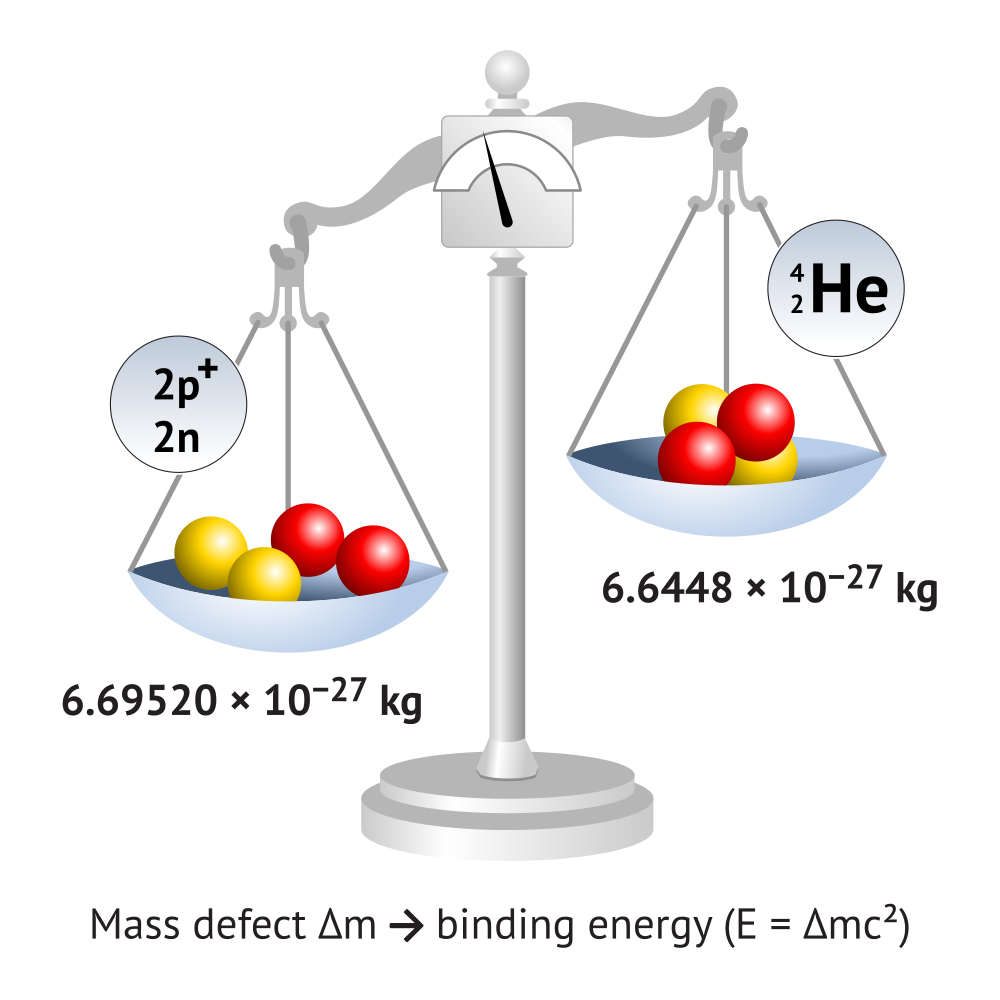
Similarly, when a heavy nucleus such as uranium undergoes fission, the resulting nuclei have a higher binding energy per nucleon and the difference is released as energy. This corresponds to roughly 0.9 MeV per nucleon, or about 200 MeV per fission.
Controlled nuclear fusion, in which light atomic nuclei combine and release energy, is still under development as a potential source of electricity. Present-day nuclear power plants obtain energy primarily from the fission of uranium and plutonium isotopes. Thorium can also be used in a nuclear fuel cycle by converting fertile 232Th into fissile 233U. Nuclear fission converts approximately 0.1% of the rest mass of the reacting material into energy.
The energy released by the fission of a single uranium nucleus is approximately 3.2 × 10⁻¹¹ joules. That is about five orders of magnitude less than the kinetic energy of a flying mosquito.
Keep reading
Articles
Types of Nuclear Reactions
Nuclear reactions can lead to scattering, capture, or splitting depending on neutron velocity. So-called "slow" neutrons (0.02 eV) can split 235U nuclei.
3 min read
Fission Chain Reaction
When a neutron splits the 235U nucleus, 2-3 neutrons are released. The fission chain reaction occurs when they split other nuclei, releasing more neutrons.
3 min read
Control and Reaction States
The chain fission reaction in a nuclear reactor is controlled by the neutron absorber content. The reactor can be subcritical, critical, or supercritical.
3 min read
Moderator
To increase the chance of fission, the moderator slows down neutrons by collisions. The usual moderators are water, heavy water, and graphite.
3 min read
Absorber
The absorber (boron, cadmium) captures the neutrons and thus regulates the nuclear reactor output. It can be part of the coolant or control rods.
3 min read
Coolant
The coolant removes heat from the fission reaction. The most commonly used is water, but also helium, CO2, molten sodium, lead, or fluoride salts are used.
3 min read
Fission Products
After fission, the uranium nucleus decays into two approximately equal halves. Typical products are iodine and cesium, but other ways of decay exist.
3 min read
The Largest Nuclear Power Plants
In 2012, there were 436 reactors in use worldwide. The largest nuclear power plant is Japan's Kashiwazaki Kariwa with 7,965 MW of installed power output.
3 min read
Questions
How does a nuclear reactor generate electricity?
Fission heat raises steam. A turbine-generator does what it does in any thermal plant.