Coolant
3 min read · Energy Atlas Editorial
The coolant removes heat from the fission reaction. The most commonly used is water, but also helium, CO2, molten sodium, lead, or fluoride salts are used.
The fission of a single 235U nucleus releases about 200 MeV (3.2 × 10⁻¹¹ J) of energy. However, in a reactor with a thermal power of 3,000 MW, approximately 1020 nuclei undergo fission every second. The resulting heat must be continuously removed from the reactor core to prevent the fuel from overheating. The heat is then used to produce steam or otherwise transferred to a power conversion system to generate electricity. The most common reactor coolant is water, but other coolants include carbon dioxide, helium, liquid sodium, lead and molten salts.
Water
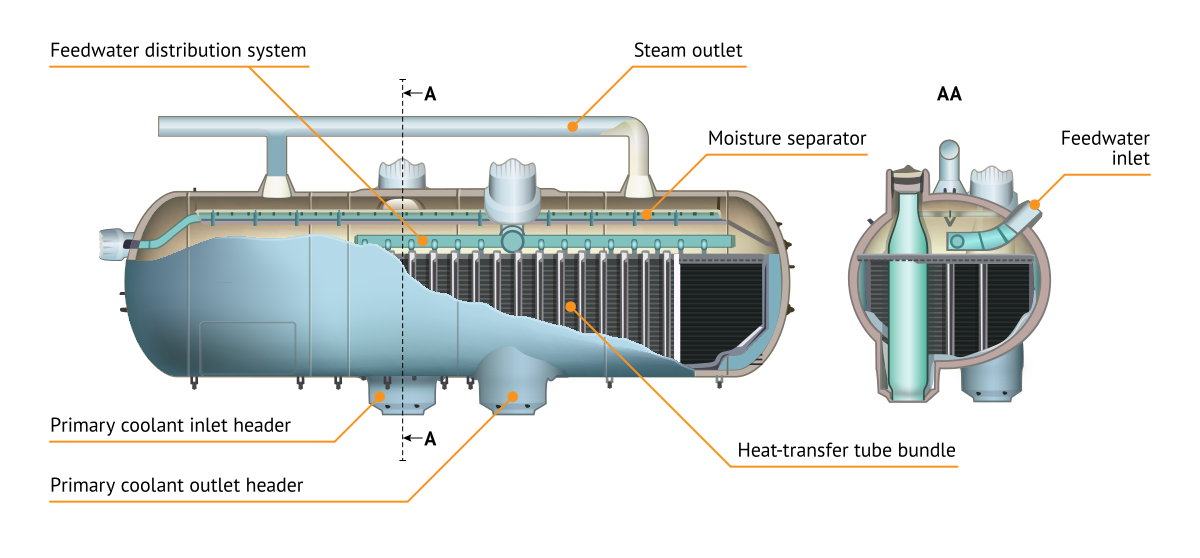
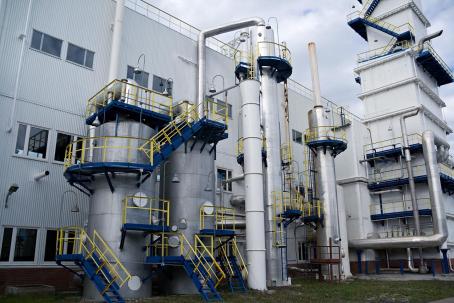
In light water reactors, water serves as both the moderator and the coolant. In pressurised water reactors (PWRs), the primary coolant is maintained at a pressure of about 15—16 MPa, preventing it from boiling at temperatures of around 300 °C. In boiling water reactors (BWRs), the coolant operates at a lower pressure of about 7 MPa and boils directly in the reactor core to produce steam.
Gases
Helium is used as a coolant in high-temperature gas-cooled reactors. It is chemically inert, remains gaseous at reactor operating temperatures and can operate at very high temperatures. In some advanced reactor concepts, hot helium may be used in a direct Brayton cycle to drive a gas turbine. Carbon dioxide is used as the coolant in British Magnox and advanced gas-cooled reactors (AGRs).
In a large PWR, around 20 m3 of water may pass through the reactor core every second, typically heating up by several tens of degrees Celsius.
Liquid Metals
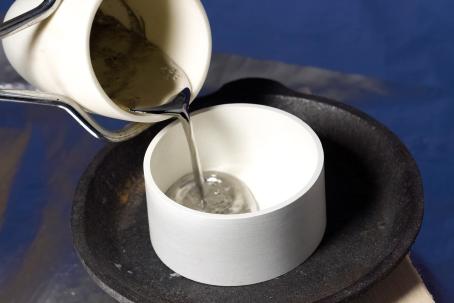
Fast reactors require coolants with little moderating effect in order to maintain a fast neutron spectrum. Liquid sodium is the most widely used liquid-metal coolant in fast reactors. It has excellent heat-transfer properties and a high boiling point, allowing the primary system to operate at relatively low pressure. Lead and lead-bismuth eutectic are alternative liquid-metal coolants. Unlike sodium, they do not react vigorously with water or burn in air, but they present other challenges, including corrosion of structural materials.
Molten salts
Molten salts can also be used as reactor coolants. Depending on the reactor design, the fuel may be dissolved directly in the molten salt or the salt may serve only as a coolant. Depending on the reactor design, heat from the primary coolant is transferred through one or more intermediate circuits to a steam or gas power conversion system.
4 pictures 4 pictures
The temperature at the centre of a fuel pellet in a light water reactor can exceed 1,000 °C during normal operation, while the surrounding coolant remains at about 300 °C. Zirconium alloys commonly used for fuel cladding have melting temperatures of around 1,850 °C.
Keep reading
Articles
Principle of Operation
The binding energy that holds nucleons together is different for each isotope. When fusing light nuclei or splitting heavy nuclei, energy is released.
3 min read
Types of Nuclear Reactions
Nuclear reactions can lead to scattering, capture, or splitting depending on neutron velocity. So-called "slow" neutrons (0.02 eV) can split 235U nuclei.
3 min read
Fission Chain Reaction
When a neutron splits the 235U nucleus, 2-3 neutrons are released. The fission chain reaction occurs when they split other nuclei, releasing more neutrons.
3 min read
Control and Reaction States
The chain fission reaction in a nuclear reactor is controlled by the neutron absorber content. The reactor can be subcritical, critical, or supercritical.
3 min read
Moderator
To increase the chance of fission, the moderator slows down neutrons by collisions. The usual moderators are water, heavy water, and graphite.
3 min read
Absorber
The absorber (boron, cadmium) captures the neutrons and thus regulates the nuclear reactor output. It can be part of the coolant or control rods.
3 min read
Fission Products
After fission, the uranium nucleus decays into two approximately equal halves. Typical products are iodine and cesium, but other ways of decay exist.
3 min read
The Largest Nuclear Power Plants
In 2012, there were 436 reactors in use worldwide. The largest nuclear power plant is Japan's Kashiwazaki Kariwa with 7,965 MW of installed power output.
3 min read
Questions
How does a nuclear reactor generate electricity?
Fission heat raises steam. A turbine-generator does what it does in any thermal plant.