Absorber
3 min read · Energy Atlas Editorial
The absorber (boron, cadmium) captures the neutrons and thus regulates the nuclear reactor output. It can be part of the coolant or control rods.
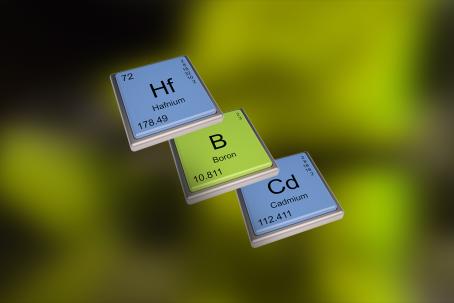
The rate of the fission chain reaction depends on the neutron population in the reactor core. One of the principal ways of controlling the reaction is therefore to use materials that absorb neutrons without undergoing fission. Such materials are known as neutron absorbers. Many different elements can be used for this purpose; boron and cadmium are among the most common.
Water with Dissolved Boric Acid
Many pressurised water reactors use boric acid dissolved in the reactor coolant as an additional means of controlling reactivity. Boron is a very effective neutron absorber. The boric acid concentration can be adjusted to provide relatively uniform reactivity control throughout the reactor core. During refueling and certain fuel-handling operations in PWRs, sufficiently borated water is maintained to ensure an adequate shutdown margin.
Control Rods
Video: Operating principle of control rods.
Control rods contain neutron-absorbing materials such as boron carbide, silver-indium-cadmium alloys or hafnium. They can be inserted into or withdrawn from the reactor core to control reactivity. Withdrawing the control rods reduces neutron absorption and increases reactivity, while inserting them increases neutron absorption and reduces reactivity. Control rods are therefore used to regulate reactor power and maintain the required operating state.
In VVER-440 reactors, some control assemblies consist of a fuel section and an absorber section located above it. When the absorber section is inserted into the active core, the fuel section is simultaneously displaced downwards out of the core. Moving the assembly in the opposite direction withdraws the absorber section and inserts the fuel section, thereby increasing reactivity.
Shut-off Rods
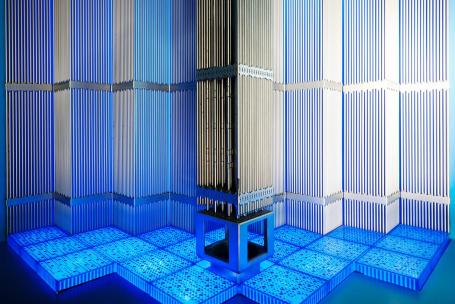
For rapid reactor shutdown, neutron-absorbing rods are rapidly inserted into the reactor core. They absorb neutrons and quickly suppress the fission chain reaction. In some reactor designs, the rods are held above the core by electromagnets and, when released, fall into the core under gravity. In other designs, they are actively driven or otherwise rapidly inserted into the core.
Absorbing Material Contained in the Fuel
Uranium fuel contains both 235U and 238U. Some neutrons are captured by 238U without causing fission, although this capture can ultimately lead to the production of fissile 239Pu. Fission also produces many different nuclides, some of which have very high neutron absorption cross-sections and therefore act as neutron poisons. Important examples include xenon-135 and samarium-149.
Neutron-absorbing materials may also be deliberately incorporated into the fuel as burnable absorbers. Gadolinium, for example, may be added to the fuel in the form of gadolinium oxide. As the fuel is irradiated, these absorbers gradually capture neutrons and are converted into isotopes with lower neutron absorption, reducing their effect over time. Burnable absorbers compensate for the excess reactivity of fresh fuel. As fuel burnup increases and the amount of fissile material decreases, the absorber is gradually depleted as well, helping to limit changes in reactivity during the fuel cycle.
4 pictures 4 pictures
Some fission products with very high neutron absorption cross-sections are known as reactor poisons. One of the most important is xenon-135, which strongly affects reactor reactivity after changes in power and after shutdown.
Keep reading
Articles
Principle of Operation
The binding energy that holds nucleons together is different for each isotope. When fusing light nuclei or splitting heavy nuclei, energy is released.
3 min read
Types of Nuclear Reactions
Nuclear reactions can lead to scattering, capture, or splitting depending on neutron velocity. So-called "slow" neutrons (0.02 eV) can split 235U nuclei.
3 min read
Fission Chain Reaction
When a neutron splits the 235U nucleus, 2-3 neutrons are released. The fission chain reaction occurs when they split other nuclei, releasing more neutrons.
3 min read
Control and Reaction States
The chain fission reaction in a nuclear reactor is controlled by the neutron absorber content. The reactor can be subcritical, critical, or supercritical.
3 min read
Moderator
To increase the chance of fission, the moderator slows down neutrons by collisions. The usual moderators are water, heavy water, and graphite.
3 min read
Coolant
The coolant removes heat from the fission reaction. The most commonly used is water, but also helium, CO2, molten sodium, lead, or fluoride salts are used.
3 min read
Fission Products
After fission, the uranium nucleus decays into two approximately equal halves. Typical products are iodine and cesium, but other ways of decay exist.
3 min read
The Largest Nuclear Power Plants
In 2012, there were 436 reactors in use worldwide. The largest nuclear power plant is Japan's Kashiwazaki Kariwa with 7,965 MW of installed power output.
3 min read
Questions
How does a nuclear reactor generate electricity?
Fission heat raises steam. A turbine-generator does what it does in any thermal plant.