Tritium Production
4 min read · Energy Atlas Editorial
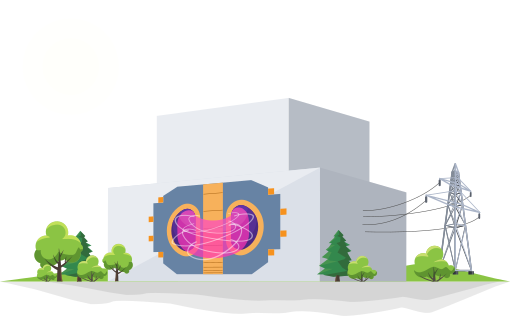
The ITER machine will be the first thermonuclear reactor fully designed to operate with deuterium-tritium fusion reaction.
The ITER machine will be the first thermonuclear reactor fully designed to operate with deuterium-tritium fusion reaction. While the first part of the necessary fuel — deuterium — could be extracted from seawater in almost unlimited amounts, the second one — tritium — is very scarce on Earth.
Tritium Origin
Tritium is produced in the upper parts of the atmosphere by cosmic rays. Some small amounts are diluted in water as remnants of atmospheric nuclear tests carried out between 1945 and 1980 and also a few kilograms are produced in CANDU-type nuclear reactors all over the world.
Production
The annual production of tritium is estimated to about 20 kilograms and because of its short half-life (12.3 years) it cannot be stored for a long time. This production will be sufficient for ITER's 15 years long D-T campaign, but future fusion power plants will need significantly larger amounts of fuel, around 100—200 kg of tritium per year.
Transmutation
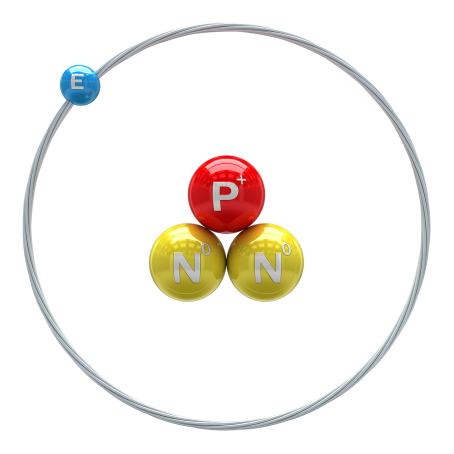
Fortunately, the tritium could be "transmuted" from lithium which is abundant in the earth's mantle, and seawater. When D-T fusion reaction occurs, helium nuclei and neutrons are produced. The neutron, as a particle without charge, is not confined by a magnetic field, escapes and hits the vacuum vessel wall with high energy. This energy will be used for electricity production in the power plant. But if instead of striking the wall, the neutron strikes an atom of lithium-6, it is absorbed and a resulting 3 protons and 4 neutrons are rearranged into one atom of helium (2 protons, 2 neutrons) and one atom of tritium (1 proton, 2 neutrons) while at the same time energy is released. So this tritium "breeding" enhances thermal yield and could be used as way of in-situ fuel production for a thermonuclear power plant. The only fuel needed to be transported into a fusion power plant than will be deuterium and lithium, both abundant elements, so the electricity will be, figuratively speaking, produced from water and rocks.
Tritium Breeding Tests
Such a concept needs to be proved and details to be fine-tuned, so ITER will serve as the testing site. In later phases of experiments, two blanket modules will be replaced by four Test Blanket Modules, each of them will test different approaches to tritium breeding and collecting. Two of them will test liquid lithium, while the other two solid breeders. Also, two types of cooling, by water and by helium, will be explored. All approaches have their advantages and disadvantages.
Liquid Breeders
In liquid lithium breeder, the mixture of lithium and lead is flowing through module. The lead serves as a neutron multiplier allowing the production of more tritium atoms from one neutron impact as lead releases two neutrons after being hit by one. A liquid mixture allows the collection of produced tritium continuously in huge adjacent facility behind tokamak, but as lithium and lead are metals, their movement could interact with magnetic fields. To overcome this problem, the lithium-lead has to either flow at a low velocity or be electrically isolated from the metallic walls.
Solid Breeders
In contrast, the solid breeder does not interfere with magnetic fields, but to collect the produced tritium the machine has to be stopped and the breeder module removed and replaced with a fresh one. The tritium will then be extracted from the breeder in a facility.
Cooling Options
Excess heat has to be removed from the breeder by a coolant. As a lithium-lead mixture becomes a liquid at 235 °C, the cooling water needs to be pressurized to avoid boiling, while helium could be easily heated up to 500 to 600 °C, but it has the disadvantage of a much lower heat capacity. It is estimated that each of the test modules (measuring approximately 1.7 × 0.5 × 0.6 metres each) will produce a maximum of 20 milligrams of tritium per day. The commercial thermonuclear power plant will have plenty of such modules which will supply it with all the tritium necessary for its power output. During fusion less than 1 gram of fuel is present in the vacuum vessel at any one moment.
Fuelling
After separating the tritium from the breeder and mixing it with deuterium in desired 1 : 1 ratio, the fuel needs to be inserted into the core of the burning plasma. This is not an easy task because plasma is so hot that the neutral particles of fuel will be ionized on the very edge of the plasma column and then they will be prevented from entering the core by the magnetic field. The goal is to give fuel particles enough velocity that they could reach the plasma core before ionization. Two systems of fuel injection are implemented in the ITER machine. The first one is powerful pumps that inject gaseous fuel into the chamber with throughput of 200 Pa m³/sec on average and 400 Pa m³/sec at peak. The second system is a gas gun that propels a millimetre-sized frozen deuterium-tritium pellets into the plasma with a velocity of up to 3,600 km/h, so the pellets are so fast and cold enough to penetrate deep into the plasma core. The frozen pellet injections are also very useful in ELMs mitigation. ELMs are Edge Localised Modes, bursts of plasma that escape magnetic fields, and which hurtle towards vessel walls. Frozen fuel pellet fired in the right place of the plasma is an effective way of ELMs management.
Keep reading
Articles
The Next Step on the Way Toward a Thermonuclear Fusion Power Plant
In the beginning of the 20th century, the potential energy of the atom was discovered.
3 min read
Main Parameters
The ITER is an experimental device designed to demonstrate the possibility of harnessing energy from thermonuclear fusion.
3 min read
Timeline
From 1985 to 2050 ...
3 min read
Record Breakers
Being the largest tokamak ever built, the ITER is a record holder in many ways.
3 min read
Magnets
The ITER magnet system will be the largest and most integrated superconducting magnet system ever built. It will produce magnetic fields that will initiate, confine, shape and control the ITER plasma.
5 min read
Vacuum Vessel
Plasma will be held inside a steel torus called a vacuum vessel. It was proven that the bigger the plasma volume, the better the confinement, so the ITER vacuum vessel will be really big.
3 min read
Blanket
Blanket protects vacuum vessel from harsh conditions provided by fusion plasma. Because the vessel cannot be replaced, any damage to it will incur would cause termination of experiments.
3 min read
Divertor
For a successful fusion reaction only the presence of fuel (deuterium and tritium in the case of ITER) in the plasma core is needed; all other particles, whether impurities or helium ash, are unwanted and need to be diverted away from the plasma, because they could cause energ…
3 min read
Cryostat
During ITER operation the 150 million kelvin hot plasma core will be just a few meters away from only 4 Kelvin cold toroidal magnetic coils.
3 min read
Cooling
Tokamak ITER operation would not be possible without several types of cooling methods, because heat generated by fusion must be discarded.
3 min read
Diagnostics
The main goal of the ITER is not to just create fusion plasma but to get as much information about such plasma as possible.
4 min read
External Heating
Successful deuterium-tritium fusion reaction requires 150 million Kelvin, a temperature that is not easy to reach.
3 min read
The ITER Site
The ITER 180-hectare site is located near Saint Paul-lez-Durance, southern France.
3 min read
Disruptions and Instabilities
Plasma never behaves calmly and shortly after its creation begins to show an assortment of instabilities.
3 min read