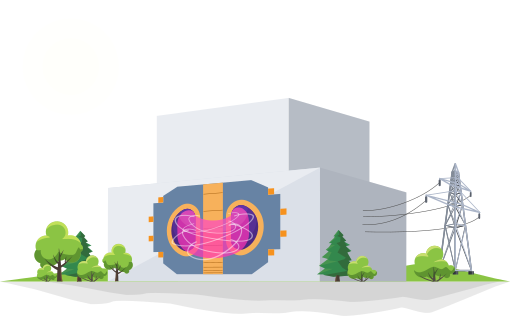
Cryostat
3 min read · Energy Atlas Editorial
During ITER operation the 150 million kelvin hot plasma core will be just a few meters away from only 4 Kelvin cold toroidal magnetic coils.
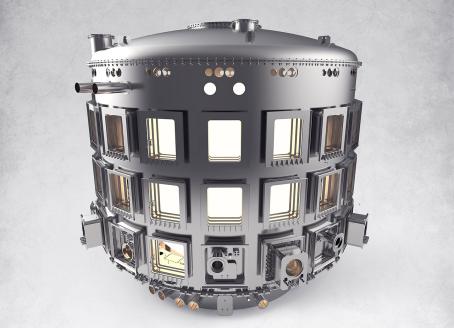
During ITER operation the 150 million kelvin hot plasma core will be just a few meters away from only 4 kelvin cold toroidal magnetic coils. Their extreme coldness is necessary for superconductivity and the creation of magnetic fields that hold the extremely hot plasma.
World's Largest Thermos
In order to minimize heat transfer from plasma to coils the whole system is enclosed in a big vacuum chamber, the largest thermos ever build, called cryostat. The vacuum vessel itself is protected by a thermal shield actively cooled to 80 kelvin and the vacuum in cryostat will keep the heat transfer from vessel to liquid helium cooled coils as low as possible.
Size
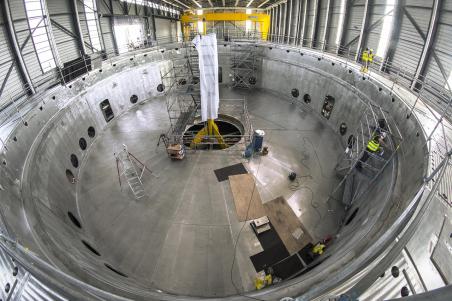
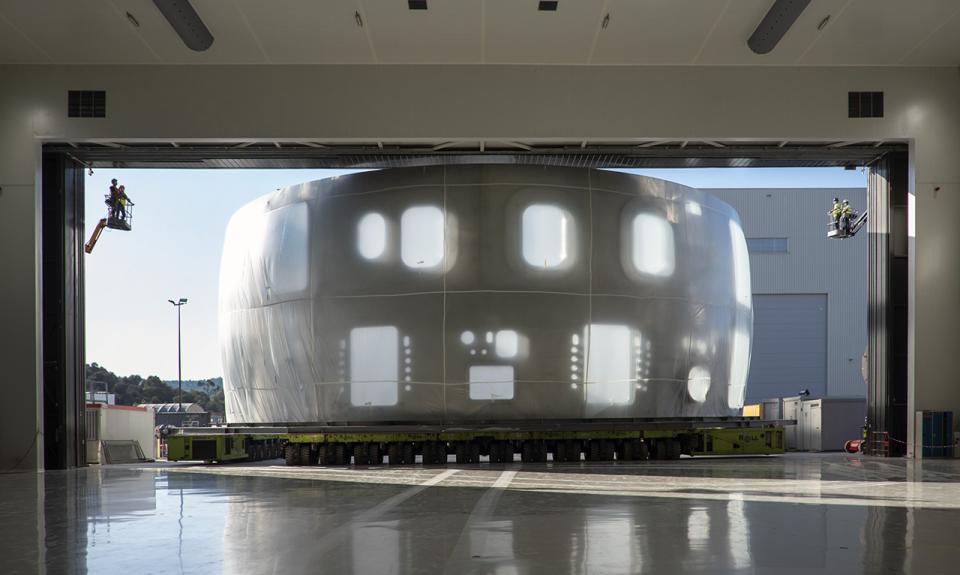
This enormous stainless steel cylinder is nearly 30 metres wide and as many in height. The internal diameter of the cryostat has been determined by the size of the largest component it surrounds: the two largest poloidal field coils. Cryostat's internal volume is 16,000 m3 and the high vacuum is maintained by a system of two vacuum pumps creating continuously vacuum pressure of 1 × 10⁻⁴ Pa.
Robustness
The whole structure weighs 3,850 tonnes. There are some 280 penetrations in cryostat, some of them more than four meters wide, for allowing maintenance, to provide access for piping, electricity, heating, diagnostics and a remote handling system that will manipulate, for example, eight-tonne divertor cassettes or four-tonne blanket modules. Each one of these openings will have to be as leak-proof as possible to preserve the cryostat's vacuum environment. But during operation the vessel will experience thermal contraction and expansion and also cryostat can shake a little because of extreme forces that will act on it during the switching of superconducting magnets. Fixed connections would be in at risk of cracking, therefore eighty-five large, rectangular bellows are situated on the connection between cryostat and vessel and between cryostat and the Tokamak building itself.
Segments
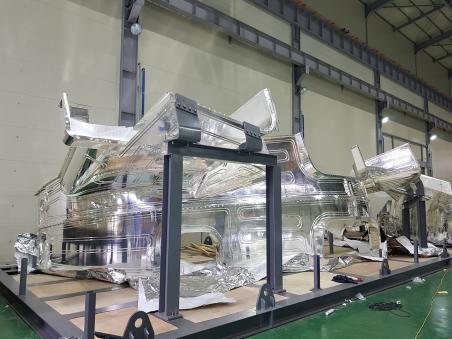
The cryostat is made up of 54 segments that will be welded and assembled on-site. The first part of cryostat, the 1,250 tonnes base section, will be the first large component installed in the Tokamak Pit. Then the other parts will be gradually assembled as the works continues and the last part of cryostat, a 600-tonne heavy lid, will be the last large component set into place after the installation of the vacuum vessel, magnets, thermal shielding and central solenoid.
Support Function
Besides thermal insulation, the cryostat has also a supportive function as it is connected to the ITER machine and in this way is part of a structural assembly. The concrete and steel pedestal that supports it was measured for a total mass of 23,000 tonnes — the 3,850 tonnes of the cryostat itself as well as the 18,900 tonnes of the ITER machine.
Keep reading
Articles
The Next Step on the Way Toward a Thermonuclear Fusion Power Plant
In the beginning of the 20th century, the potential energy of the atom was discovered.
3 min read
Main Parameters
The ITER is an experimental device designed to demonstrate the possibility of harnessing energy from thermonuclear fusion.
3 min read
Timeline
From 1985 to 2050 ...
3 min read
Record Breakers
Being the largest tokamak ever built, the ITER is a record holder in many ways.
3 min read
Magnets
The ITER magnet system will be the largest and most integrated superconducting magnet system ever built. It will produce magnetic fields that will initiate, confine, shape and control the ITER plasma.
5 min read
Vacuum Vessel
Plasma will be held inside a steel torus called a vacuum vessel. It was proven that the bigger the plasma volume, the better the confinement, so the ITER vacuum vessel will be really big.
3 min read
Blanket
Blanket protects vacuum vessel from harsh conditions provided by fusion plasma. Because the vessel cannot be replaced, any damage to it will incur would cause termination of experiments.
3 min read
Divertor
For a successful fusion reaction only the presence of fuel (deuterium and tritium in the case of ITER) in the plasma core is needed; all other particles, whether impurities or helium ash, are unwanted and need to be diverted away from the plasma, because they could cause energ…
3 min read
Tritium Production
The ITER machine will be the first thermonuclear reactor fully designed to operate with deuterium-tritium fusion reaction.
4 min read
Cooling
Tokamak ITER operation would not be possible without several types of cooling methods, because heat generated by fusion must be discarded.
3 min read
Diagnostics
The main goal of the ITER is not to just create fusion plasma but to get as much information about such plasma as possible.
4 min read
External Heating
Successful deuterium-tritium fusion reaction requires 150 million Kelvin, a temperature that is not easy to reach.
3 min read
The ITER Site
The ITER 180-hectare site is located near Saint Paul-lez-Durance, southern France.
3 min read
Disruptions and Instabilities
Plasma never behaves calmly and shortly after its creation begins to show an assortment of instabilities.
3 min read