Blanket
3 min read · Energy Atlas Editorial
Blanket protects vacuum vessel from harsh conditions provided by fusion plasma. Because the vessel cannot be replaced, any damage to it will incur would cause termination of experiments.
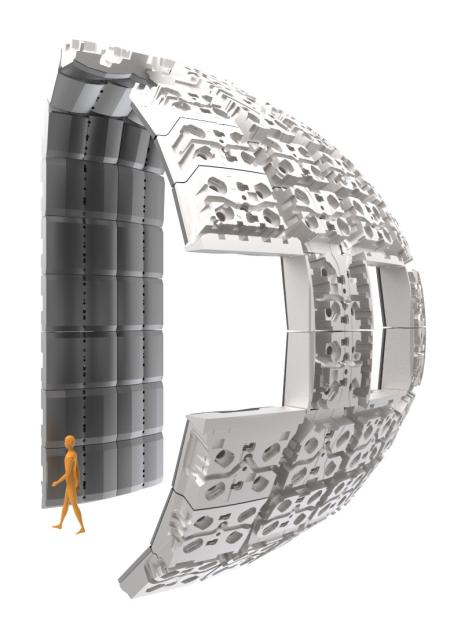
Blanket protects vacuum vessel from harsh conditions provided by fusion plasma. Because the vessel cannot be replaced, any damage to it will incur would cause termination of experiments.
Blanket Modules
Besides temperatures of 150 million kelvin, the plasma tries to attack the vessel with high neutron flux and also with plenty of instabilities and disruptions that eject high-energy particles. The vacuum vessel wall is therefore coated with 440 removable modules of blanket that protects vessel and toroidal magnets behind it from neutron flux and heat.
Design
Their design varies slightly depending on the position of the modules in the vacuum vessel, but generally each blanket module measures 1 × 1.5 metres and weighs up to 4.6 tonnes. They consist of a main shield block mounted on the vessel wall and a detachable first wall that directly faces the plasma. Stainless steel shielding blocks are designed as neutron shielding — as neutrons slowdown in the material of the block, they change their kinetic energy into heat. This is removed by water flowing at 4 MPa through channels in the blocks.
Active Cooled Blanket
ITER will be the first tokamak with an active cooled blanket. The cooling system is prepared to remove up to 736 MW of thermal power. In a thermonuclear power plant, this energy will be used for electricity production.
Plasma Facing Components
Each shielding block is bolted onto a vacuum vessel at four points and to it detachable first wall panels are mounted by special studs. First wall panels cover a surface of 600 m².
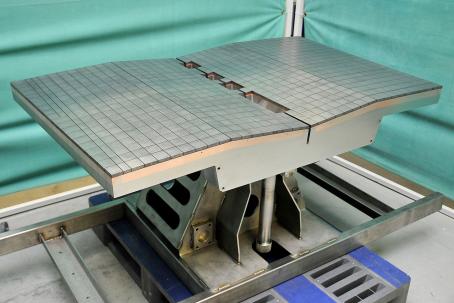
There are two types of plasma facing components — 215 normal heat flux first wall panels are designed for heat fluxes of up to 2 MW/m², while the rest 225 enhanced heat flux panels are designed to survive harsher plasma conditions and heat flux up to 4.7 MW/m². To help them survive contact with 150 million kelvin hot plasma they are made from beryllium tiles bonded to a copper alloy heat sink mounted on a stainless steel structure. These tiles resemble carbon tiles which protect space shuttles during their descent through the atmosphere — but ITER tiles will have to withstand several times more intensive heat flux than any space shuttle. Beryllium was chosen for its unique physical properties — it does not cause plasma contamination and does not accumulate tritium on its surface. Tritium retention would otherwise be a problem; tritium stuck to the walls is missing in the fusion reaction.
First Wall Panels
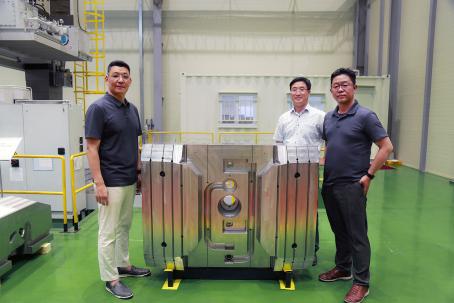
The first wall panels are made out of shaped "fingers" that are attached to a structural beam that serves as the backbone of each panel and that also houses the cooling water channels. It is assumed that each first wall panel will be at least once remotely replaced during ITER operations.
Keep reading
Articles
The Next Step on the Way Toward a Thermonuclear Fusion Power Plant
In the beginning of the 20th century, the potential energy of the atom was discovered.
3 min read
Main Parameters
The ITER is an experimental device designed to demonstrate the possibility of harnessing energy from thermonuclear fusion.
3 min read
Timeline
From 1985 to 2050 ...
3 min read
Record Breakers
Being the largest tokamak ever built, the ITER is a record holder in many ways.
3 min read
Magnets
The ITER magnet system will be the largest and most integrated superconducting magnet system ever built. It will produce magnetic fields that will initiate, confine, shape and control the ITER plasma.
5 min read
Vacuum Vessel
Plasma will be held inside a steel torus called a vacuum vessel. It was proven that the bigger the plasma volume, the better the confinement, so the ITER vacuum vessel will be really big.
3 min read
Divertor
For a successful fusion reaction only the presence of fuel (deuterium and tritium in the case of ITER) in the plasma core is needed; all other particles, whether impurities or helium ash, are unwanted and need to be diverted away from the plasma, because they could cause energ…
3 min read
Cryostat
During ITER operation the 150 million kelvin hot plasma core will be just a few meters away from only 4 Kelvin cold toroidal magnetic coils.
3 min read
Tritium Production
The ITER machine will be the first thermonuclear reactor fully designed to operate with deuterium-tritium fusion reaction.
4 min read
Cooling
Tokamak ITER operation would not be possible without several types of cooling methods, because heat generated by fusion must be discarded.
3 min read
Diagnostics
The main goal of the ITER is not to just create fusion plasma but to get as much information about such plasma as possible.
4 min read
External Heating
Successful deuterium-tritium fusion reaction requires 150 million Kelvin, a temperature that is not easy to reach.
3 min read
The ITER Site
The ITER 180-hectare site is located near Saint Paul-lez-Durance, southern France.
3 min read
Disruptions and Instabilities
Plasma never behaves calmly and shortly after its creation begins to show an assortment of instabilities.
3 min read