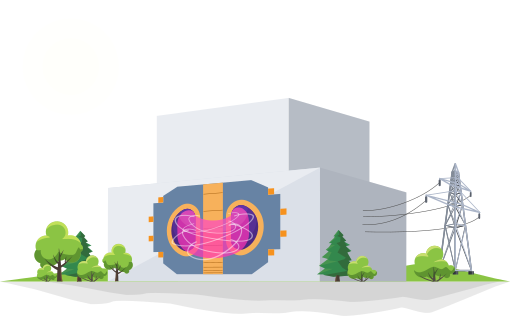
The Next Step on the Way Toward a Thermonuclear Fusion Power Plant
3 min read · Energy Atlas Editorial
In the beginning of the 20th century, the potential energy of the atom was discovered.
Demand for a New Energy Source
As energy consumption of humankind grew, so did the need for another source of electricity. Such a source should be renewable—or not be exhausted for millennia. Such a source should not produce any emissions, whether CO2 or other, problematic waste, nor radiation or toxins. Its fuel should be distributed evenly on Earth and have sufficient energy density. Thermonuclear fusion could be such a new, clean, more sustainable source of energy, so no wonder that developed nations supported its research.
International Collaboration
The idea of international collaboration was proposed at the Geneva Superpower Summit in November 1985 by General Secretary Gorbachev of the former Soviet Union to US President Ronald Reagan. As tokamaks seemed in those days as the most promising devices, it was decided that the tokamak concept would be used. Only one year later, the European Union (Euratom), Japan, the Soviet Union and the USA agreed to build a large international fusion facility, ITER. Its name came from an acronym of International Thermonuclear Experimental Reactor, but it also means "way" in Latin as ITER could be the way to new clean source of energy. Because research to date has shown that it is easiest to maintain fusion in greater plasma volumes, ITER bet on size and with its 840 m3 of plasma will be the biggest tokamak ever built. The largest operating tokamak, JET, has only 100 m3 plasma volume. After many turbulent years of creating a final design, and political negotiations, the ITER Agreement was signed in 2006 by ITER Members (finally, there were seven of them: the People's Republic of China, the European Atomic Energy Community (Euratom), the Republic of India, Japan, the Republic of Korea, the Russian Federation and the United States of America) and a site at Saint Paul-lez-Durance was chosen for ITER. In 2007 construction work began.
ITER
Despite its enormous size, budget and countless technical challenges, the ITER will not be a power plant. Lots of theories about plasma behaviour can only be verified or refuted experimentally on plasma with volume and temperature similar to conditions that will be used in the power plant. The aim of the ITER is to prove such concepts. The ITER will generate about 500 MW of fusion power from only 50 MW of external heating power, so more energy will be gained than put into the reaction. The potential for reaching a burning plasma state (when fusion reaction generates all necessary heat; no external heating is needed) will be shown and ways of effective heat removal from a vacuum vessel will be explored. The ITER will also probe the possibilities of tritium generation by neutron capture in lithium, this so-called tritium breeding should be a way to generate enough fuel within the reactor of a fusion power plant; the second component of fuel is deuterium — element abundant on Earth. Many technologies and manufacturing processes will be developed and tested during ITER construction as well as diagnostics and plasma control during experiments. New materials, for example first wall blanket or vacuum vessel, will be tested in extreme conditions of high thermal loads and radiation. All gained knowledge will be then used in the construction of the fusion power plant. Last but not least, the ITER will demonstrate that the fusion power plant could be operated safely with negligible consequences to the environment.
Keep reading
Articles
Main Parameters
The ITER is an experimental device designed to demonstrate the possibility of harnessing energy from thermonuclear fusion.
3 min read
Timeline
From 1985 to 2050 ...
3 min read
Record Breakers
Being the largest tokamak ever built, the ITER is a record holder in many ways.
3 min read
Magnets
The ITER magnet system will be the largest and most integrated superconducting magnet system ever built. It will produce magnetic fields that will initiate, confine, shape and control the ITER plasma.
5 min read
Vacuum Vessel
Plasma will be held inside a steel torus called a vacuum vessel. It was proven that the bigger the plasma volume, the better the confinement, so the ITER vacuum vessel will be really big.
3 min read
Blanket
Blanket protects vacuum vessel from harsh conditions provided by fusion plasma. Because the vessel cannot be replaced, any damage to it will incur would cause termination of experiments.
3 min read
Divertor
For a successful fusion reaction only the presence of fuel (deuterium and tritium in the case of ITER) in the plasma core is needed; all other particles, whether impurities or helium ash, are unwanted and need to be diverted away from the plasma, because they could cause energ…
3 min read
Cryostat
During ITER operation the 150 million kelvin hot plasma core will be just a few meters away from only 4 Kelvin cold toroidal magnetic coils.
3 min read
Tritium Production
The ITER machine will be the first thermonuclear reactor fully designed to operate with deuterium-tritium fusion reaction.
4 min read
Cooling
Tokamak ITER operation would not be possible without several types of cooling methods, because heat generated by fusion must be discarded.
3 min read
Diagnostics
The main goal of the ITER is not to just create fusion plasma but to get as much information about such plasma as possible.
4 min read
External Heating
Successful deuterium-tritium fusion reaction requires 150 million Kelvin, a temperature that is not easy to reach.
3 min read
The ITER Site
The ITER 180-hectare site is located near Saint Paul-lez-Durance, southern France.
3 min read
Disruptions and Instabilities
Plasma never behaves calmly and shortly after its creation begins to show an assortment of instabilities.
3 min read
Questions
Tokamak or stellarator — what is the difference?
Both confine plasma in a torus. Tokamaks use plasma current; stellarators use twisted coils.