Main Parameters
3 min read · Energy Atlas Editorial
The ITER is an experimental device designed to demonstrate the possibility of harnessing energy from thermonuclear fusion.
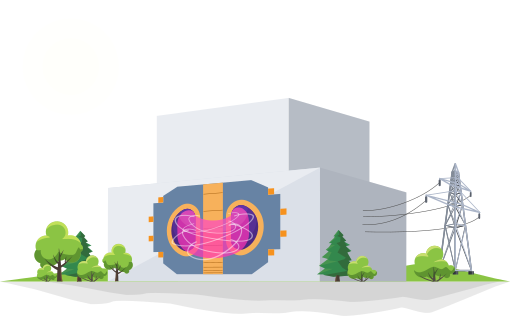
The ITER is an experimental device designed to demonstrate the possibility of harnessing energy from thermonuclear fusion. It is being built in Saint Paul-lez-Durance, France and is supposed to start operation in 2026. During the experimental stage, it will fuse deuterium and tritium atoms releasing 10 times more energy than was needed to ignite the thermonuclear reaction. The energy will not be used for electricity production, but results from the ITER experiments will pave the way for the first fusion power plant. In such a plant, called DEMO, the thermal energy of fusion will heat water and turn it into steam that will drive turbine and generator — in the same way that thermal power plants do.
Tokamak
Deuterium-tritium fusion occurs at an incredible temperature of 150 million kelvin, more than is in the core of the Sun. The ITER will reach and maintain such temperature in the tokamak. This is a device with a toroidal chamber (donut shape) where hot plasma is confined inside a magnetic cage generated by huge toroidal magnets encircling a vacuum vessel.
Vacuum Vessel
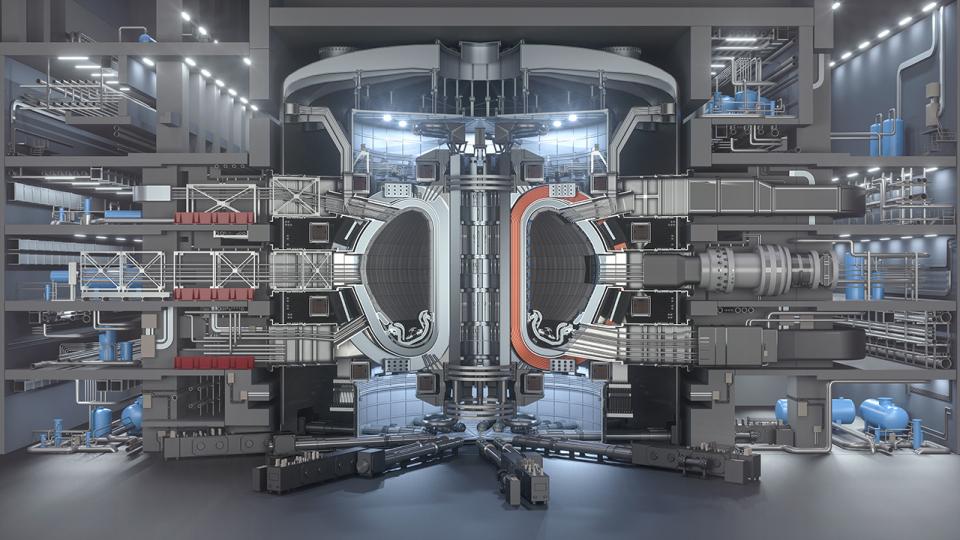
The ITER vessel will measure 19.4 metres across, will be 11.4 metres high, and will weigh approximately 5,200 tonnes. The cross-section of the chamber is elongated to the shape of a "D". The interior volume of 1,400 m³ will make it the largest tokamak vessel ever built. The vessel will contain 840 m³ of plasma.
Magnetic Coils
The main magnetic field will be created by eighteen toroidal coils, each 17 metres high and weighing 360 tonnes. They will generate a maximum magnetic field of 11.8 Tesla. The total magnetic energy will be 41 gigajoules. Coils will be made from superconducting Nb3Sn alloy and cooled to 4 kelvin (−269 °C) to reach and keep a superconductivity state. The current flowing through the plasma will be initiated by central solenoid, 13 metres tall, 4 metres wide, weighing one thousand tonnes. It will be capable of generating a maximum field of 13 Tesla. During operation, very strong electromagnetic forces will act on the solenoid trying to tear it apart, two times stronger than the force behind the thrust of a Space Shuttle lift off.
External Heating
Plasma heating will be ensured by ion and electron cyclotron resonance heating and by three neutral beam injection machines, each steam-locomotive-sized and nearly bigger than tokamak itself.
Fusion Reaction
The ITER will generate long pulses of 400 to 600 seconds during which fusion power of about 500 MW is estimated to be released. The vessel's inner side, called blanket or first wall, will experience extreme neutron bombardment and heat fluxes ten times higher than heat experienced by a spacecraft re-entering the Earth's atmosphere. But the amount of neutrons produced during reaction will also do something very important and useful. As there are not enough tritium reserves on Earth for commercial fusion plant operation, the ITER will test the tritium breeding blanket that will create tritium from lithium via neutron capture.
Cost
The ITER is one of the most ambitious projects since the development of the International Space Station, and the Large Hadron Collider. It is also the most complicated engineering and collaboration project, where parts measuring many metres and weighing many tonnes are constructed in different countries but have to be fitted together with sub millimetre accuracy. Corresponding to such a challenging task is the budget — the ITER is now expected to cost at least €22 billion.
Keep reading
Articles
The Next Step on the Way Toward a Thermonuclear Fusion Power Plant
In the beginning of the 20th century, the potential energy of the atom was discovered.
3 min read
Timeline
From 1985 to 2050 ...
3 min read
Record Breakers
Being the largest tokamak ever built, the ITER is a record holder in many ways.
3 min read
Magnets
The ITER magnet system will be the largest and most integrated superconducting magnet system ever built. It will produce magnetic fields that will initiate, confine, shape and control the ITER plasma.
5 min read
Vacuum Vessel
Plasma will be held inside a steel torus called a vacuum vessel. It was proven that the bigger the plasma volume, the better the confinement, so the ITER vacuum vessel will be really big.
3 min read
Blanket
Blanket protects vacuum vessel from harsh conditions provided by fusion plasma. Because the vessel cannot be replaced, any damage to it will incur would cause termination of experiments.
3 min read
Divertor
For a successful fusion reaction only the presence of fuel (deuterium and tritium in the case of ITER) in the plasma core is needed; all other particles, whether impurities or helium ash, are unwanted and need to be diverted away from the plasma, because they could cause energ…
3 min read
Cryostat
During ITER operation the 150 million kelvin hot plasma core will be just a few meters away from only 4 Kelvin cold toroidal magnetic coils.
3 min read
Tritium Production
The ITER machine will be the first thermonuclear reactor fully designed to operate with deuterium-tritium fusion reaction.
4 min read
Cooling
Tokamak ITER operation would not be possible without several types of cooling methods, because heat generated by fusion must be discarded.
3 min read
Diagnostics
The main goal of the ITER is not to just create fusion plasma but to get as much information about such plasma as possible.
4 min read
External Heating
Successful deuterium-tritium fusion reaction requires 150 million Kelvin, a temperature that is not easy to reach.
3 min read
The ITER Site
The ITER 180-hectare site is located near Saint Paul-lez-Durance, southern France.
3 min read
Disruptions and Instabilities
Plasma never behaves calmly and shortly after its creation begins to show an assortment of instabilities.
3 min read