External Heating
3 min read · Energy Atlas Editorial
Successful deuterium-tritium fusion reaction requires 150 million Kelvin, a temperature that is not easy to reach.
Successful deuterium-tritium fusion reaction requires 150 million kelvin, a temperature that is not easy to reach.
Joule Heating
In the very beginning of a plasma pulse, when the gas is not fully ionized yet, the plasma heats itself by Joule heat (ohmic heating resulting from plasma resistance) but for temperatures higher than 10 million kelvin plasma resistance sharply decreases and ohmic heating is no longer an option.
Heating Systems
Three different systems for external heating will be installed on the ITER and will work in cooperation to heat plasma to the desired fusion temperature — neutral beam injection, ion cyclotron resonance heating and electron cyclotron resonance heating. They will also provide current drive that is necessary for maintaining long pulses and in a fusion power plant to keep a steady state operation.
Neutral Beam Injection
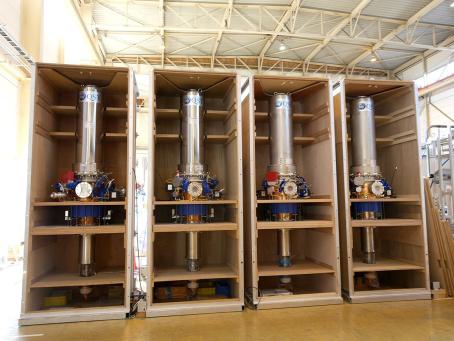
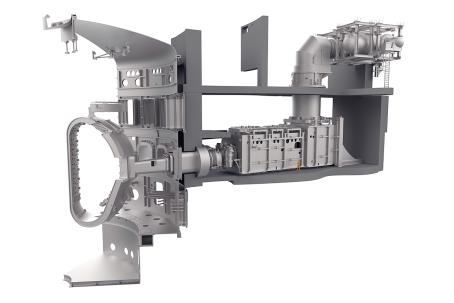
Neutral beam injection is based on shooting high energy particles into the plasma, where they pass its thermal energy through multiple collisions with plasma particles. The ITER will be equipped with two heating neutral beam injectors, one smaller neutral beam injector for diagnostic purposes, and has a place for a third heating device if needed. These are monstrous machines sized like steam locomotives — 25 metres long, 5 metres high and 5 metres wide — with a chimney-like bushing reaching up 9 metres to connect to the openings on the third floor. Each one will deliver a deuterium beam of 16.5 MW with particle energies of 1 MeV. The neutral beam injector is in fact a particle accelerator where deuterium ions are accelerated by an electric field. Before entering the plasma, they need to be neutralized, because charged particles will be deflected by a magnetic field and prevented from entering the plasma core where their energy is most needed. The large plasma volume at the ITER will impose new requirements on this proven method — the particles will have to move three to four times faster than in previous systems (more than 10,000 km/s) in order to penetrate far enough into the plasma, and at these higher rates the positively-charged ions become difficult to neutralize, so negative ions will be used for the first time. Those ions will be created by adding some extra electrons to atoms, not by stripping them as usual. Although the negative ions will be easier to neutralize, they will also be more challenging to create and to handle than positive ions. The neutral beam injectors will be capable of functioning through the whole plasma pulse of up to 3,600 seconds.
Ion Cyclotron Resonance Heating
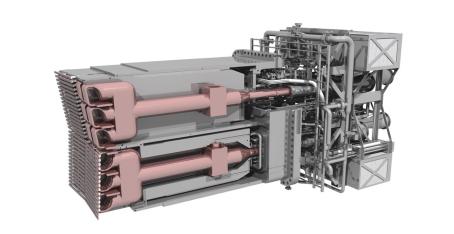
Ion cyclotron resonance heating use radio waves in frequencies corresponding to ion cyclotron frequency (40 to 55 MHz). When ion absorbs such waves, it increases its kinetic energy. Emitting antennas will be about 3.5 metres long, with a cross section of 2 × 2 metres and a weight between 45 and 50 tonnes. They will occupy two of the vacuum vessel's equatorial ports. The system will deliver 20 MW of energy (corresponding to the power needed to heat 2,000 houses during a European winter) to about 1 gram of plasma thus raising its temperature very high and very quickly.
Electron Cyclotron Resonance Heating
Electron cyclotron resonance heating transfers heat to electrons by electromagnetic radiation at a frequency of 170 GHz, the resonant frequency of electrons. Electrons could then pass their energy to ions by collisions. This system could be used for depositing energy in particular places of plasma thus minimizing the rise of certain instabilities that could cause the cooling of plasma. High-frequency electromagnetic waves of the ITER's electron and ion cyclotron resonance heating systems will be generated in the Radiofrequency Building.
Burning Plasma
Ultimately, researchers hope to achieve a state of "burning plasma" where the energy of helium nuclei produced by fusion reaction will be sufficient to maintain plasma temperature. External heating systems than could be turned off. This is unlikely to be reached at the ITER, but it will be necessity for a power plant.
Keep reading
Articles
The Next Step on the Way Toward a Thermonuclear Fusion Power Plant
In the beginning of the 20th century, the potential energy of the atom was discovered.
3 min read
Main Parameters
The ITER is an experimental device designed to demonstrate the possibility of harnessing energy from thermonuclear fusion.
3 min read
Timeline
From 1985 to 2050 ...
3 min read
Record Breakers
Being the largest tokamak ever built, the ITER is a record holder in many ways.
3 min read
Magnets
The ITER magnet system will be the largest and most integrated superconducting magnet system ever built. It will produce magnetic fields that will initiate, confine, shape and control the ITER plasma.
5 min read
Vacuum Vessel
Plasma will be held inside a steel torus called a vacuum vessel. It was proven that the bigger the plasma volume, the better the confinement, so the ITER vacuum vessel will be really big.
3 min read
Blanket
Blanket protects vacuum vessel from harsh conditions provided by fusion plasma. Because the vessel cannot be replaced, any damage to it will incur would cause termination of experiments.
3 min read
Divertor
For a successful fusion reaction only the presence of fuel (deuterium and tritium in the case of ITER) in the plasma core is needed; all other particles, whether impurities or helium ash, are unwanted and need to be diverted away from the plasma, because they could cause energ…
3 min read
Cryostat
During ITER operation the 150 million kelvin hot plasma core will be just a few meters away from only 4 Kelvin cold toroidal magnetic coils.
3 min read
Tritium Production
The ITER machine will be the first thermonuclear reactor fully designed to operate with deuterium-tritium fusion reaction.
4 min read
Cooling
Tokamak ITER operation would not be possible without several types of cooling methods, because heat generated by fusion must be discarded.
3 min read
Diagnostics
The main goal of the ITER is not to just create fusion plasma but to get as much information about such plasma as possible.
4 min read
The ITER Site
The ITER 180-hectare site is located near Saint Paul-lez-Durance, southern France.
3 min read
Disruptions and Instabilities
Plasma never behaves calmly and shortly after its creation begins to show an assortment of instabilities.
3 min read