Fusion: Key Ideas
5 min read · Energy Atlas Editorial
A compact recap of fuels, confinement, ITER, and what remains unsolved.
Overview
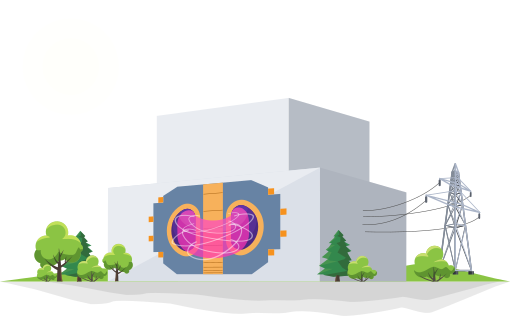
Fusion can release energy because light nuclei gain binding energy. Earthbound schemes use magnetic cages or inertial implosion. Tokamaks lead in plasma performance; stellarators offer steady fields; lasers demonstrated scientific target gain. ITER is the large next magnetic step. A grid-connected fusion plant remains a future engineering project, not a present asset.
Keep reading
Articles
Why it Works?
In small atoms, from hydrogen to sodium, the binding energy per nucleon increases with an increasing atomic number. This is because each additional nucleon is attracted by other nearby nucleons, and thus more tightly bound to the whole.
5 min read
Tokamaks
The word "tokamak" is of Russian origin and means "toroidal chamber and magnetic coils." This magnetic confinement system holds plasma in magnetic fields of toroidal shape. The first tokamak, the T-1, started operation in 1958 in Russia, and since then the greatest advances in th
16 min read
Stellarators
Stellarators are "generators of stellar energy", and their principle was discovered before tokamaks. A helical-twisted magnetic field, necessary for successful plasma confinement, is generated only by magnetic coils of various shapes. The stellarator is a device capable of contin
14 min read
The Next Step on the Way Toward a Thermonuclear Fusion Power Plant
In the beginning of the 20th century, the potential energy of the atom was discovered.
3 min read
Questions
What is the difference between fusion and fission?
Fission splits heavy nuclei. Fusion joins light ones. Both can release binding energy; only fission is commercial electricity today.
Tokamak or stellarator — what is the difference?
Both confine plasma in a torus. Tokamaks use plasma current; stellarators use twisted coils.