Artificial Fusion Principles
5 min read · Energy Atlas Editorial
The Lawson criterion gives essentially two ways how to harness an effective fusion reaction.
The Lawson criterion gives essentially two ways how to harness an effective fusion reaction. One is to confine plasma with low density but for a long confinement time (n ≈ 1020 m−3, τ ≈ few seconds) and the second is to confine it with very high density, but for a shorter confinement time (n ≈ 1030 m−3, τ ≈ 10−10 seconds). From these conditions, two basic types of confinement arise: magnetic and inertial.
Magnetic Confinement
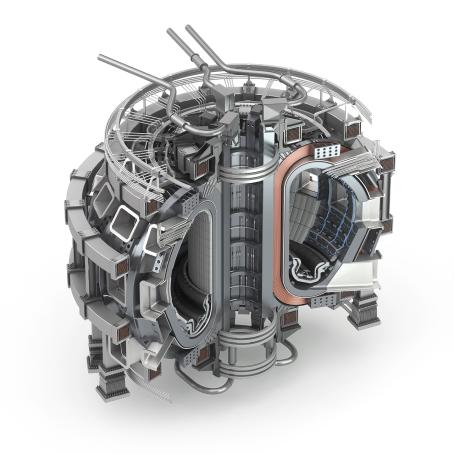
Magnetic confinement tries to hold plasma in some kind of bottle while heating it to fusion temperatures. Because no material could sustain several million kelvin, the bottle made from magnetic fields is used. In the presence of a magnetic field, charged particles move along magnetic field lines. To prevent them from escaping on the end of the device, magnetic traps or closed magnetic curves are used.
Traps create an increased magnetic field on each end which slows down the charged particle and eventually reverses its direction and sends it back into the centre of the magnetic trap. But such a magnetic mirror works only for particles with certain velocities and directions. Other particles will escape so a magnetic trap is inevitably leaky.
Closed magnetic surfaces seem to be a solution. If the charged particle is trapped on a circular magnetic field line, it continues running round and round and cannot escape. Such a field could be created by magnetic coils called toroidal coils. Tokamaks and stellarators are based on this idea. Unfortunately, a simple magnetic torus (the shape of donut or tire) will not work. The magnetic field will be stronger on the inner side and particles will drift to the outer side where the magnetic field is weaker and leave reaction space. Helically wound magnetic field lines would make particle travel not only around the torus, but to spiral and so the particle would not perceive the stronger field on the inner side and would not escape. You can imagine the helical magnetic field as if you would squeeze a towel and then roll it into a circle.
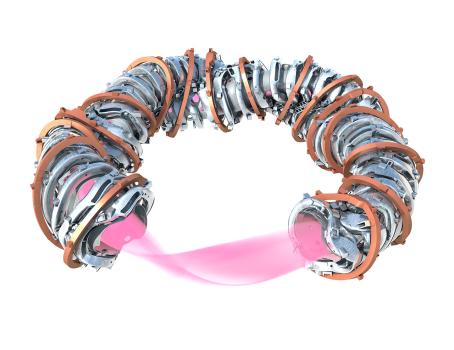
Stellarators create a helical magnetic field by adding helical magnetic coils, mostly of a very bizarre shape. Such a device could work continuously.
Tokamaks generate the necessary addition to toroidal magnetic fields from an electric current flowing through the plasma (the magnetic field is created around a conductor through which the current is flowing, and the conductor is in this case plasma itself). Such a current is produced by magnetic induction by increasing the magnetic field generated by a central solenoid. Because the field cannot be increased to infinity, the tokamak is in principle a pulse device.
Spheromaks and field-reverse configurations are stable plasma arrangements similar to smoke ring with relatively long confinement times of about a microsecond. Such plasmatic self-sustaining "blobs" are relatively easy to create and are widely used for the study of astrophysical events, but they are also explored as possible ways to achieve fusion.
Z pinch lies by the Lawson criterion between magnetic and inertial confinement. Its principle is compressing plasma by a strong electric current flowing through it.
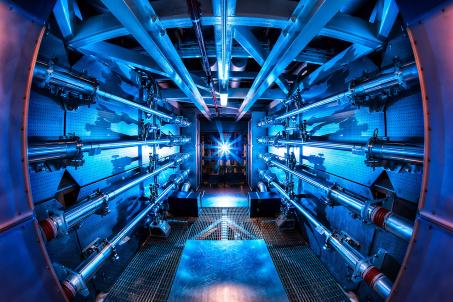
Inertial Confinement
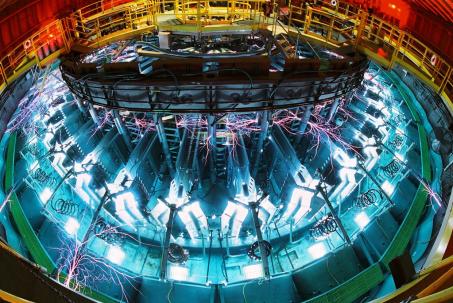
Inertial confinement tries to confine high density plasma for a short time. Fusion material will not be held by any fields but stay in one place only thanks to the inertia of matter — the material will be blown out after the fusion takes place. To reach fusion, pellets from fusion material (frozen of gaseous D-T mixture filled into a thin plastic ball) is compressed from all sides in order to reach fusion density and temperature in its centre, a so-called hotspot. Lasers seem to be the best instruments for that job but beams of electrons or ions were also considered. Ignition could be direct or indirect. Direct ignition fires lasers directly on the surface of the fuel pellet. The surface is ablated and a shock wave travels inward compressing the centre of the pellet, finally igniting the fusion. In indirect ignition, lasers are fired into a small gold cylinder (called hohlraum). After irradiation, the walls of the cylinder begin to produce X-rays which are directed to the pellet and compress it.
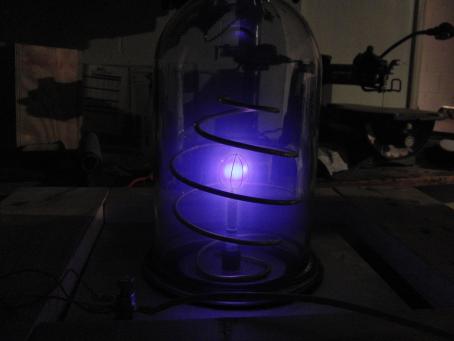
Alternative Types of Confinement
Fusor is a type of inertial electrostatic confinement where ions are accelerated by electric potential toward the centre of the device where they can fuse.
A hydrogen bomb is also a kind of inertial confinement but unsuitable for peaceful electricity production. Fusion material is compressed by an exponential fission reaction in surrounding material.
Gravitational confinement is very reliable but unusable in terrestrial conditions. Gravitational confinement is used by stars with a mass thousands of times more than the Earth's mass.
Muon-catalysed fusion is a hypothetical way of cold fusion. If you replace the electron in a hydrogen atom by muon which is 207 times more massive than an electron, the nuclei of such atoms could approach each other in a hydrogen molecule so close that the fusion could occur. But cheap muon production is an unsolved problem so far.
Bubble fusion is probably not a working fusion method. It was hypothesized to occur inside collapsing bubbles in liquid during acoustic cavitation but has never been proven.
Keep reading
Articles
Why it Works?
In small atoms, from hydrogen to sodium, the binding energy per nucleon increases with an increasing atomic number. This is because each additional nucleon is attracted by other nearby nucleons, and thus more tightly bound to the whole.
5 min read
How it Works?
In normal conditions, atom nuclei don't fuse spontaneously. The nucleus is positively charged and electrostatic forces will repel each other long before they come so close that strong nuclear forces can start to act and bind nuclei together.
5 min read
Fusion Fuel
All light elements and their isotopes could be used as a fusion fuel, but when talking about the use of nuclear fusion as source of energy and electricity, some types of fuel are more suitable than others.
5 min read
Fusion in Stars
The only functioning fusion reactor in our solar system is the Sun. Our central star, weighting 1,9 × 10´30 kg (more than 330,000 Earth masses) burns 500 million metric tons of hydrogen in its core every second at temperatures of about 15,7 million kelvin.
5 min read
Lawson Criterion
John D. Lawson wondered what conditions need to be fulfilled in order to get enough energy from a fusion reaction to use it in a power plant.
5 min read
Plasma
To enable thermonuclear fusion, the matter has to be heated to several million kelvin. But what will happen to such incredibly hot substances?
5 min read
How to Measure the Temperature in the Core of the Sun? or Diagnostics
Measuring the properties of something with extremely high temperatures like fusion plasma is difficult because every type of measuring device inserted into such a hostile environment will be instantly turned into plasma.
5 min read
Questions
What is the difference between fusion and fission?
Fission splits heavy nuclei. Fusion joins light ones. Both can release binding energy; only fission is commercial electricity today.