How to Measure the Temperature in the Core of the Sun? or Diagnostics
5 min read · Energy Atlas Editorial
Measuring the properties of something with extremely high temperatures like fusion plasma is difficult because every type of measuring device inserted into such a hostile environment will be instantly turned into plasma.
- LearningNuclear Fusion Courses
- Nuclear Energy Courses
- Renewable Energy Courses

- ITER Tokamak Interactive 3D Model
- Stellarator Interactive 3D Model
- ITER Tokamak and Stellarator Models for 3D Printing
- Thermonuclear Fusion
- Tokamaks
- Stellarators
- Inertial Confinement Fusion
- ITER
- History
- Thermonuclear Fusion Power Plant
- Nuclear Fusion Summary
- Nuclear Power Plant Interactive 3D Model
- Nuclear Power
- The Nuclear Power Industry
- Nuclear Fuel
- The Nuclear Reactors
- Radioactive Waste
- The Safety of Nuclear Power Plants






- Online 3D
- 3D Printing
- Images
- Videos
- Animations
- LearningNuclear Fusion CoursesHow Does Thermonuclear Fusion Work?
- Construction and Working Principle of Tokamaks
- Construction and Working Principle of Stellarator
- Inertial Confinement Fusion
- ITER — a Major Step Towards Thermonuclear Fusion
- Fusion Power Plant as a Clean Energy Source
- Basic principles
- Magnetic confinement
- Inertial and electrostatic confinement
- Summative, cross-sectional test — Light version
- Radioisotopes as Sources of Ionizing Radiation
- Interaction of Atomic Nuclei with Particles
- Nuclear Fuel and the Nuclear Fuel Cycle
- The Principles of Operating a Nuclear Power Plant
- The First Reactor and the First Nuclear Power Plant
- The Most Used Nuclear Reactors: PWR and BWR
- Sources, Processing, and Storage of Radioactive Waste
- Nuclear Power Plant Safety
- Nuclear fuel
- Nuclear fuel and nuclear reactors
- Nuclear power industry
- Nuclear reactors
- Radioactive waste
- Radioactive waste and safety of nuclear power plants
- Nuclear power
- Summative, cross-sectional test — Light version
- Summative, cross-sectional test — PRO version
- Types of RES and the Use of Renewable
- Comparison of Renewable Energy Source
- Characteristics of Hydropower
- Water Turbines in Hydroelectric Power Plants
- Wind Power Plants
- Solar Energy
- Solar Power Plants
- Biomass energy
- Geothermal energy
- Solar energy
- Water energy
- Wind energy
- ITER Tokamak Interactive 3D Model
- Stellarator Interactive 3D Model
- ITER Tokamak and Stellarator Models for 3D Printing
- Thermonuclear FusionWhy it Works?
- How it Works?
- Fusion Fuel
- Fusion in Stars
- Lawson Criterion
- Plasma
- How to Measure the Temperature in the Core of the Sun? or Diagnostics
- Artificial Fusion Principles
- Main Principles
- Material for Magnetic Coils
- Central Solenoid
- Toroidal Field
- Poloidal Field
- Vacuum Chamber
- Divertor
- External Heating
- Fuel
- Problems
- Most Important Tokamaks in the World
- Milestones
- Main Principles
- Magnetic Coils
- Vacuum Chamber
- Divertor
- Problems
- Most Important Stellarators in the World
- Milestones
- Main Principles
- Lasers
- Target
- Chamber
- Most Important Inertial Fusion Facilities in the World
- Milestones
- The Next Step on the Way Toward a Thermonuclear Fusion Power Plant
- Main Parameters
- Timeline
- Record Breakers
- Magnets
- Vacuum Vessel
- Blanket
- Divertor
- Cryostat
- Tritium Production
- Cooling
- Diagnostics
- External Heating
- The ITER Site
- Disruptions and Instabilities
- Early Fusion Research
- Thermonuclear Bomb
- Pinch
- Stellarator Concept
- Tokamak Invention
- Inertial Fusion Proposal
- ITER Organisation
- Fusion Today
- Clean Energy Source
- Dates and Locations
- Challenges
- Safety
- How it Will Look Like
- Fuel
- Waste
- Best Fusion Reactor for Power Plant
- Nuclear Power Plant Interactive 3D Model
- Nuclear PowerRadioactivity
- Ionising Radiation
- Natural Sources
- Man-made Sources
- Half-life
- Decay Series
- Quantities and Units
- Effects of Ionising Radiation
- Radiation Doses and Activities
- Nuclear Power Summary
- Principle of Operation
- Types of Nuclear Reactions
- Fission Chain Reaction
- Control and Reaction States
- Moderator
- Absorber
- Coolant
- Fission Products
- The Largest Nuclear Power Plants
- Fuel Production
- Fuel Enrichment
- Fuel Assembly
- Fuel Cycle
- Interim Storage
- Transportation
- Reprocessing
- Final Repositories
- The Nuclear Power Plant — How it Works
- The First Reactor
- Pressurized Water Reactor (PWR)
- Boiling Water Reactor (BWR)
- Heavy Water Reactor (PHWR)
- Gas-cooled Reactor (GCR) and Advanced Gas-cooled Reactor (AGR)
- RBMK Type Reactor
- High Temperature Reactor (HTGR)
- Reactor Using Fast Neutrons (FR)
- Small Modular Reactors
- The Future of Fission Reactors
- NPP PWR Interactive 3D Model
- NPP BWR Interactive 3D Model
- NPP Small Modular Reactors Interactive 3D Model
- AGR Reactor Interactive 3D Model
- CANDU Reactor Interactive 3D Model
- HTGR Reactor Interactive 3D Model
- Superphénix Interactive 3D Model
- Production of Radioactive Waste
- Types of Radioactive Waste
- The Processing of Radioactive Waste
- The Disposal of Radioactive Waste
- Nuclear Safety
- Safety Systems
- External Hazards
- INES Scale
- Nuclear Accidents
- International Nuclear Organizations
- Nuclear Power Plants and the Environment
- WATER energyHydroelectric Power Plant Interactive 3D Model
- The Physical Properties of Water
- The Origin of Water Energy
- History of Water Energy Utilization
- Water Energy and Its Uses
- Dams and Reservoirs
- The Highest Dams and Largest Reservoirs
- The Segner Wheel
- Francis Turbine
- Kaplan Turbine
- Pelton Turbine
- Choosing a turbine (Turbine selection graph)
- Hydroelectric Power Plant Operating Principles
- Types of Hydroelectric Power Plants
- The Largest Hydroelectric Power Plants in the World
- Tidal Energy and Sea Wave Power
- Marine Current Power and Ocean Thermal Energy
- Environmental Impact of Hydropower
- Wind Turbine Interactive 3D Model
- The Energy of Flowing Air
- The Beaufort Wind Force Scale
- The History of Wind Power Utilization
- Wind Power Plants
- Wind Turbine and its Working Principle
- The Largest Wind Farms
- Types of Wind Turbines
- Wind Turbines and the Environment
- Solar Power Plant Interactive 3D Model
- Solar Rays Energy
- Ways to Use Solar Heat
- Solar Collectors
- Solar Concentrators
- Central Tower Solar Power Plants
- Solar Farms
- The Largest Solar Power Plants
- The Energy Use of the Photovoltaic Effect
- Photovoltaic Farms
- Solar Energy and the Environment
- Solar Energy and Solar Power Systems Summary
- Hot Dry Rock (HDR) Geothermal Energy Interactive 3D Model
- Heat from the Earth’s Core
- Geothermal Phenomena
- Mankind and the Energy from the Earth
- Geothermal Systems
- Geothermal Power Plant
- Environmental Impact
- Biomass Energy Interactive 3D Model
- Biomass
- Types and Processing of Biomass
- Available Technology of Biomass
- Biofuels
- Biomass Power Plants
- Biomass and the Environment
- Rapid development of energy consumption
- The Future of Solar Energy
- The Future of Hydro Energy
- The Future of Renewable Energy Sources
- Development of Renewable Sources
- Online 3D
- 3D Printing
- Images
- Videos
- Animations
- Glossary
- Log-in
- Create new account
- ITER Tokamak Interactive 3D Model
- Stellarator Interactive 3D Model
- ITER Tokamak and Stellarator Models for 3D Printing
- Thermonuclear FusionWhy it Works?
- How it Works?
- Fusion Fuel
- Fusion in Stars
- Lawson Criterion
- Plasma
- How to Measure the Temperature in the Core of the Sun? or Diagnostics
- Artificial Fusion Principles
- Glossary
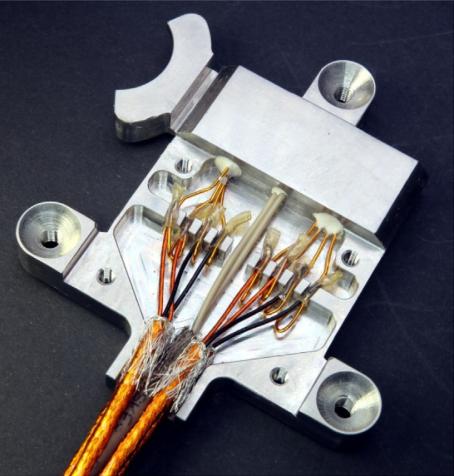
Hall sensor for ITER.
Measuring the properties of something with extremely high temperatures like fusion plasma is difficult because every type of measuring device inserted into such a hostile environment will be instantly turned into plasma. But to gain information about fusion plasma and to control it in a fusion reactor, it is necessary to know about it as much as possible. It is important to know what the plasma shape and position is, its temperature, density and composition and in the case of magnetic confinement, what the current flowing through the plasma or the shape of magnetic fields are, and of course, whether the fusion reaction has occurred and what the energy output is.
Most plasma diagnostics are the passive ones, observing particles or electromagnetic radiation emitted from plasma. The active diagnostics explore the plasma with microwaves, laser or particle beams and tries not to perturb plasma too much. Only a small range of diagnostics touch the plasma directly although on its very edge and for short time — the probes.
High temporal resolution is required from all diagnostics to observe the plasma evolution and to react to its changes as soon as possible. Some diagnostics give information only about one specific part of the plasma (e.g. probes), some give overall information (e.g. total power output) and others give line integrated data (e.g. spectroscopy). Only by the combination of data from more kinds of diagnostics and by the help of complex computational algorithms, the complete information about fusion plasma, its density or temperature profiles and their evolution in time can be obtained.
Here is the list of some important plasma diagnostic methods in more detail:
Magnetic Diagnostics
Magnetic diagnostics are used for measuring basic plasma parameters like the plasma current, position, shape and pressure, as well as for detecting plasma instabilities. They react to the electromagnetic field generated by plasma, mostly by the Faraday's law (changes in the magnetic field cause voltage induction on the surrounding loops/coils). In the field of magnetic diagnostics, you can find for example pick-up coils (their integrated voltage output helps to detect the plasma position and shape), Hall sensors (use Hall effect for local measurements of the magnetic field), Rogowski coil (is wound poloidaly around the tokamak chamber and measures plasma current), voltage loop (from which the ohmic input power can be calculated) or Mirnov coils (detect plasma instabilities).
Microwave Diagnostics
Microwave diagnostics work with frequencies from 1 GHz to 3 THz and is mostly active, probing plasma with microwave beam and deducing plasma properties from its reflection or scattering. In reflectometry, a wave is launched into plasma and reflects from the so-called critical density layer giving information about its position. Swept frequency reflectometry systems are employed for measuring the electron density profile. Other information about its density could be obtained by interferometry (it compares phase shift of a wave passing through plasma with a wave passing through a vacuum). In polarimetry, changes in polarization gives information about the internal magnetic field and, so, the current density. Electron cyclotron absorption is used to measure electron temperature and density and collective Thomson scattering measures fluctuations in the electron density or the velocity distribution of fast ions. An example of passive microwave diagnostics is electron cyclotron emission based on the cyclotron radiation emitted by the electrons during their gyration around the magnetic field lines. The frequency depends on the strength of the magnetic field and, hence, on the position in the plasma.
Spectroscopy
Spectroscopy in the visible, ultraviolet and soft x-ray spectral regions gives information on ion densities, temperatures and plasma rotation by detecting incoming light from plasma. Mostly, some computer reconstruction of the plasma profile like tomography is needed. Bolometers are used to measure the radiation losses from the plasma in a wide wavelength range. Synchrotron radiation spectroscopy gives valuable information about runaway electrons. Active spectroscopy systems also exist like beam emission spectroscopy that measures light emitted by the beam of neutral atoms (e.g. lithium) after interaction with plasma which gives information about the plasma density.
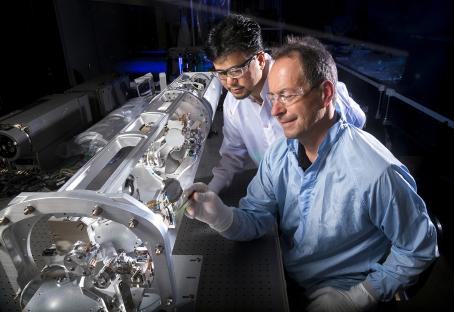
Laser-aided diagnostics fire laser beam into plasma and measure its scattering. Incoherent Thomson scattering uses Ruby and neodymium-doped yttrium aluminium garnet lasers and measures electron density and the electron velocity distribution function. Coherent Thomson scattering uses CO2 lasers and measures either the velocity distributions of fast ions or electron density fluctuations.
Probes are the only diagnostic that is touching plasma, although on its very edge and for short times. They are basically wires inserted into the peripheral regions of plasma and could be used for measuring electron density, temperature and plasma potential. A Langmuir probe is an insulated metallic pin inserted into the plasma with its tip uninsulated. When voltage is applied to the tip, the current is drawn from plasma and by its measurement, the electron density, plasma potential and electron temperature can be deduced.
Particle Diagnostic
Particle diagnostic analyses particles escaping from plasma. If the fusion is supposed to be present, fusion products are also analysed (e.g. tritium, protons, 3He, neutrons and gammas). The analysis of unwanted particles called impurities (e.g. carbon, oxygen) which could drain off energy from plasma due to radiation losses is very important. Active particle diagnostics use different types of particle beams and observe their changes after an injection into plasma.
Keep reading
Articles
Why it Works?
In small atoms, from hydrogen to sodium, the binding energy per nucleon increases with an increasing atomic number. This is because each additional nucleon is attracted by other nearby nucleons, and thus more tightly bound to the whole.
5 min read
How it Works?
In normal conditions, atom nuclei don't fuse spontaneously. The nucleus is positively charged and electrostatic forces will repel each other long before they come so close that strong nuclear forces can start to act and bind nuclei together.
5 min read
Fusion Fuel
All light elements and their isotopes could be used as a fusion fuel, but when talking about the use of nuclear fusion as source of energy and electricity, some types of fuel are more suitable than others.
5 min read
Fusion in Stars
The only functioning fusion reactor in our solar system is the Sun. Our central star, weighting 1,9 × 10´30 kg (more than 330,000 Earth masses) burns 500 million metric tons of hydrogen in its core every second at temperatures of about 15,7 million kelvin.
5 min read
Lawson Criterion
John D. Lawson wondered what conditions need to be fulfilled in order to get enough energy from a fusion reaction to use it in a power plant.
5 min read
Plasma
To enable thermonuclear fusion, the matter has to be heated to several million kelvin. But what will happen to such incredibly hot substances?
5 min read
Artificial Fusion Principles
The Lawson criterion gives essentially two ways how to harness an effective fusion reaction.
5 min read
Questions
What is plasma?
Ionized gas: free charges that feel magnetic fields. Fusion research lives in this state of matter.