Why it Works?
5 min read · Energy Atlas Editorial
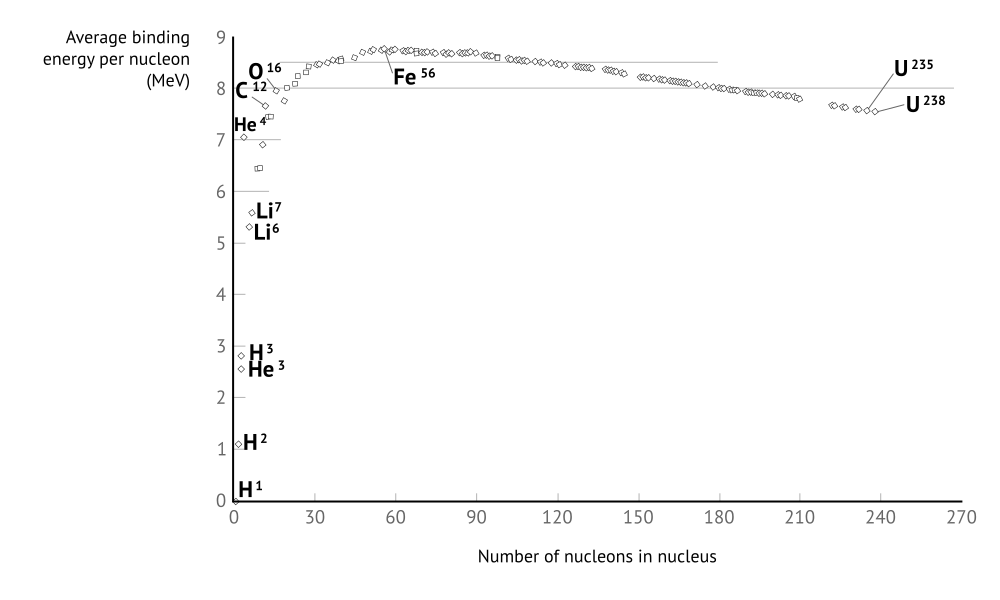
In small atoms, from hydrogen to sodium, the binding energy per nucleon increases with an increasing atomic number. This is because each additional nucleon is attracted by other nearby nucleons, and thus more tightly bound to the whole.
An atom consists of a nucleus composed of protons and neutrons, surrounded by electrons. Protons and neutrons (collectively known as the nucleons) are held together by strong nuclear forces. This is a kind of short-reach force, weak in large distances but strong in distances smaller than atom nuclei. At larger distances, electrostatic forces dominate, that for example tries to repel positively charged protons.
In order to separate nucleons from nuclei, some amount of energy is needed. This energy is called nuclear binding energy. If you weigh separate nucleons, their weight will differ from the weight of the whole nucleus — the difference is exactly the nuclear binding energy (energy can be converted to mass by the famous Einstein equation E = mc2). In periodic table of elements, nuclei have different binding energy per nucleon depending on which atom they came from.
Light Atoms
In small atoms, from hydrogen to sodium, the binding energy per nucleon increases with an increasing atomic number. This is because each additional nucleon is attracted by other nearby nucleons, and thus more tightly bound to the whole. Some atoms, such as helium-4 or oxygen-16, are exceptions — their nuclei are very stable because the number of protons and neutrons is so that they can be arranged in complete shells within an atomic nucleus.
With increasing atomic numbers, the region of relative stability is reached from magnesium to xenon. Binding energy remains more or less the same. This is because the nuclei become large enough to balance attractive strong nuclear forces and repellent electrostatic forces.
Heavy Atoms
In elements heavier than xenon, the nucleus is large enough that strong nuclear forces can't reach across the whole nucleus and repellent electrostatic forces became more dominant. Binding energy per nucleon decreases with increasing atomic numbers.
The point is, when you want to disassemble the nucleus of light atoms, like helium, you need to add energy. If you put two nuclei of light atoms together and manage to make a new nucleus, energy will be released. In the middle of the periodic table of elements, nothing will be gained or lost by nucleus assembling or disassembling because the difference in binding energy between those atoms is very small. In the heavier atoms, tearing apart the nucleus of heavy atoms will release energy and vice versa, assembling nucleus of a heavy atom will need some extra energy to be added.
Fusion and Fission
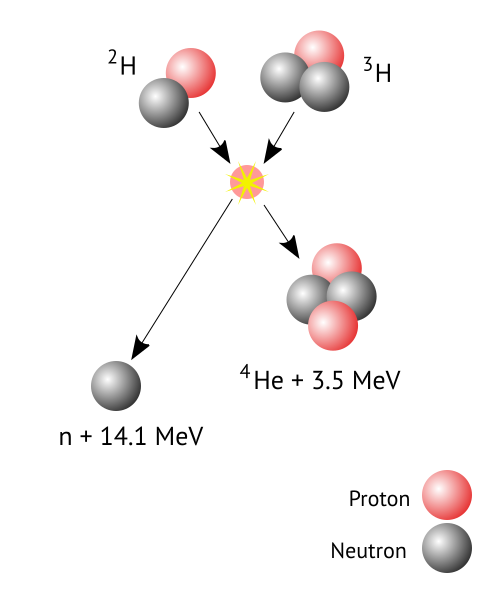
This fact is used in energetics. Fission power plants rely on disassembling the nuclei of the uranium fissile isotope 235U and harness released energy. But fusing light atoms together will make even more energy than fission. When deuterium (hydrogen with one neutron) and tritium (hydrogen with two neutrons) are fused, this reaction releases 17.53 MeV of energy. On the contrary, fission of one uranium nucleus releases 200 MeV of energy. After recalculation, energy released per nucleon is 3.5 MeV for fusion and 0.5 MeV for fission. You can get seven times more energy from one gram of fusion fuel than from one gram of fission fuel. The only thing needed is to persuade atoms to fuse.
Keep reading
Articles
How it Works?
In normal conditions, atom nuclei don't fuse spontaneously. The nucleus is positively charged and electrostatic forces will repel each other long before they come so close that strong nuclear forces can start to act and bind nuclei together.
5 min read
Fusion Fuel
All light elements and their isotopes could be used as a fusion fuel, but when talking about the use of nuclear fusion as source of energy and electricity, some types of fuel are more suitable than others.
5 min read
Fusion in Stars
The only functioning fusion reactor in our solar system is the Sun. Our central star, weighting 1,9 × 10´30 kg (more than 330,000 Earth masses) burns 500 million metric tons of hydrogen in its core every second at temperatures of about 15,7 million kelvin.
5 min read
Lawson Criterion
John D. Lawson wondered what conditions need to be fulfilled in order to get enough energy from a fusion reaction to use it in a power plant.
5 min read
Plasma
To enable thermonuclear fusion, the matter has to be heated to several million kelvin. But what will happen to such incredibly hot substances?
5 min read
How to Measure the Temperature in the Core of the Sun? or Diagnostics
Measuring the properties of something with extremely high temperatures like fusion plasma is difficult because every type of measuring device inserted into such a hostile environment will be instantly turned into plasma.
5 min read
Artificial Fusion Principles
The Lawson criterion gives essentially two ways how to harness an effective fusion reaction.
5 min read
Questions
What is the difference between fusion and fission?
Fission splits heavy nuclei. Fusion joins light ones. Both can release binding energy; only fission is commercial electricity today.