Fusion Fuel
5 min read · Energy Atlas Editorial
All light elements and their isotopes could be used as a fusion fuel, but when talking about the use of nuclear fusion as source of energy and electricity, some types of fuel are more suitable than others.
All light elements and their isotopes could be used as a fusion fuel, but when talking about the use of nuclear fusion as source of energy and electricity, some types of fuel are more suitable than others.
The first criterion is whether it is possible to ignite such a reaction. The Sun core has about 15 million kelvin and other reactions need even higher temperatures.
Energetic yield of a reaction is also important. The more energy that is released from a reaction, the more interesting the reaction is for energetics. Another question is how likely it is that the reaction will occur when you put enough suitable particles of suitable temperatures in some reaction space. The probability of a desired reaction is called cross-section, and some types of fusion reactions have higher cross-section than others. Obviously, a reaction with a higher cross-section is more valuable.
Least, but not last are the products of the reaction. If neutrons are created, they cannot be trapped in a magnetic field cage because they don't have an electric charge, and by hitting the equipment of the fusion reactor, they activate it and it becomes radioactive. On the other hand, when alpha particles are created by reaction, the obey electromagnetic fields and can be directly used for electricity generation. Some types of reactions could produce fuel for other types of reactions.
Considering all of these conditions, here are several thermonuclear fusion reactions that were found interesting and which humankind would like to try to ignite:
2H + 2H → 3H + p · Q ≈ 4.08 MeV · Ignition temperature ≈ 30 keV (340 million kelvin) 2H + 3H → 4He + n · Q ≈ 17.53 MeV · Ignition temperature ≈ 14 keV (160 million kelvin) 2H + 3He → 4He + p · Q ≈ 18.34 MeV · Ignition temperature ≈ 65 keV (750 million kelvin) p + 11B → 3 4He · Q ≈ 8.68 MeV · Ignition temperature ≈ 123 keV (1.4 billion kelvin) p + 7Li → 2 4He · Q ≈ 17.2 MeV · Ignition temperature ≈ 66 keV (760 million kelvin)
keV means kiloelectronvolt. One electronvolt is a unit of energy equal to the work done on an electron in accelerating it through a potential difference of one volt. In plasma physics it is often used to express temperature, where 1 keV equals 11.6 million kelvin.
Q is the reaction energy yield.
Hydrogen (H)
Hydrogen is a very abundant element on Earth and in the whole Universe. We can easily obtain it by the electrolysis of water. However, to try and use simple hydrogen fusion, which is in fact proton-proton fusion ongoing in the Sun, is not a good idea. Although its ignition temperature is low, only about 15 million kelvin, its energy yield and cross-section are very low. To get usable energy from fusion on Earth, we have to do better than the Sun.
Deuterium (D, or 2H)
Deuterium is an isotope of hydrogen containing one proton and one neutron in the nucleus. It is a naturally occurring stable isotope. It accounts for approximately 0.0156 percent of hydrogen atoms — in another words, one atom from 6,420 hydrogen atoms is deuterium. Deuterium was discovered 1931 by American chemist Harold C. Urey. Deuterium can be extracted from seawater by a simple and well proven industrial process. First, heavy water (a water molecule with deuterium instead of ordinary hydrogen) is separated by the Girdler sulfide process and then deuterium is created by electrolysis. Multiple step distillation can also be used. But deuterium-deuterium fusion reaction has a lower yield and higher ignition temperature than the deuterium-tritium reaction that looks most promising.
Tritium (T, or 3H)
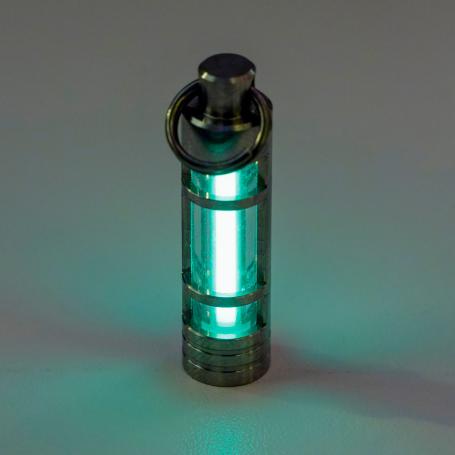
Tritium is a slightly radioactive isotope of hydrogen containing one proton and two neutrons in the nucleus. It was first detected by Rutherford, Oliphant and Hartec in 1934. Its half-life is about 12 years. Naturally occurring tritium is extremely rare on Earth. Small amount of tritium is formed in the upper parts of the atmosphere by interactions with cosmic rays. Artificially is tritium produced as by-product in nuclear reactors. The tritium could be produced by neutron capture by lithium or boron. The disadvantage of a fusion reaction of tritium and deuterium is the production of an energy neutron.
A reactor chamber housing a D-T reaction will suffer from very high neutron flux and therefore activation and embrittlement of components.
Lithium
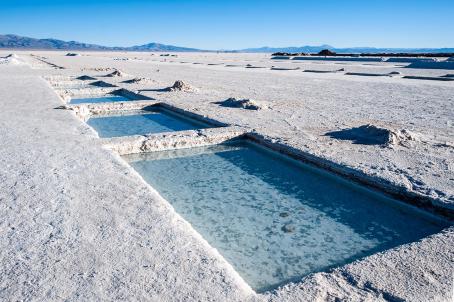
Lithium is a light metal that could be cut by a knife and floats in oil. It is highly reactive with water and air, so it never occurs freely in nature, only in compounds. Lithium was discovered in 1817 by Johan August Arfwedson. Lithium is present in sea water and in minerals of the Earth's crust, but not in high concentrations. The overall content of lithium in the Earth's oceans is about 200 billion tonnes. Lithium is produced mostly from ores and brines from land, its harvesting from oceans remains mostly unexplored. Pure lithium can be obtained by electrolysis of a liquid mixture of lithium chloride and potassium chloride.
Reactions with a higher ignition temperature which, however, did not produce neutrons, are for example a helium-3-deuterium reaction and a proton-boron-11 reaction. Both produce only charged particles. After mastering the DT reaction, this could be another challenge that could bring the energy of stars to Earth.
Helium-3
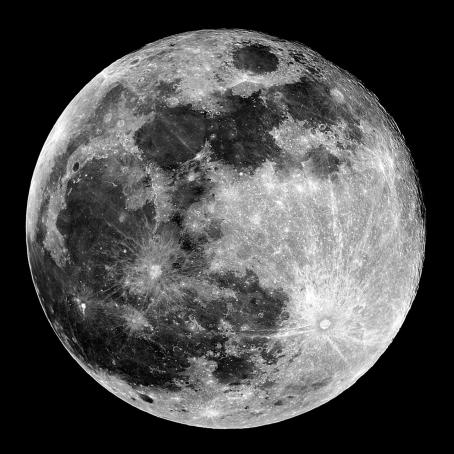
Helium-3 could be mined on Moon.
Helium-3 is stable isotope of helium with two protons and one neutron. Isolation of helium-3 was first accomplished by Luis Alvarez and Robert Cornog in 1939. As a light gas, helium is rare on Earth. Some is trapped inside the Earth mantle and some can be found in the atmosphere. The ratio of helium-3 to helium-4 varies from 2 to 300 ppm (particles per million). Helium-3 is supposed to be abundant in Lunar regolith and in gas giants like Jupiter, but to harvest it for fusion fuel will need extra-terrestrial mining.
Boron
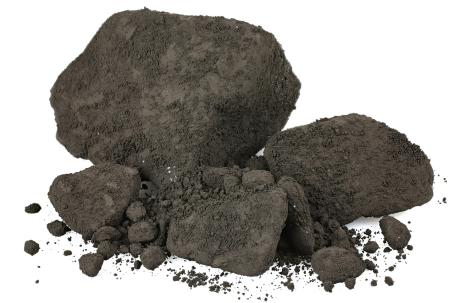
In its crystalline form, boron is a brittle, dark, lustrous metalloid; in its amorphous form, it is a brown powder. It constitutes about 0.001 percent by weight of the Earth's crust and its global proven mineral mining reserves exceed one billion metric tonnes. It occurs in the form of borate minerals such as borax (sodium borate), ulexite (sodium-calcium borate) or colemanite (calcium borate) and is mined for wide commercial use. Boron was first isolated in 1808 by French chemists Joseph-Louis Gay-Lussac and Louis-Jacques Thenard.
Keep reading
Articles
Why it Works?
In small atoms, from hydrogen to sodium, the binding energy per nucleon increases with an increasing atomic number. This is because each additional nucleon is attracted by other nearby nucleons, and thus more tightly bound to the whole.
5 min read
How it Works?
In normal conditions, atom nuclei don't fuse spontaneously. The nucleus is positively charged and electrostatic forces will repel each other long before they come so close that strong nuclear forces can start to act and bind nuclei together.
5 min read
Fusion in Stars
The only functioning fusion reactor in our solar system is the Sun. Our central star, weighting 1,9 × 10´30 kg (more than 330,000 Earth masses) burns 500 million metric tons of hydrogen in its core every second at temperatures of about 15,7 million kelvin.
5 min read
Lawson Criterion
John D. Lawson wondered what conditions need to be fulfilled in order to get enough energy from a fusion reaction to use it in a power plant.
5 min read
Plasma
To enable thermonuclear fusion, the matter has to be heated to several million kelvin. But what will happen to such incredibly hot substances?
5 min read
How to Measure the Temperature in the Core of the Sun? or Diagnostics
Measuring the properties of something with extremely high temperatures like fusion plasma is difficult because every type of measuring device inserted into such a hostile environment will be instantly turned into plasma.
5 min read
Artificial Fusion Principles
The Lawson criterion gives essentially two ways how to harness an effective fusion reaction.
5 min read
Questions
What is the difference between fusion and fission?
Fission splits heavy nuclei. Fusion joins light ones. Both can release binding energy; only fission is commercial electricity today.