Stellarators
14 min read · Energy Atlas Editorial
Stellarators are "generators of stellar energy", and their principle was discovered before tokamaks. A helical-twisted magnetic field, necessary for successful plasma confinement, is generated only by magnetic coils of various shapes. The stellarator is a device capable of contin
Stellarators are "generators of stellar energy", and their principle was discovered before tokamaks. A helical-twisted magnetic field, necessary for successful plasma confinement, is generated only by magnetic coils of various shapes. The stellarator is a device capable of continual work, which is an important feature for a power plant. However, stellarators experienced a boom only recently, when sufficient computational power for creating desired magnetic coil shapes became available. There are over ten stellarators operating around the world. The largest are the Wendelstein 7-X in Germany, the Large Helical Device in Japan, and the Helically Symmetric eXperiment in the USA.
Main Principles
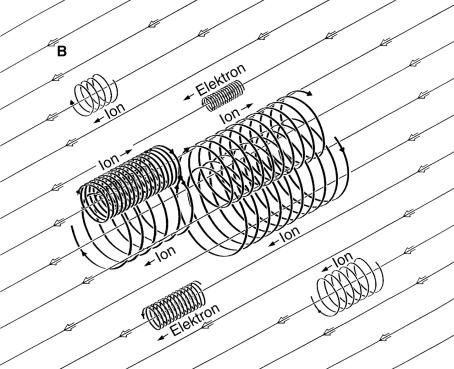
As deuterium-tritium fusion occurs at temperatures exceeding 100 million kelvin, the necessity to confine such hot substance arises, and a magnetic cage seems like a possibility. Plasma is made up of electrons and ions, which, as charged particles, obey magnetic fields. When a charged particle encounters a magnetic field, it starts to spiral along these magnetic field lines. Ions spiral in slightly larger circles (known as the Larmor radius) and in the opposite direction as electrons. When parallel magnetic field lines are offered, plasma particles travel in one dimension only and create a column of hot plasma isolated from the walls of the device. Such a field exists in the core of a solenoid, but unfortunately, all solenoids are of limited length, and particles that reach its end escape. The idea is to bend the solenoid into a torus (donut shape) so the particles will circle endlessly round and round. For pure geometrical reasons, the coils of the solenoid on the inner side of the torus (in the donut hole) will be closer to each other, so the magnetic field will be stronger there than at the outer edge of the torus. Particles in a gradual magnetic field will start to move across the field lines. Electrons drift down and ions up, so gradually the charges will separate and the resulting electric field will overcome the magnetic one and push the plasma out of the torus. To overcome this, the particle must be forced to spiral around the torus. When travelling on the inner side, it will drift in one direction, while on the outer side, it will drift in the opposite direction, so the drifts cancel out and plasma stays inside the torus.
Stellarator Types
As the particle travels and twists around the torus, you can imagine its path as a three-dimensional figure "8". To build a device in such a shape was exactly the idea of the first stellarator created by Lyman Spitzer in 1953. It was a tube of borosilicate glass bent into the "8" shape, wrapped by magnetic coils. Because the straight tubes could not pass through each other, the design did not lie flat. The bent parts at either end were tilted. This is called the "figure 8 stellarator". From it, a simpler "racetrack" design evolved. This stellarator has an oval shape with toroidal winding and additional corkscrew winding to provide the required magnetic twist. So-called "classical stellarators" are derived from it. These have a toroidal shape of a chamber with toroidal coils around them. Corkscrew winding wraps itself around torus inside them. Current in adjacent wires of these winding flows in opposite directions. "Torsatron" creates its magnetic cage by one or two single helical coils spiralling around a torus completed by several poloidal coils.
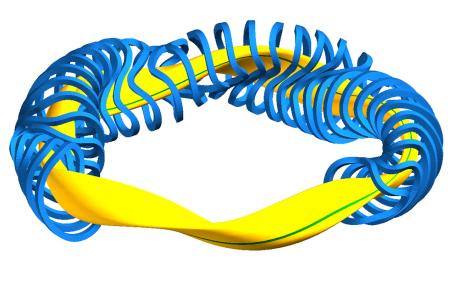
Very similar is the "heliotron" design. The "heliac" uses a set of off-axis toroidal coils completed by several poloidal coils to create a twisted magnetic field with a bean-like cross-section. With progress in computing, plasma theory, and technologies, it was possible to manufacture odd-shaped modular coils, crooked into bizarre shapes that could give plasma exactly the desired shape of a twisted ribbon with a changing bean-like cross-section. This "modular stellarator" design, also called "Helias", seems to be the most promising type of stellarator device with very good confinement.
Plasma Formation
The modular magnetic field is activated first in a stellarator discharge, creating a magnetic cage. Then gas (usually hydrogen) is puffed into the vacuum vessel and is heated by high-frequency electromagnetic waves that pass energy to the electrons. The accelerating electrons transfer their energy to ions through collisions, thus ionizing plasma completely. Another possibility for plasma heating is neutral beam injection, in which accelerated neutral particles are fired into plasma, passing their energy to plasma particles. The plasma can be confined as long as the heating is available, so in principle, the stellarator could operate in a steady-state regime.
Magnetic Coils
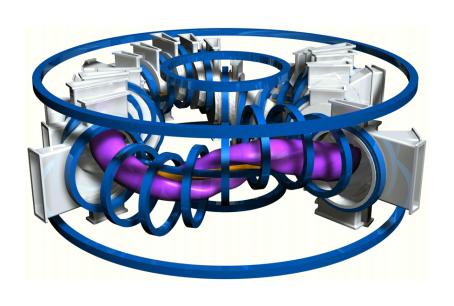
Toroidal and Poloidal Coils
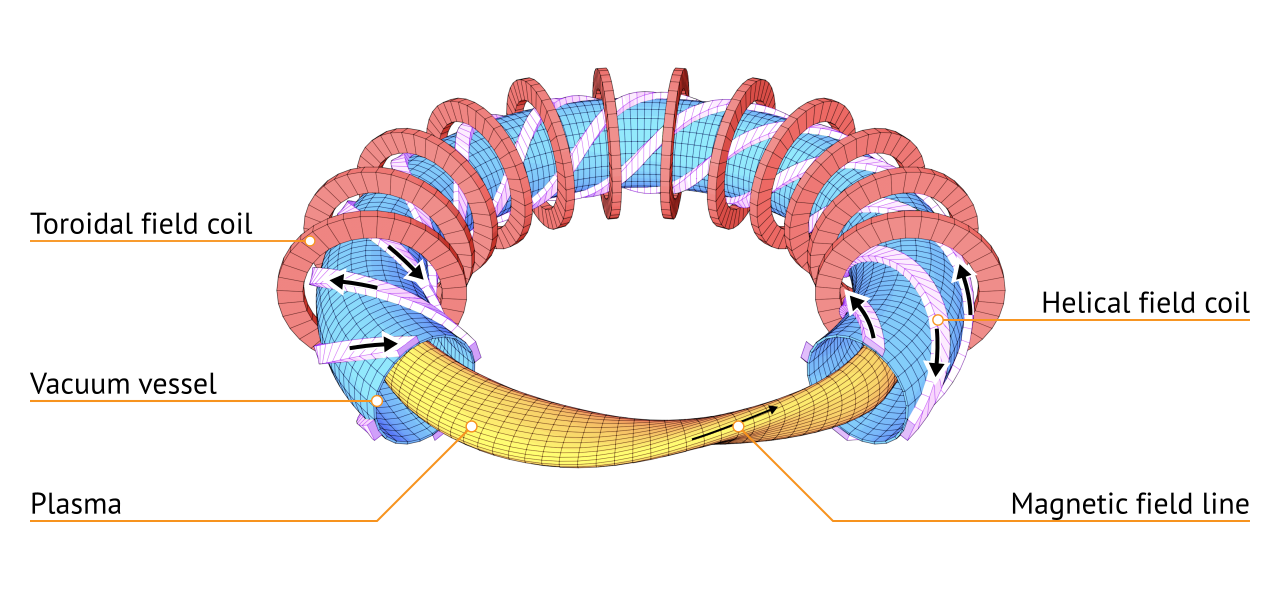
When talking about magnetic confinement in thermonuclear fusion, two terms are usually mentioned: toroidal and poloidal. To explain them, let's imagine a donut. This shape is technically called a torus. If you take a walk around a donut, starting in the donut hole, then through a place where there is icing on the real donut, to the outer side, and finally back to the donut hole, this direction will be called toroidal. Rings on the donut corpus are toroidal coils. The poloidal walk will take you around donut — for example, along the edge of the icing. Poloidal coils have the same orientation as your donut and are kind of hoops strung on the donut. The magnetic field created by toroidal coils has the shape of a torus. Poloidal coils are creating a field that pushes expanding plasma back to the centre of the torus.
Helical and Modular Coils
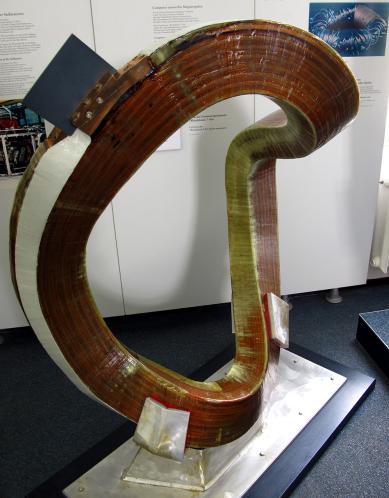
The third type of coil is required in a stellarator, either in the form of a spiral turning around a torus (helical coil) or in the form of separate modular coils of a special non-planar shape. These coils are accompanied by either poloidal or toroidal coils, or both, according to stellarator configuration. Helical coils are a bit easier to calculate and manufacture as they are symmetrical, but because they are wound around the vacuum vessel, there is not much space between them to reach the vacuum vessel. In most devices, two pairs of helical windings are used, so the free manipulation space is even more limited. Separated modular coils allow a little better access to the chamber. They are not simple round coils — their shape is crooked in order to achieve the best magnetic confinement possible. Though around one stellarator there are several dozen coils, the effort is to use only about five types of modular coils to make manufacture easier and less costly. So the device usually has five-fold, four-fold, or even three-fold symmetry with repetitive sets of modular coils.
Shape Calculation
The shapes of the coils have to be computed with powerful supercomputers. That's why stellarators have experienced a boom only recently when enough computational power was available. First, the optimal shape of the plasma is calculated. The aim is to achieve the best confinement possible, reduce particle losses, and the formation of instabilities or unwanted magnetic islands. Then, using a custom algorithm, coils are created where the resultant field best matches the desired shape of plasma. Limitations, such as the number of coils and the possibility of engineering the created shape, are added.
Manufacturing
Manufacturing requirements are enormous — a few millimetres of deviation could spoil the resulting magnetic field entirely. As the coils need to be placed with millimetre accuracy, a strong supporting structure is needed that will hold the magnets in the proper place during the whole operation. By changing the current flowing through the coils, operators could set several different types of magnetic configurations.
Superconducting Materials
To reduce energy consumption, the coils are superconducting. This means that they are made from a material that uses quantum effects of superconductivity where electrical resistance vanishes and magnetic flux fields are expelled from the material when cooled below a critical temperature of around 4 kelvin (−269 °C). Superconductive magnets carry a higher current and produce stronger magnetic fields, consume less power, and therefore are cheaper to operate than their conventional counterparts. Stellarator coils are made from NbTi (niobium-titanium) superconductor, which is easy to work with (a feature necessary for the production of such a complicated shape) but loses its superconductivity in higher magnetic fields, which limits its usage in devices where a strong magnetic field is necessary. Present stellarators produce a magnetic field of around 3 Tesla. If usage of the stellarator as a power plant required a higher magnetic field, another superconducting material, such as ReBCO, would have to be used. ReBCO is an acronym for Rare-earth Barium Copper Oxide, and this new material exhibits high-temperature superconductivity and could sustain high magnetic fields. These properties could make it a candidate for usage in future stellarators or other magnetic confinement devices. The operation of a stellarator usually requires the presence of several other types of coils, for plasma shaping, positioning, and measuring its properties.
Stronger Magnetic Field
In present day stellarators, the magnetic coils are packed as close to the vacuum vessel as possible. But when deuterium-tritium fusion is ignited inside, a heavy flux of neutrons starts to attack the precious coils. This will require heavy shielding. Neutron flux will also serve for tritium breeding when lithium inside the breeder captures neutrons and produces an atom of tritium. But the one-meter-thick breeder will push magnetic coils away from the vessel wall, so for plasma confinement, a stronger magnetic field will be needed than before.
Vacuum Chamber
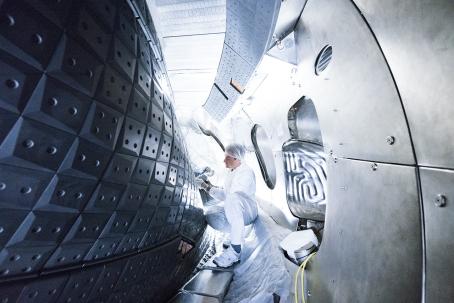
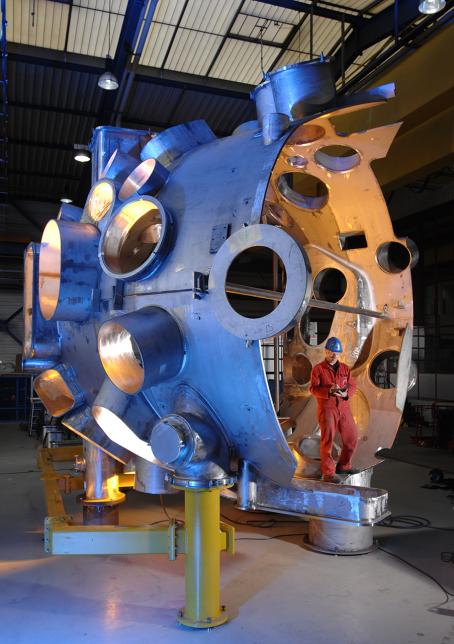
Since stellarator plasma has the shape of a twisted ribbon with a changing bean-like cross-section, the vacuum vessel that encloses it also has a strange and irregular shape. You can imagine it like a hollow steel donut that has been randomly squashed by a giant hand in some places.
Shape
The exact shape of the vacuum chamber depends on the type of magnetic configuration each device uses. The chamber is slightly more symmetrical for those with helical winding around the torus (e.g. heliotrons) than for those with modular coils (e.g. modular stellarators), but still more complex than a simple torus. Magnetic coils are placed very close to the vacuum vessel, and between them there is only limited space for access to the vessel. This is ensured by ports, which protrude from the vessel like hedgehog thorns. They are used for heating, maintenance, diagnostics, vacuum pumps, or gas piping.
Heat Load
The plasma temperature inside the vacuum vessel reaches 100 million kelvin and is insulated from the vessel wall by a magnetic field only. So, the vessel has to be constructed to sustain high thermal loads during operation (similar to the heat load experienced by spacecraft re-entering the Earth's atmosphere). The main body of the vessel is stainless steel with carbon tiles inside. The active water cooling of tiles is necessary in modern stellarators. Part of the vessel is lined with divertor plates, beneath which the vacuum pumps are located. Magnetic field lines direct impurities toward the divertors.
Cryostat
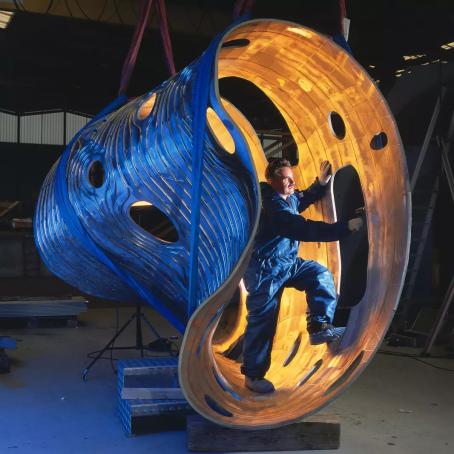
While plasma has a temperature of 100 million kelvin, magnetic coils located nearby must maintain their superconductivity at only 4 kelvin. To minimize heat transfer from plasma to coils, the outer side of the vessel used to be actively cooled and covered by thermal shield insulation. To minimize heat transfer even more, a vacuum is maintained in the space between the vessel and the coils. This is ensured by an outer vessel called a cryostat, which is in fact a very large and sophisticated thermos and encapsulates the vacuum vessel and coils.
Future Shielding
Deuterium-tritium fusion has not taken place at any stellarator yet. To be prepared for that, stellarators need to first install proper neutron shielding between the plasma and vessel wall or coils. This shielding will also serve in a power plant as a tritium breeder, capturing neutrons in lithium and producing desirable fuel — tritium. But for best operation, the shielding with incorporated breeders has to be about 1 metre thick. This will push magnets away from the vessel and will lead to the need for stronger magnets and bigger machines.
Divertor
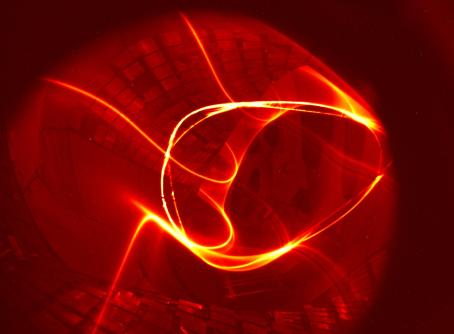
Thermonuclear fusion takes place between hydrogen atoms, but plasma is never so pure. Impurities — atoms with higher atomic numbers — get into plasma by various means, for example, from the vessel walls. Those impurities could cause great radiation losses and undesirably cool the plasma. Also, no matter how good the magnetic confinement is, some particles will escape from the magnetic cage all the time. All those particles, impurities as the refugees, are better collected in the same place, cooled, and evacuated from the vessel. For this purpose, devices called divertors are used to control the purity and density of the plasma.
Island Divertor
In the core of stellarator plasma, the magnetic field is forming closed surfaces — that means that if the particle were alone in the vessel, it would stay trapped on this surface and never move inward or outward. The magnetic surface near the vessel wall is a special one and is called the last closed surface. It delimits the area of the core, where particles are confined. The space between the last closed surface and the wall is called the "Scrape-Off Layer", and it is better to keep it free of particles that could otherwise heat up the vessel wall. But the magnetic field still exists beyond this line. In a stellarator, it could be arranged to form small islands — local magnetic traps where particles are captured. It is then easy to put them in the way special collector plates (another word for divertor) and exhaust these trapped particles by vacuum pumps beneath the plates. Because it exploits magnetic islands, this device is called an island divertor.
Divertor Structure
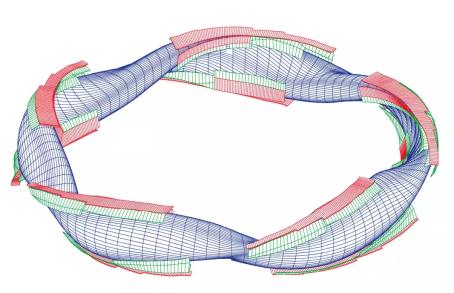
The divertor shape is very complicated as it has to follow the curved contour of the plasma edge. It is made from small tiles of carbon-fibre-reinforced-carbon (such as in the Wendelstein 7-X stellarator) welded on the backbone and infused with water-cooling piping. The surface of each tile had to be milled three-dimensionally into shape — with tolerances of sometimes only 0.1 millimetres to avoid any overheating of protruding edges. They have to withstand a similar heat load during a plasma pulse as spacecraft re-entering the Earth's atmosphere are experiencing. Since the magnetic field lines in the scrape-off layer, which approach the last closed flux surface, only connect to certain wall regions, the target plates do not have to cover the whole plasma surface.
Though the first stellarator equipped with a divertor was Model B-64, completed in 1955, research on stellarator island divertors started just recently.
Problems
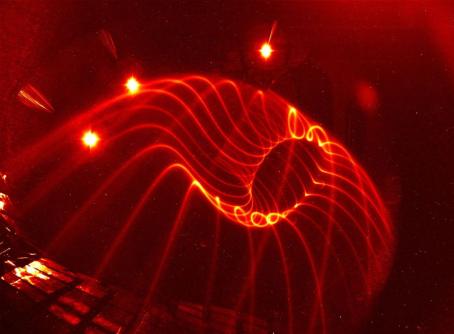
The idea of a magnetic cage is that a particle is trapped on one closed magnetic surface (depicted by a single magnetic line), spiralling endlessly. Theoretically, the particle will stay on that closed magnetic surface forever and never escape, but the reality is different. With many particles spiralling close together, collisions sometimes occur, which fling particles out to other magnetic field lines. After such a collision, particles sometimes found themselves closer to the plasma core, which is desirable, but sometimes found themselves closer to the stellarator walls. By gradual collisions, some particles will finally escape the magnetic confinement and end up on the device wall. The problem is not that the particle is missing — it can be easily replaced by fuelling — but the escaped particle takes all the laboriously delivered energy with it. This energy ends up useless on the vacuum vessel wall and the newly added particle has to be again heated by an external heating device. If too many particles are escaping, the plasma cannot be heated to thermonuclear temperatures and such a device is useless as a power plant.
Diffusion
The fact that the particles are moving from one magnetic surface to another is called diffusion, and the whole process of particles escaping from magnetic confinement is called transport. This is a very important topic in fusion science — if the transport did not exist or was very low, we would've reached ignition a long time ago. For the first stellarator, the diffusion rate was predicted as "classical" (this theory counts only with random particle collisions in an infinite long cylinder). But the diffusion rate was many times worse. It was worse than "neoclassical diffusion" (counting the toroidal magnetic field shows that particles have more ways to escape from the cage; this theory was developed in the 60s) and worse than "Bohm diffusion" (under certain conditions, particles stop "seeing" the magnetic field and are able to move across magnetic lines almost freely, resulting in rapid particle loss). The diffusion rate in the first stellarators, namely the series of Model B and Model C in the Princeton Plasma Physics Laboratory, was so bad that it seems that these concepts of magnetic confinement will never be of practical use. After the fine-tuning of magnetic fields and ways of heating, the Bohm diffusion rate was finally achieved, but for many decades, stellarators fought with poor particle confinement. Their magnetic cage, created by external fields only, was not perfect. Only when plasma theory, computing, and engineering advanced to a certain point was it possible to not only calculate but also manufacture magnetic coils capable of producing tailored magnetic fields. After that, stellarator plasma confinement improved dramatically, and modern stellarators are able to keep and heat plasma particles to fusion temperatures.
Keep reading
Questions
Tokamak or stellarator — what is the difference?
Both confine plasma in a torus. Tokamaks use plasma current; stellarators use twisted coils.