Ionising Radiation
4 min read · Energy Atlas Editorial
Ionizing radiation can be classified into alpha, beta, gamma, X-rays, and neutrons, while cosmic radiation is composed primarily of high-energy protons.
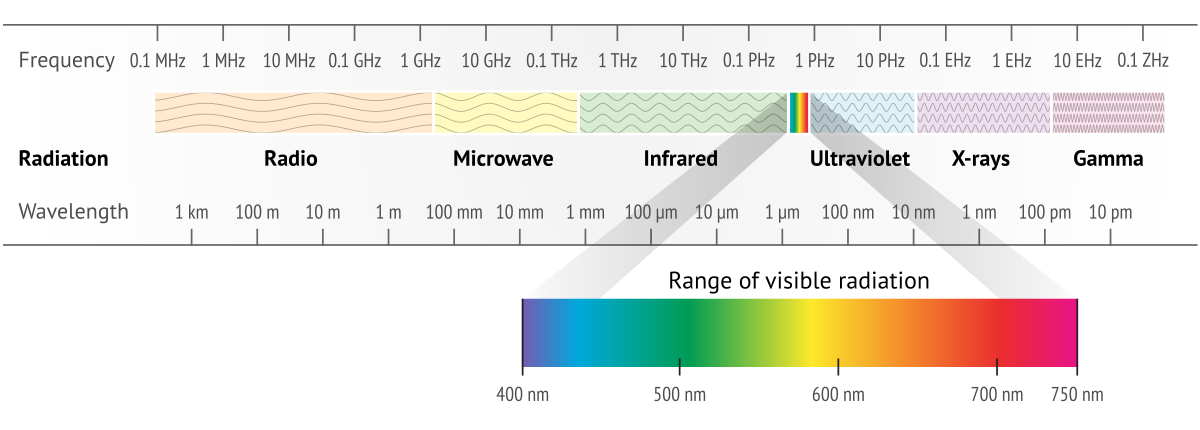
The world around us is full of radiation. For example, we are able to see thanks to visible radiation from the Sun, while mobile communication makes use of electromagnetic radiation in the radio-frequency and microwave regions of the spectrum. The term "radiation" refers not only to electromagnetic waves, consisting of photons, but also to streams of particles, such as alpha particles. Ionising radiation has sufficient energy to remove electrons from atoms or molecules, thereby producing ions.
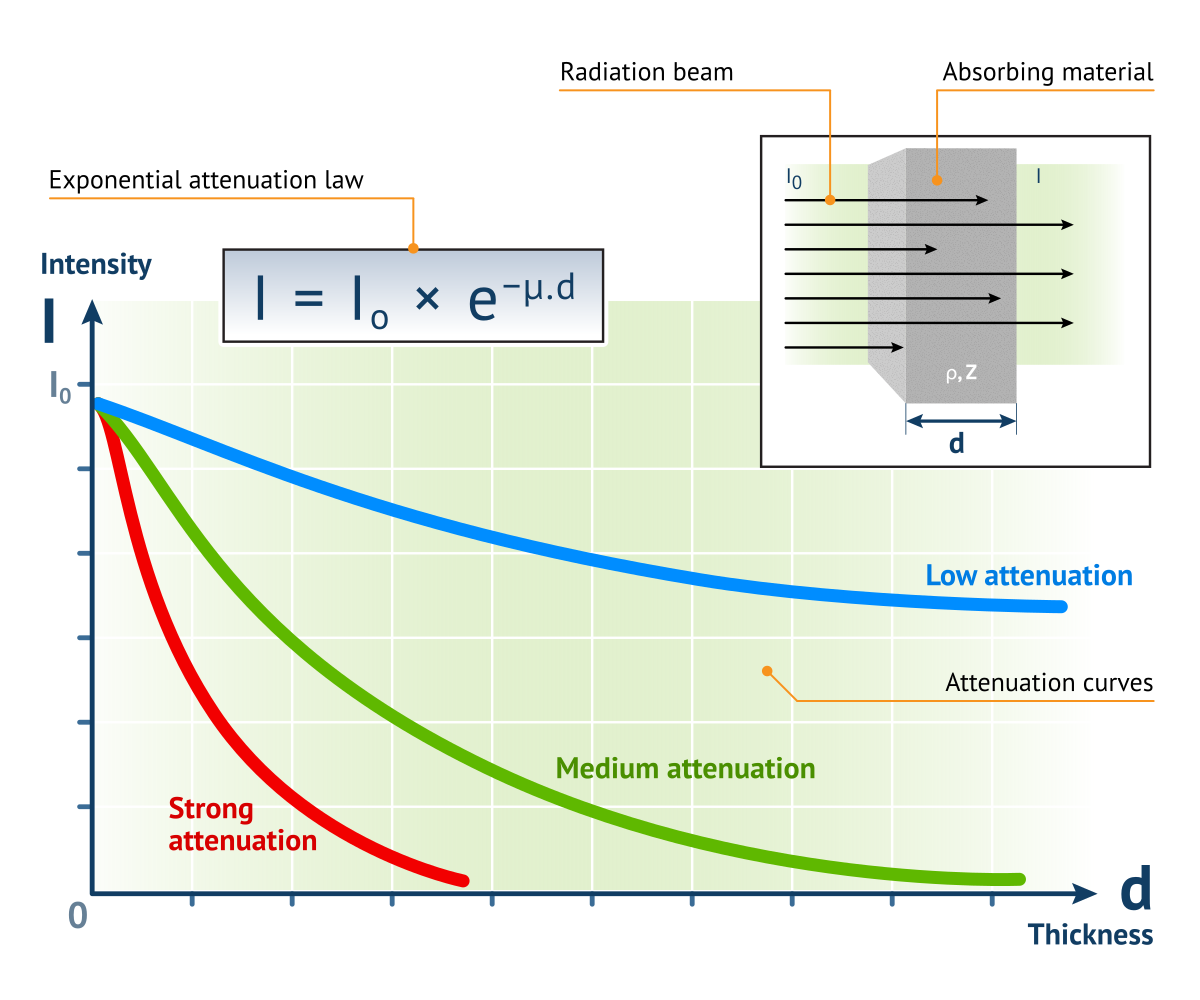
As charged particles pass through matter, they lose energy through interactions with atoms and molecules, including excitation and ionisation, until they eventually come to rest. Photons, by contrast, do not gradually slow down; they may be absorbed or scattered as they interact with matter. The distance travelled by a charged particle before it comes to rest is referred to as its range, whereas the penetration of photons is usually described in terms of attenuation. Ionising radiation is a natural part of our environment. Natural sources include radioactive nuclides in the Earth's crust, air, food and living organisms, as well as cosmic radiation.
Common types of ionising radiation include alpha and beta particles, gamma rays, X-rays and neutrons. Primary cosmic radiation consists predominantly of high-energy protons and atomic nuclei.
Alpha Radiation
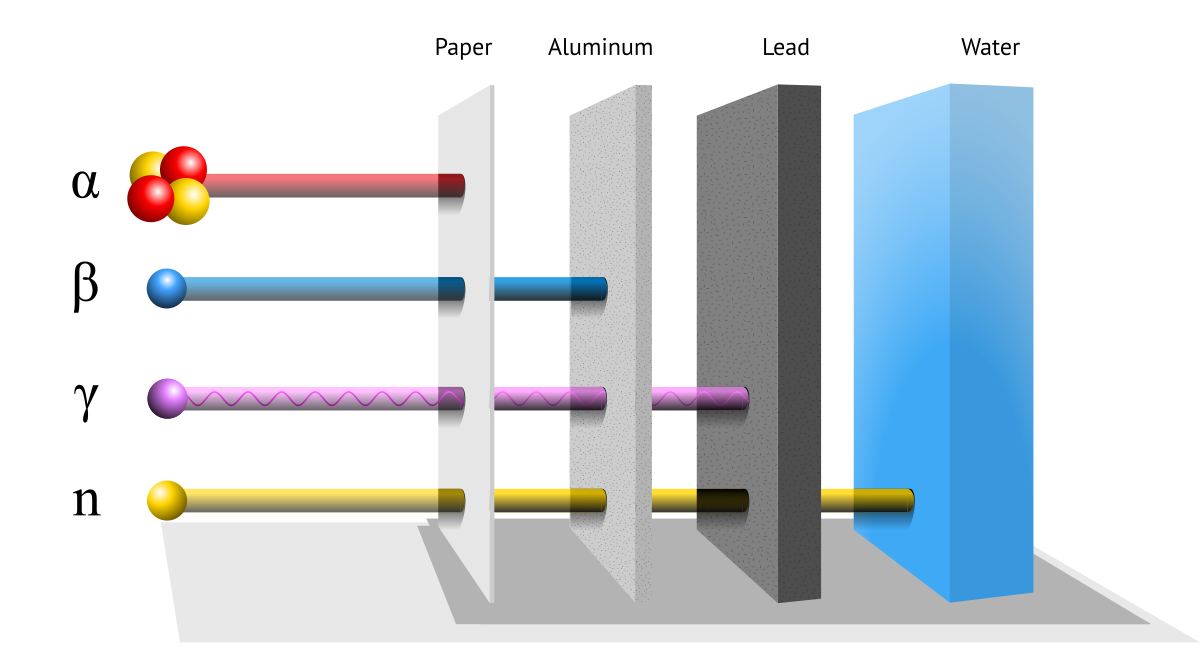
Alpha radiation consists of helium-4 nuclei, each containing two protons and two neutrons. Alpha particles have a positive electric charge of +2e and are deflected by magnetic and electric fields. Because they interact strongly with matter, they have a very short range and are stopped by a sheet of paper or the outermost layer of human skin. During alpha decay, the mass number of the parent nucleus decreases by four and its atomic number decreases by two. Typical alpha-emitting radionuclides include isotopes of uranium, thorium and radium.
Beta Radiation
Beta radiation consists of high-energy electrons or positrons, the antiparticles of electrons. Beta particles carry either negative or positive electric charge and are therefore deflected by magnetic and electric fields. They are much lighter than alpha particles and generally have a greater range in matter. Beta radiation can typically be shielded by a few millimetres of aluminium or other suitable materials. In beta-minus (β−) decay, a neutron in the nucleus is transformed into a proton, with the emission of an electron and an electron antineutrino; the atomic number therefore increases by one. In beta-plus (β+) decay, a proton is transformed into a neutron, with the emission of a positron and an electron neutrino; the atomic number decreases by one. Typical beta-emitting radionuclides include 137Cs and 40K.
Gamma Radiation
Gamma radiation consists of high-energy photons emitted during transitions of atomic nuclei from excited states to lower-energy states. Gamma rays have no electric charge and are therefore not deflected by electric or magnetic fields. They are highly penetrating and their intensity can be strongly reduced by sufficiently thick layers of dense materials such as lead or concrete. Gamma radiation is indirectly ionising: its photons transfer energy to charged particles in matter, which then cause ionisation. Gamma emission often follows alpha or beta decay when the daughter nucleus is left in an excited state, but not every alpha or beta decay is accompanied by gamma radiation.
There is no difference between the ionising radiation produced by natural sources and ionising radiation of the same type and energy produced by artificial sources.
X-rays
X-rays are high-energy electromagnetic radiation produced by processes involving electrons rather than by transitions within the atomic nucleus. Like gamma rays, X-rays have no electric charge and are not deflected by electric or magnetic fields. They can penetrate matter and are attenuated by sufficiently thick shielding materials such as lead or concrete. X-rays are indirectly ionising, producing energetic charged particles when they interact with matter. They can be generated when electrons in atoms move into vacancies in lower-energy electron shells, producing characteristic X-rays, or when high-energy electrons are decelerated in the electric field of atomic nuclei, producing bremsstrahlung ("braking radiation").
8 pictures 8 pictures
Neutrons
Video: Types of radiation and their deflection in a magnetic field.
Neutrons are electrically neutral subatomic particles. Together with protons, they are constituents of atomic nuclei, and their mass is slightly greater than that of a proton. Because neutrons have no net electric charge, they are not deflected by electric fields. Neutron radiation is indirectly ionising: neutrons interact with atomic nuclei and can produce energetic charged particles or secondary radiation that causes ionisation. Materials rich in hydrogen, such as water, polyethylene or paraffin, are effective for slowing down neutrons, while additional neutron-absorbing materials may be used to capture them. Neutrons are produced in nuclear fission, certain nuclear reactions and dedicated neutron sources. Traditional neutron sources include radium-beryllium (Ra-Be) and polonium-beryllium (Po-Be) sources.
Protons
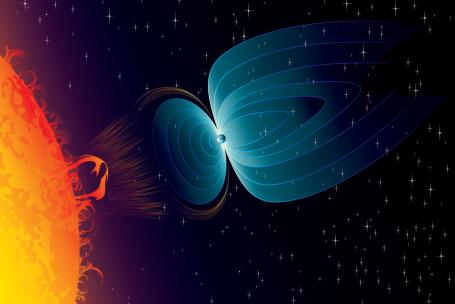
Protons are the most abundant particles in primary cosmic radiation reaching the Earth from the Sun and from more distant astrophysical sources. Cosmic-ray protons span an enormous range of energies, with the most energetic observed cosmic rays exceeding 1020 eV. The Earth's magnetic field deflects many lower-energy charged particles, while sufficiently energetic cosmic rays can reach the atmosphere. Collisions with nuclei in the upper atmosphere then produce cascades of secondary particles known as cosmic-ray air showers.
A proton with an energy of 1020 eV carries about 16 joules of energy — comparable to the kinetic energy of a baseball travelling at about 50—60 km/h.
Keep reading
Articles
Radioactivity
Radioactivity is a natural phenomenon. Unstable atom nuclei release particles: helium nuclei (alpha); electrons or positrons (beta); photons (gamma).
5 min read
Natural Sources
Natural sources of radioactivity can be found in the air, soil, cosmic rays, or humans. The annual dose received from them is called "natural background".
4 min read
Man-made Sources
Man-made radioactivity sources are mostly used in medicine for diagnostics and treatment. Coal and nuclear plants produce radioactive waste.
4 min read
Decay Series
Unstable isotopes decay in four decay series (thorium, neptunium, uranium, actinium) into other radionuclides and finally into stable atoms.
3 min read
Quantities and Units
The radioactivity and its effects are measured by detectors and dosimeters (activity in becquerels, dose in grays, equivalent dose in sieverts).
4 min read
Effects of Ionising Radiation
Ionising radiation could change material properties. In living tissue, it could damage DNA and lead to cell death. This is used in tumor treatment.
3 min read
Radiation Doses and Activities
A chart of the radioactivity of various objects (e.g., nuts or coal) and the doses produced by some activities (like eating bananas or visiting Chernobyl).
3 min read
Nuclear Power Summary
Nuclear energy originates from the makeup of the atom. Ionizing radiation caused by decay of the atom nuclei is a natural part of our environment.
17 min read