
The Origin of Water Energy
3 min read · Energy Atlas Editorial
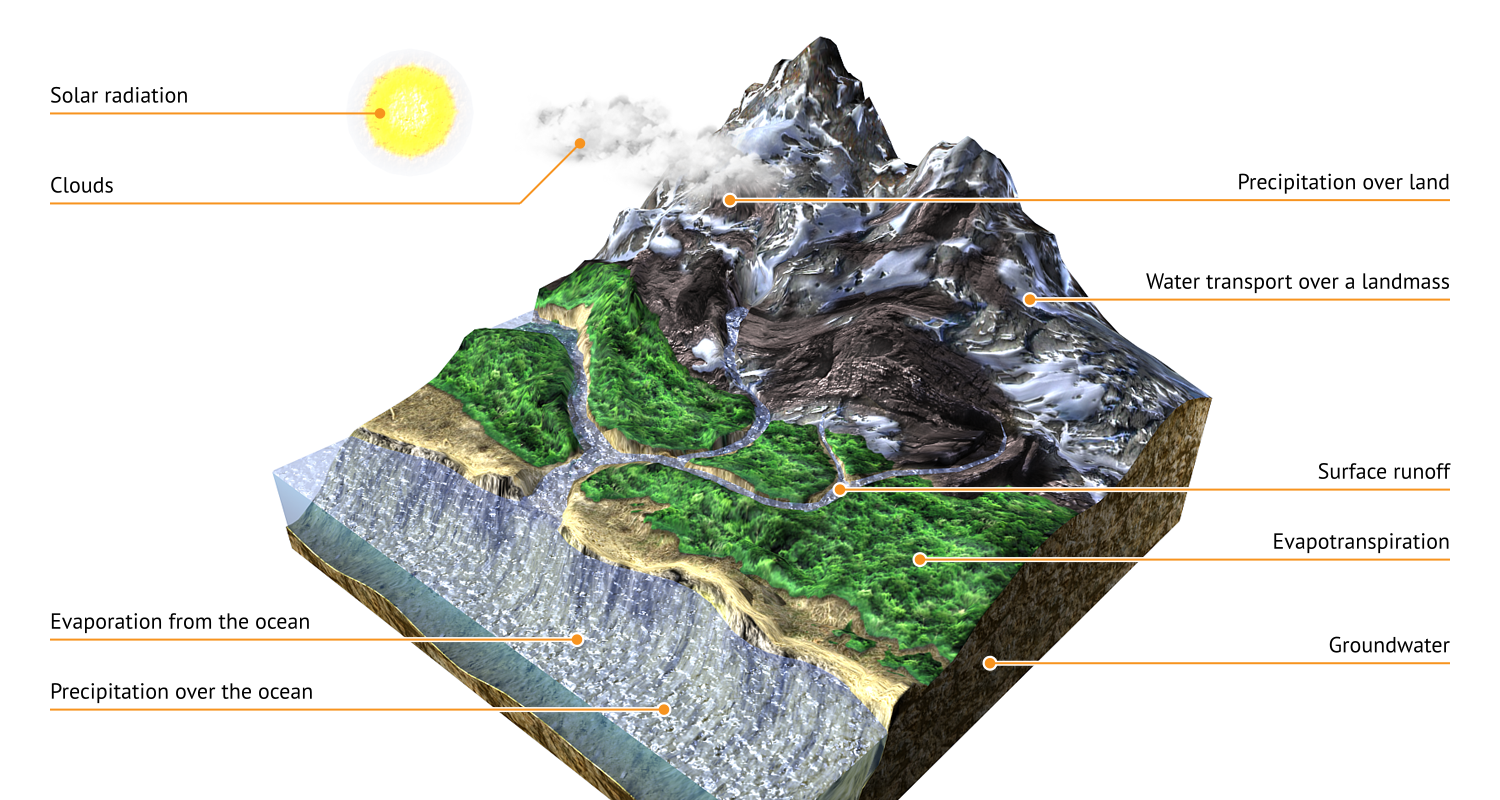
The Sun warms surface water and evaporates it. After condensation, the water falls on the land with exploitable potential energy relative to ocean level.
Water Cycle in Nature
Hydropower is constantly renewed through the natural water cycle, driven primarily by energy from the Sun and gravity. Water continuously circulates through evaporation, atmospheric transport, condensation and precipitation, while gravity moves water from higher to lower elevations. Water also circulates through currents within the oceans.
The Source of Energy in Flowing Water
Solar radiation makes water evaporate from water bodies. The water vapour then moves over land where, when it is cooled, condenses and then falls to the ground as precipitation in the form of rain, snow or hail, thus acquiring tremendous potential energy relative to sea level.

The amount of precipitation and the terrain determine the hydropower potential of a geographic location. The more precipitation and the more mountainous a region is, the greater the potential of that region for obtaining energy from water. After falling to the ground, water from precipitation has a relatively high potential energy. Gravity forces the water to flow into valleys whereby the potential energy is turned into kinetic energy. If the path of the flowing water is blocked in a certain place, a part of its energy can be used for power production. Thus, water stored in hydroelectric power plant reservoirs transfers part of its mechanical energy to the turbines as it passes through them.
![Map of average annual precipitation worldwide [mm/year].](/assets/hydro/water-energy-the-origin-of-the-water-energy-mapa-uhrnu-srazek.fitbox.x1090.y2090-b53528e05ba4.jpg)
In addition to harnessing watercourses on land, energy can also be obtained from seas and oceans. Energy can be captured from waves and ocean currents, while tidal power exploits differences in water level between high and low tide. Temperature differences between surface and deeper ocean waters can also be used to produce energy.

Deuterium in Water
Water contains small amounts of deuterium, a heavy isotope of hydrogen that can be used as fuel in thermonuclear fusion reactions.
Nuclear fusion is a process in which two light atomic nuclei combine to form a heavier nucleus, releasing a large amount of energy. For fusion energy research on Earth, the most readily achievable reaction is between deuterium and tritium, two isotopes of hydrogen. Deuterium accounts for approximately 0.0156 per cent of all hydrogen atoms on Earth. Tritium can be produced from lithium through reactions with neutrons and is expected to be bred in the blankets of future fusion reactors.
To advance research into thermonuclear fusion, the large experimental ITER tokamak is currently under construction in Cadarache, France. Under the updated project baseline, research operations are planned to begin in 2034, with deuterium-tritium operation scheduled to start in 2039. ITER is an experimental facility and will not generate electricity for the grid.
The deuterium contained in one litre of water could theoretically yield as much energy through fusion as burning 300 litres of petrol.


Keep reading
Articles
The Physical Properties of Water
Water is a chemical compound made from one oxygen and two hydrogen atoms. At normal conditions, it is a colourless, clear, and odourless liquid.
3 min read
History of Water Energy Utilization
The energy of water was used since ancient times for grinding grain or irrigation. Later it powered mills or hammers, and finally a turbine was invented.
3 min read
Water Energy and Its Uses
The amount of available water energy, kinetic and potential, depends on hydrologic potential, mostly on hydraulic head and flow rate.
3 min read
Dams and Reservoirs
The dams create water reservoirs for hydro power plants, to prevent floods or to collect drinking water. Typical dams are gravity or concrete arch dams.
3 min read
The Highest Dams and Largest Reservoirs
The highest dam is the 305 m high, concrete arch-shaped Jinping-I dam in China. The largest reservoir is Lake Kariba in Zambezi, with a volume of 180 km3.
3 min read
The Segner Wheel
The Segner wheel was an important step on the way to modern turbines. Its principle is today used in rotating irrigation sprinkler systems.
3 min read
Francis Turbine
The Francis turbine has a radial-axial design, variable pitch guide vanes, and fixed runner blades. The largest one has a diameter of 10 m.
3 min read
Kaplan Turbine
The Kaplan reaction water turbine with adjustable blades, invented in 1918, is used in places with minimal heads and relatively high, variable flow rates.
3 min read
Pelton Turbine
The Pelton turbine is an isobaric impulse action turbine. The water jet is directed tangentially at the spoon-shaped buckets on the runner.
3 min read
Choosing a turbine (Turbine selection graph)
The turbine selection graph helps to select the best turbine type for the given hydraulic head and rate of flow.
3 min read
Hydroelectric Power Plant Operating Principles
In hydroelectric power plants, the water propels the turbine blades, and the generator transforms the energy of a rotating turbine shaft into electricity.
3 min read
Types of Hydroelectric Power Plants
The hydroelectric power plants can be divided into accumulation ones with a reservoir, run-of-the river without a dam, derivational, and pumped-storage.
3 min read
The Largest Hydroelectric Power Plants in the World
The largest hydroelectric dams in the world are the "Three Gorges Dam" in China, Itaipú Dam and Guri Dam in South America.
4 min read
Tidal Energy and Sea Wave Power
Tidal power plants use ebb-tide energy from turbines in the dam enclosing a tidal basin, while tidal stream generators are turbines anchored to the seabed.
3 min read
Marine Current Power and Ocean Thermal Energy
Energy contained in ocean currents can be exploited by various underwater turbines or by an OTEC system that uses ocean temperature differences.
3 min read
Environmental Impact of Hydropower
The construction of a hydroelectric power plant affects a large area ecosystem and often leads to people's relocation. Then a new balance is established.
3 min read