
Kaplan Turbine
3 min read · Energy Atlas Editorial
The Kaplan reaction water turbine with adjustable blades, invented in 1918, is used in places with minimal heads and relatively high, variable flow rates.
Viktor Kaplan
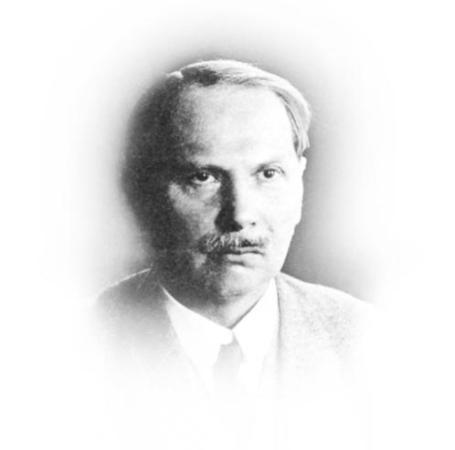
27. 12. 1876, Mürzzuschlag, Austria
23. 8. 1934, Rochuspoint, Austria
Viktor Kaplan was an Austrian engineer and the inventor of the Kaplan turbine. After graduating from the Vienna University of Technology, Kaplan moved to Brno, where he worked as a design engineer at the Department of Machine Theory, Kinematics and Mechanical Engineering at the German Technical University. In 1912, he published his work on a new water turbine designed for low heads and large flow rates. During his research, Kaplan combined theoretical calculations with hundreds of experiments aimed at improving existing water turbines. By gradually modifying the flow passages of the Francis turbine, he eventually developed an axial-flow runner resembling a ship propeller with adjustable blades.
The first Kaplan turbine was manufactured by the Ignaz Storek company in Brno and installed in Velm, Lower Austria, where it entered operation in 1919. Its success contributed to the rapid spread of Kaplan turbines around the world. In total, Kaplan registered four patents for various turbine types. Despite patent disputes and opposition from competitors, the Kaplan turbine eventually became widely established. A major breakthrough came in 1925, when a Kaplan turbine was installed at the Lilla Edet hydroelectric power plant in Sweden.
Kaplan Turbine
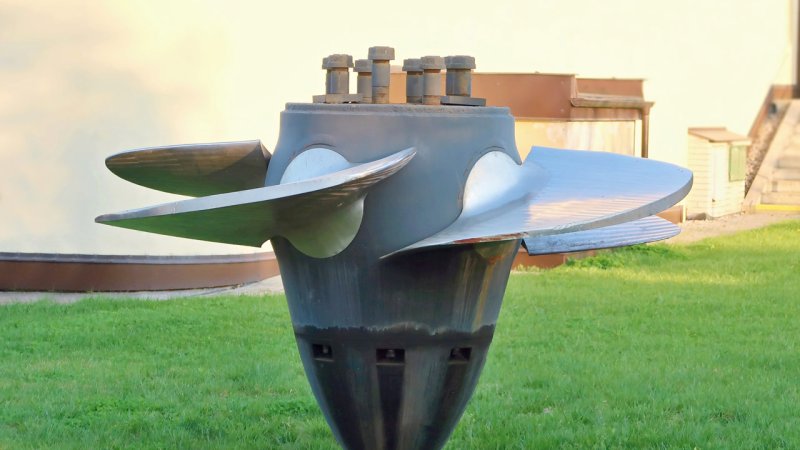
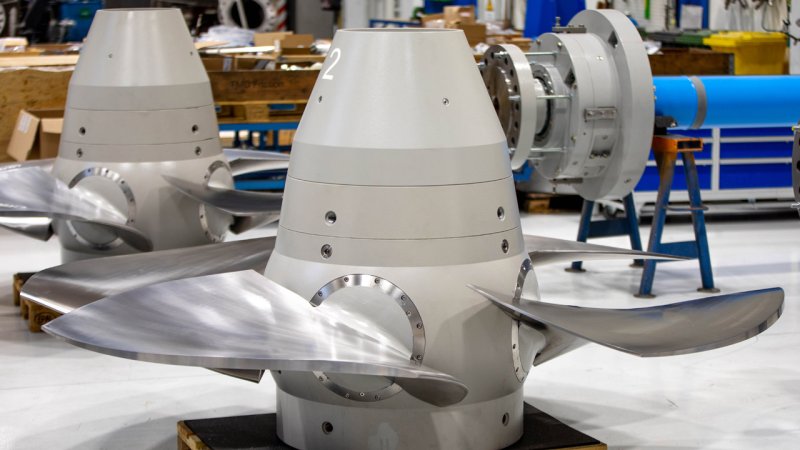
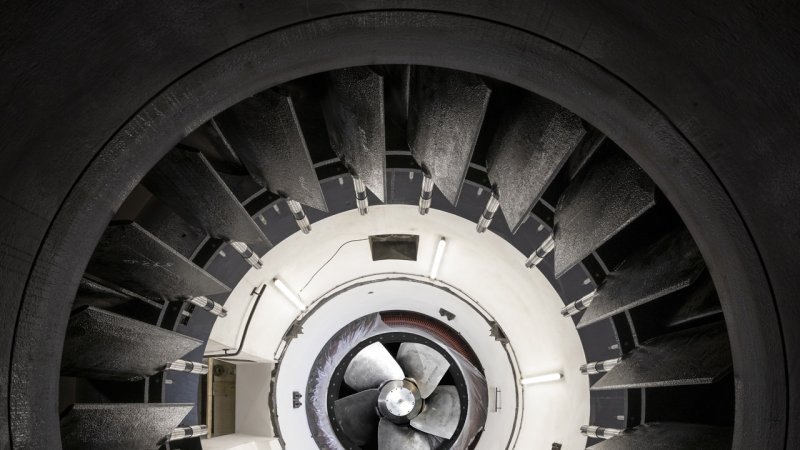
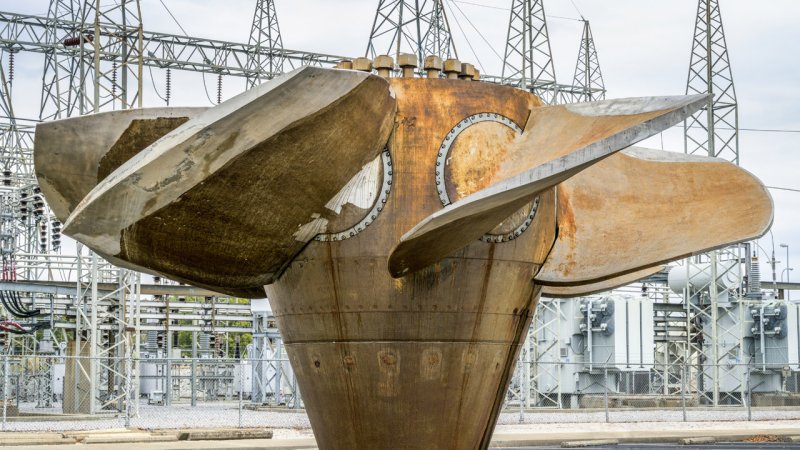
The Kaplan turbine is an axial-flow reaction turbine with adjustable guide vanes (or wicket gates) and adjustable runner blades. It is typically suitable for hydraulic heads from a few metres to about 50 metres and for large flow rates, which can reach several hundred cubic metres per second. The adjustable guide vanes and runner blades allow the turbine to maintain high efficiency over a wide range of flow rates. It is more complex than the Francis turbine but can achieve efficiencies exceeding 90% over a wide range of operating conditions. Kaplan turbines are typically used in places with relatively high, variable rates of flow and lower hydraulic heads.
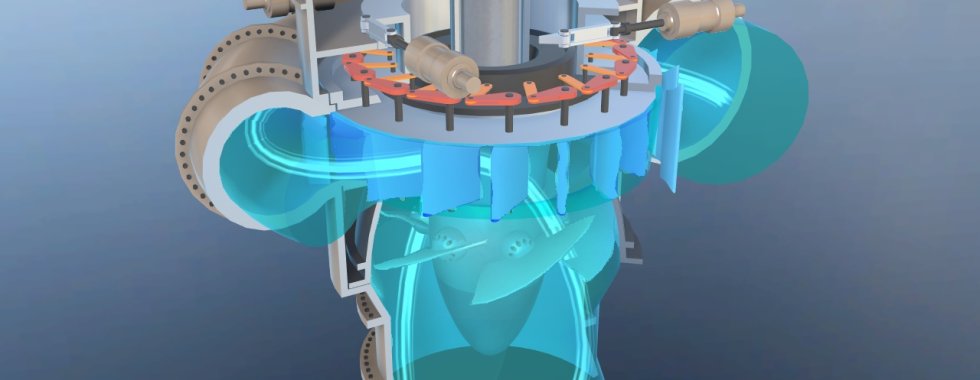
Water is led to the turbine via the penstock and through the guide vanes where it gains speed and alters direction. The runner typically has four to six blades and resembles a ship propeller. To adapt to changing flow rates, the pitch of the runner blades is adjusted by a mechanism located inside the runner hub. As the flow rate changes, the pitch of the runner blades is adjusted to maintain an optimum angle of attack and high efficiency.
To reduce costs, simplified turbines used in smaller power plants may have either fixed runner blades or fixed guide vanes. This, however, reduces their ability to maintain high efficiency under varying operating conditions.
The Kaplan turbines at the Gabčíkovo hydroelectric power plant on the Danube are among the world's largest in terms of flow rate, with each turbine capable of handling up to 636 m3/s at relatively low hydraulic heads.
Kaplan Turbine On-line interactive 3D model
Keep reading
Articles
The Physical Properties of Water
Water is a chemical compound made from one oxygen and two hydrogen atoms. At normal conditions, it is a colourless, clear, and odourless liquid.
3 min read
The Origin of Water Energy
The Sun warms surface water and evaporates it. After condensation, the water falls on the land with exploitable potential energy relative to ocean level.
3 min read
History of Water Energy Utilization
The energy of water was used since ancient times for grinding grain or irrigation. Later it powered mills or hammers, and finally a turbine was invented.
3 min read
Water Energy and Its Uses
The amount of available water energy, kinetic and potential, depends on hydrologic potential, mostly on hydraulic head and flow rate.
3 min read
Dams and Reservoirs
The dams create water reservoirs for hydro power plants, to prevent floods or to collect drinking water. Typical dams are gravity or concrete arch dams.
3 min read
The Highest Dams and Largest Reservoirs
The highest dam is the 305 m high, concrete arch-shaped Jinping-I dam in China. The largest reservoir is Lake Kariba in Zambezi, with a volume of 180 km3.
3 min read
The Segner Wheel
The Segner wheel was an important step on the way to modern turbines. Its principle is today used in rotating irrigation sprinkler systems.
3 min read
Francis Turbine
The Francis turbine has a radial-axial design, variable pitch guide vanes, and fixed runner blades. The largest one has a diameter of 10 m.
3 min read
Pelton Turbine
The Pelton turbine is an isobaric impulse action turbine. The water jet is directed tangentially at the spoon-shaped buckets on the runner.
3 min read
Choosing a turbine (Turbine selection graph)
The turbine selection graph helps to select the best turbine type for the given hydraulic head and rate of flow.
3 min read
Hydroelectric Power Plant Operating Principles
In hydroelectric power plants, the water propels the turbine blades, and the generator transforms the energy of a rotating turbine shaft into electricity.
3 min read
Types of Hydroelectric Power Plants
The hydroelectric power plants can be divided into accumulation ones with a reservoir, run-of-the river without a dam, derivational, and pumped-storage.
3 min read
The Largest Hydroelectric Power Plants in the World
The largest hydroelectric dams in the world are the "Three Gorges Dam" in China, Itaipú Dam and Guri Dam in South America.
4 min read
Tidal Energy and Sea Wave Power
Tidal power plants use ebb-tide energy from turbines in the dam enclosing a tidal basin, while tidal stream generators are turbines anchored to the seabed.
3 min read
Marine Current Power and Ocean Thermal Energy
Energy contained in ocean currents can be exploited by various underwater turbines or by an OTEC system that uses ocean temperature differences.
3 min read
Environmental Impact of Hydropower
The construction of a hydroelectric power plant affects a large area ecosystem and often leads to people's relocation. Then a new balance is established.
3 min read