
The Largest Hydroelectric Power Plants in the World
4 min read · Energy Atlas Editorial
The largest hydroelectric dams in the world are the "Three Gorges Dam" in China, Itaipú Dam and Guri Dam in South America.
At present, the largest hydroelectric power plant in the world is the Three Gorges Dam on the Yangtze River in China. Its installed capacity is 22,500 MW, followed by the Baihetan hydropower plant in China with 16,000 MW and Itaipú on the border between Brazil and Paraguay with 14,000 MW.
Three Gorges Dam, China (map)
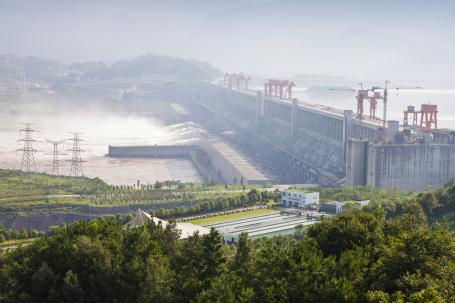
Construction of the Three Gorges Dam on the Yangtze River in China began in 1994. The dam is 181 metres high and 2,335 metres long. With an installed capacity of 22,500 MW, its hydroelectric power plant is the largest in the world. In addition to electricity generation, the project provides flood protection and improves navigation on the Yangtze River.
The project has also had significant environmental and social impacts. About 1.24 million people from more than 100 towns and over 1,000 villages had to be relocated during the creation of the reservoir. Numerous archaeological and cultural sites were also lost. The reservoir has affected the surrounding landscape, contributing to problems such as landslides, erosion and sediment accumulation.
The Three Gorges Reservoir extends for approximately 600 km along the Yangtze River and has a surface area of about 1,084 km2.
Baihetan Hydropower Station, China (map)
The Baihetan hydroelectric power plant is located on the Jinsha River, the upper section of the Yangtze River, on the border between the Chinese provinces of Sichuan and Yunnan. With an installed capacity of 16,000 MW, it is the second largest hydroelectric power plant in the world after the Three Gorges Dam. The plant has 16 generating units, each with a capacity of 1,000 MW — the largest hydropower generating units in the world. All 16 units entered operation in December 2022.
The power plant uses a 289-metre-high double-curvature concrete arch dam. Its reservoir has a total storage capacity of approximately 20.6 billion m3. Baihetan is designed to generate an average of about 62.4 TWh of electricity annually and also contributes to flood control and improved navigation conditions.
Itaipú Dam, Brazil/Paraguay (map)
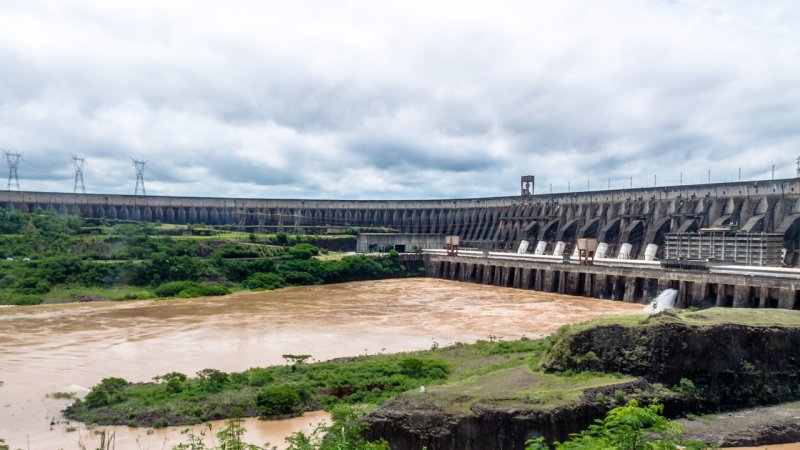
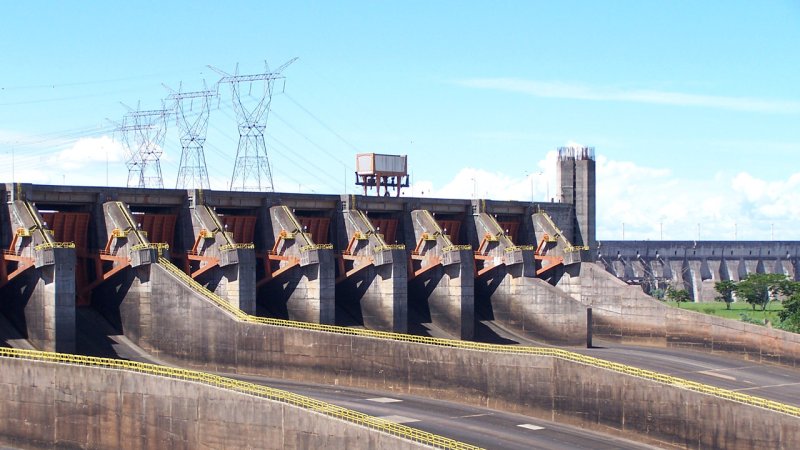
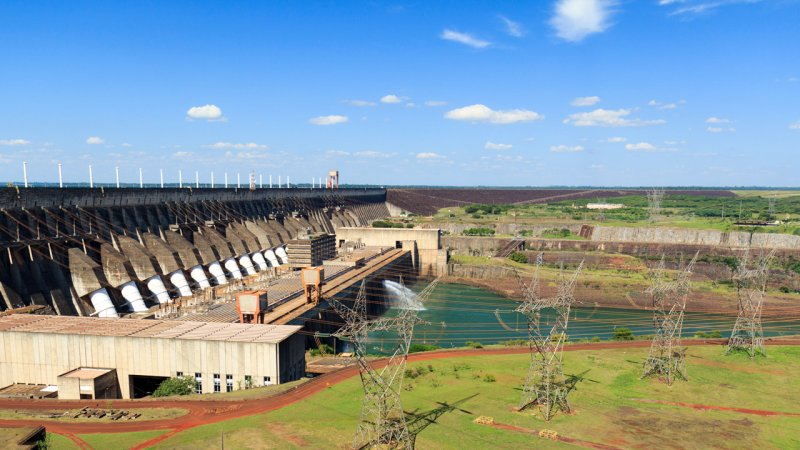
Itaipú is a hydroelectric power plant on the Paraná River on the border between Brazil and Paraguay. Operated by the binational entity Itaipu Binacional, it was the world's largest hydroelectric power plant by installed capacity before the completion of the Three Gorges project and is currently the third largest. The dam is 196 metres high and approximately 8 km long. Its 20 generating units, each rated at 700 MW, provide a total installed capacity of 14,000 MW.
The reservoir covers an area of approximately 1,350 km2. Itaipú supplies around 7% of Brazil's electricity consumption and more than three-quarters of Paraguay's.
The name "Itaipú" is commonly translated as "the sounding stone". The Yamdrok hydroelectric power plant in Tibet uses water from Yamzho Yumco Lake, situated more than 4,400 metres above sea level.
Guri Dam (Simón Bolívar), Venezuela (map)
The highest situated hydroelectric power plant was built in Tibet at the Yamzho Yumco lake, over 4,400 meters above sea level.
The third biggest hydroelectric power plant in the world is the Guri in Venezuela. The construction of this plant started in 1963, the first phase was completed in 1978 and the second in 1986. The dam is 7,426 meters long and 162 meters high. 20 turbo-generators with a total installed capacity of 10,200 MW yearly produce 47,000 GWh of electricity.
Note: 47,000 GWh is the actual value of electric energy produced, 87,000 GWh could be theoretically produced if there was enough water.
Hydroelectric power plant · Installed capacity · Country · Completed · Reservoir surface Three Gorges · 22,500 MW · China · 2012 · 1,084 km2 Baihetan · 16,000 MW · China · 2022 · ≈ 217 km2 Itaipú · 14,000 MW · Brazil/Paraguay · 2007 · 1,350 km2 Xiluodu · 13,860 MW · China · 2014 · ≈ 134 km2 Belo Monte · 11,233 MW · Brazil · 2019 · 478 km2 Guri (Simón Bolívar) · 10,235 MW · Venezuela · 1986 · 4,250 km2 Wudongde · 10,200 MW · China · 2021 · ≈ 127 km2 Tucuruí · 8,370 MW · Brazil · 2007 · 2,430 km2 Grand Coulee · 6,809 MW · USA · 1980 · 324 km2 Longtan · 6,426 MW · China · 2009 · 377 km2 Sayano-Shushenskaya · 6,400 MW · Russia · 1985 · 621 km2 Xiangjiaba · 6,400 MW · China · 2014 · 95.6 km2 Krasnoyarsk · 6,000 MW · Russia · 1972 · 2,000 km2 Nuozhadu · 5,850 MW · China · 2014 · 320 km2 Robert-Bourassa GS * · 5,616 MW · Canada · 1981 · 2,835 km2 Churchill Falls · 5,429 MW · Canada · 1971 · 6,527 km2 * Robert-Bourassa generating station · · · ·
The Highest Hydraulic Head
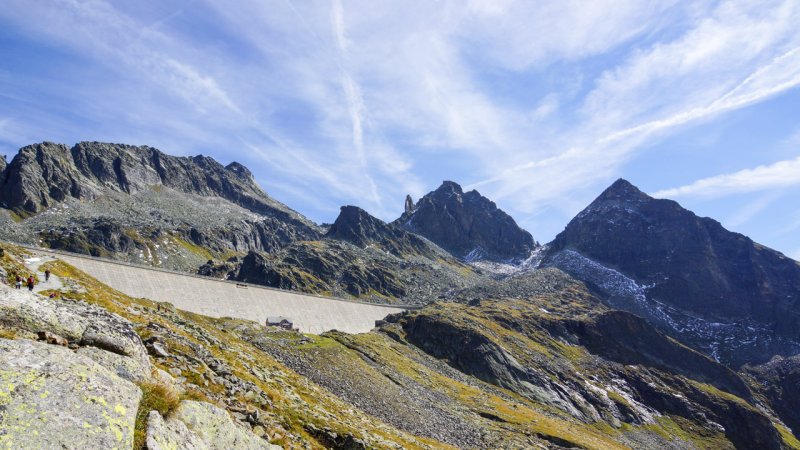
The Bieudron hydroelectric power plant in the canton of Valais, Switzerland, operates with one of the highest hydraulic heads in the world. The plant is supplied with water from the Grande Dixence reservoir, situated at an elevation of 2,364 metres above sea level, through a high-pressure system with a maximum hydraulic head of 1,883 metres.
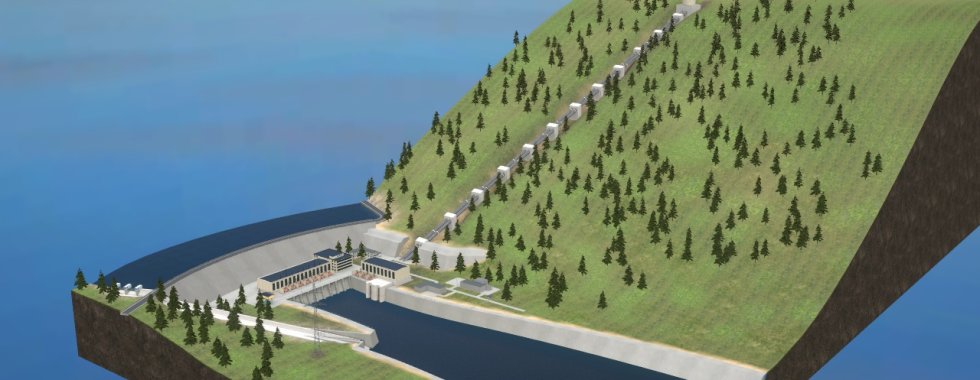
Hydropower Plant On-line interactive 3D model

Keep reading
Articles
The Physical Properties of Water
Water is a chemical compound made from one oxygen and two hydrogen atoms. At normal conditions, it is a colourless, clear, and odourless liquid.
3 min read
The Origin of Water Energy
The Sun warms surface water and evaporates it. After condensation, the water falls on the land with exploitable potential energy relative to ocean level.
3 min read
History of Water Energy Utilization
The energy of water was used since ancient times for grinding grain or irrigation. Later it powered mills or hammers, and finally a turbine was invented.
3 min read
Water Energy and Its Uses
The amount of available water energy, kinetic and potential, depends on hydrologic potential, mostly on hydraulic head and flow rate.
3 min read
Dams and Reservoirs
The dams create water reservoirs for hydro power plants, to prevent floods or to collect drinking water. Typical dams are gravity or concrete arch dams.
3 min read
The Highest Dams and Largest Reservoirs
The highest dam is the 305 m high, concrete arch-shaped Jinping-I dam in China. The largest reservoir is Lake Kariba in Zambezi, with a volume of 180 km3.
3 min read
The Segner Wheel
The Segner wheel was an important step on the way to modern turbines. Its principle is today used in rotating irrigation sprinkler systems.
3 min read
Francis Turbine
The Francis turbine has a radial-axial design, variable pitch guide vanes, and fixed runner blades. The largest one has a diameter of 10 m.
3 min read
Kaplan Turbine
The Kaplan reaction water turbine with adjustable blades, invented in 1918, is used in places with minimal heads and relatively high, variable flow rates.
3 min read
Pelton Turbine
The Pelton turbine is an isobaric impulse action turbine. The water jet is directed tangentially at the spoon-shaped buckets on the runner.
3 min read
Choosing a turbine (Turbine selection graph)
The turbine selection graph helps to select the best turbine type for the given hydraulic head and rate of flow.
3 min read
Hydroelectric Power Plant Operating Principles
In hydroelectric power plants, the water propels the turbine blades, and the generator transforms the energy of a rotating turbine shaft into electricity.
3 min read
Types of Hydroelectric Power Plants
The hydroelectric power plants can be divided into accumulation ones with a reservoir, run-of-the river without a dam, derivational, and pumped-storage.
3 min read
Tidal Energy and Sea Wave Power
Tidal power plants use ebb-tide energy from turbines in the dam enclosing a tidal basin, while tidal stream generators are turbines anchored to the seabed.
3 min read
Marine Current Power and Ocean Thermal Energy
Energy contained in ocean currents can be exploited by various underwater turbines or by an OTEC system that uses ocean temperature differences.
3 min read
Environmental Impact of Hydropower
The construction of a hydroelectric power plant affects a large area ecosystem and often leads to people's relocation. Then a new balance is established.
3 min read