Fuel Enrichment
4 min read · Energy Atlas Editorial
Enrichment is a physical process that raises the concentration of the 235U isotope to 3—5%. Gaseous diffusion, centrifuges, or laser excitation are used.
The majority of nuclear reactors require fuel containing enriched uranium, typically with a concentration of 3—5% of the fissile isotope 235U, compared with about 0.7% in natural uranium. Enrichment is a physical process rather than a chemical one because the two principal uranium isotopes have virtually identical chemical properties and differ only slightly in mass. The capacity of an enrichment facility is expressed in Separative Work Units (SWU), a measure of the effort required to separate uranium into streams with different concentrations of 235U. The amount of separative work required depends on the quantity and enrichment of the product as well as the concentration of 235U remaining in the depleted uranium, known as the tails.
In the past, gaseous diffusion enrichment was used on a large scale in France, the USA and Russia. Today, this technology has been almost entirely replaced by much more energy-efficient gas centrifuges. Centrifuge enrichment is used not only in these countries but also in the United Kingdom, the Netherlands, Germany, Japan and several other countries around the world.
About 13,300 tonnes of silver from US Treasury reserves were borrowed by the Manhattan Project and used instead of copper in the electromagnetic coils of the calutrons.
Calutron
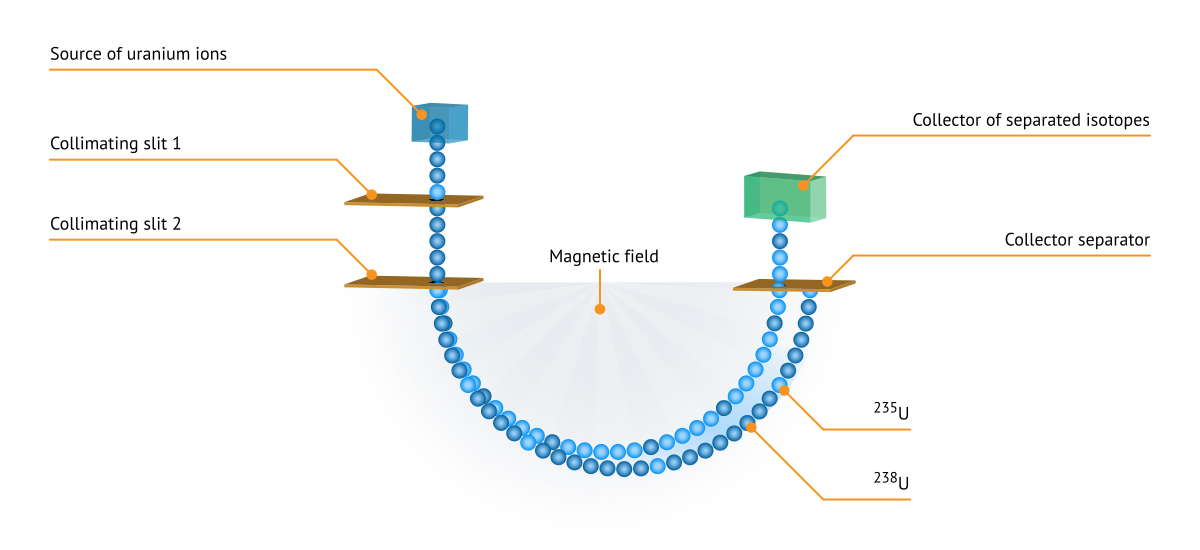
One of the first large-scale uranium enrichment methods was the calutron, developed by Ernest O. Lawrence (1901—1958). It is based on the principle of the mass spectrometer. Inside a calutron, ions of the material being separated move through a magnetic field that deflects their trajectories. The radius of their paths depends on the ions' charge and mass. In the case of uranium, the trajectories of the two isotopes differ slightly, causing the ions to strike different locations. Collectors positioned at the appropriate locations can therefore separate the 235U and 238U ions.
Gaseous Diffusion
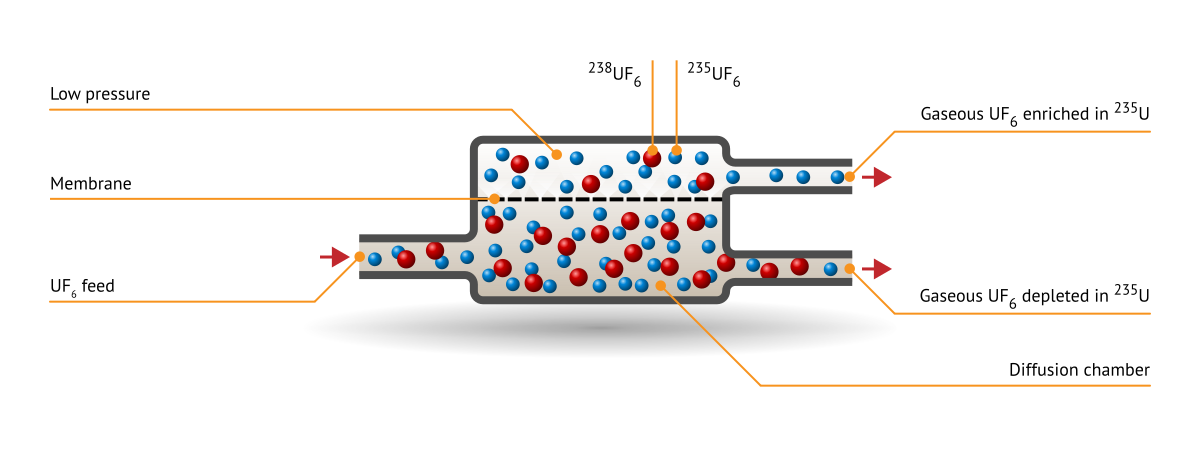
Gaseous uranium hexafluoride (UF6) is forced through a porous membrane. Molecules containing 235U are slightly lighter and pass through the membrane marginally faster than molecules containing 238U. Because the separation achieved in a single stage is extremely small, the process requires a cascade of many stages to reach the desired enrichment. Gaseous diffusion was once widely used for commercial uranium enrichment but has now been replaced by much more energy-efficient gas centrifuges.
During the Manhattan Project, several uranium enrichment technologies were developed simultaneously because it was initially uncertain which method would prove most successful.
Centrifuges
Video: Model of a cylindrical centrifuge used for uranium enrichment.
Gas centrifuges became an important enrichment technology during the second half of the 20th century and today dominate commercial uranium enrichment. A centrifuge consists of a tall, narrow rotor spinning at very high speed. Typical European centrifuge rotors are about 3—5 metres high and 20 cm in diameter and rotate at speeds of 50,000—70,000 revolutions per minute. Gaseous uranium hexafluoride is fed into the centrifuge, where molecules containing the heavier 238U isotope become slightly more concentrated towards the outer wall, while molecules containing the lighter 235U isotope become relatively more concentrated nearer the centre.
The slightly enriched and depleted gas streams are continuously withdrawn from the centrifuge. Because each centrifuge produces only a small increase in enrichment, large numbers of centrifuges are connected in cascades, with stages arranged in series and parallel. Typically, around 10—20 stages may be sufficient to reach the required enrichment, compared with a thousand or more stages in the gaseous diffusion process.
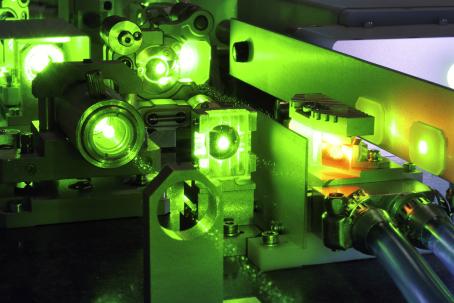
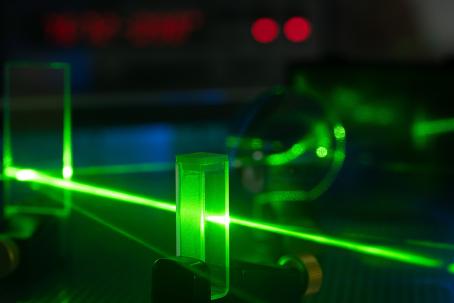
One method of laser isotope separation is based on the selective ionisation of 235U atoms using a precisely tuned laser.
Laser Excitation
Laser isotope separation has been investigated since the 1970s as a potentially more efficient method of uranium enrichment. Several different processes have been developed, using precisely tuned lasers to selectively affect molecules or atoms containing a particular uranium isotope. One technology still under development is SILEX (Separation of Isotopes by Laser Excitation), which uses uranium hexafluoride (UF6) as its feed material.
SILEX has not yet been deployed commercially for uranium enrichment. Global Laser Enrichment is currently developing the technology in the United States and operates a test facility. In 2025, the company submitted an application to the US Nuclear Regulatory Commission to construct and operate a commercial laser enrichment facility in Paducah, Kentucky.
4 pictures 4 pictures
Laser isotope separation is not limited to uranium. Similar techniques can be used to separate isotopes of other elements for applications in medicine, industry and scientific research.
Keep reading
Articles
Fuel Production
Uranium ore is turned into U3O8 (yellowcake) or UF6 (hex), enriched up to 3—5% of 235U, and as a UO2 compressed into pellets inserted into zircalloy tubes.
3 min read
Fuel Assembly
There are different types of nuclear fuel. A typical fuel assembly for PWR consists of fuel rods, long cylinders of zircaloy filled with UO2 pellets.
4 min read
Fuel Cycle
In a closed fuel cycle, spent nuclear fuel (used fuel removed from a reactor) is reprocessed. In an open cycle, it is stored in interim storage.
4 min read
Interim Storage
Spent fuel is first stored in water pools near the reactor to be cooled. Then it is moved to dry interim storage, located usually on-site.
3 min read
Transportation
Fresh fuel, yellowcake or uranium ore are transported normally, while highly radioactive materials like spent fuel are transported in special flasks.
3 min read
Reprocessing
Spent fuel can be reprocessed. Extracted uranium and plutonium can be used for MOX or uranium fuel production. The remaining waste is vitrified.
4 min read
Final Repositories
The highly radioactive vitrified waste in special leak-tight flasks will be stored for thousands of years in a deep underground final repository.
3 min read