Solar Farms
3 min read · Energy Atlas Editorial
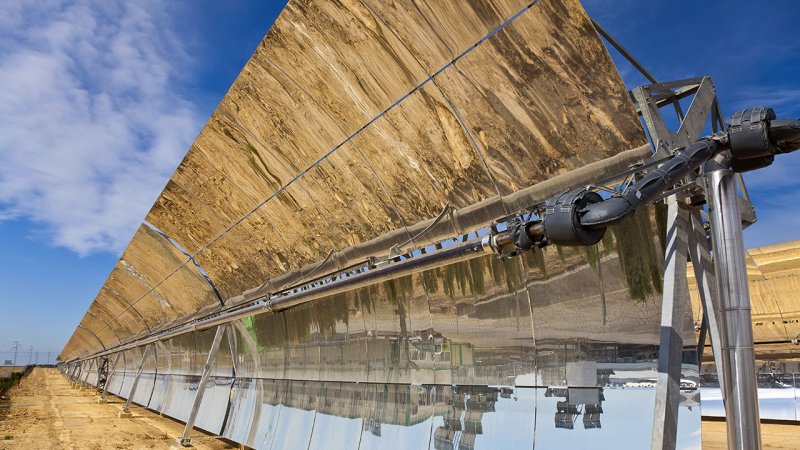
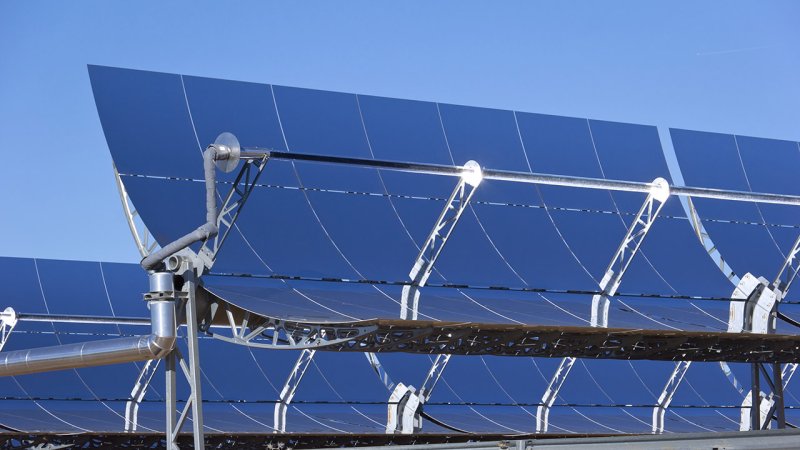
A parabolic trough collector is a parabolic mirror concentrating sun rays onto a tube with heat-transfer medium. Collectors are connected to large farms.
Parabolic trough collectors
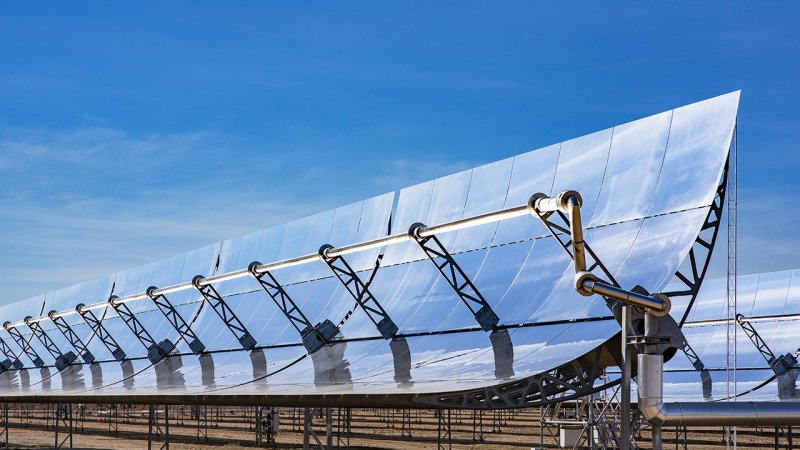
Parabolic trough collectors belong to the category of solar concentrators. They concentrate direct solar radiation from a large area onto a focal line along which the absorber tube runs. In conventional systems, the heat-transfer medium can reach temperatures of around 400 °C, making these collectors suitable for electricity generation in large solar thermal power plants. They can also supply heat for industrial processes.
In terms of design, a parabolic trough collector is essentially a long parabolic mirror with an absorber tube running along its focal line. Sunlight reflected from the mirror is concentrated onto the absorber, where it heats the heat-transfer fluid, traditionally a synthetic oil. To minimise heat loss, the metal absorber tube is typically enclosed within an evacuated glass envelope. The efficiency of parabolic trough collectors depends on the optical quality of the mirrors, the operating temperature and the thermal losses from the receiver.
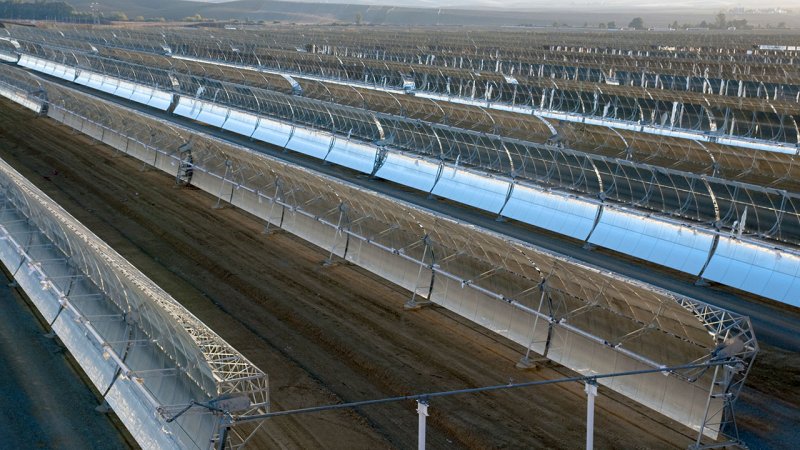
Parabolic trough collectors are interconnected to form rows, which are the basic units of a solar field. The rows are most commonly aligned along a north-south axis, with the collectors rotating about their longitudinal axis to track the Sun from east to west. Alternatively, the rows can be aligned along an east-west axis and operated at a nearly fixed inclination. Such systems have a lower annual energy yield but do not require continuous daily tracking; only occasional adjustments are needed to account for seasonal changes in the Sun's position.
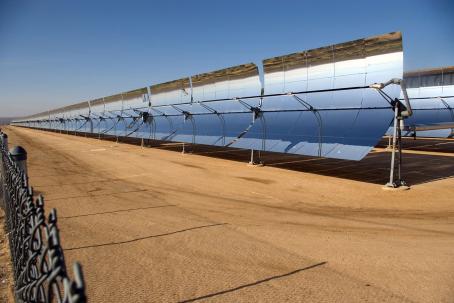
The Solar Energy Generating Systems (SEGS) in California's Mojave Desert were a pioneering complex of nine parabolic trough solar thermal power plants with a combined capacity of 354 MW. Built between 1984 and 1990 at Daggett, Kramer Junction and Harper Lake, they demonstrated the commercial viability of parabolic trough technology. Some SEGS plants could also use natural gas to supplement solar heat when solar radiation was insufficient. All nine plants have since been decommissioned.
Parabolic trough solar thermal power plants have since been built in many countries with favourable solar conditions, including Spain, Egypt, Algeria, Morocco and the United Arab Emirates. One important European project is Andasol 1 in Andalusia, Spain (map), a 50 MW parabolic trough power plant equipped with thermal energy storage.
The overall solar-to-electric efficiency of parabolic trough solar thermal power plants is typically around 15—20%.
Linear Fresnel Reflectors
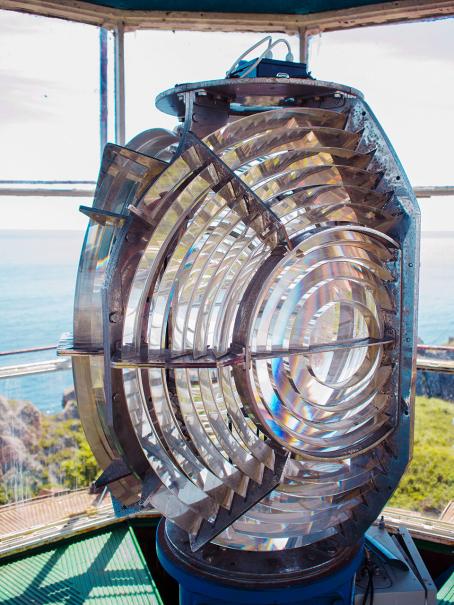
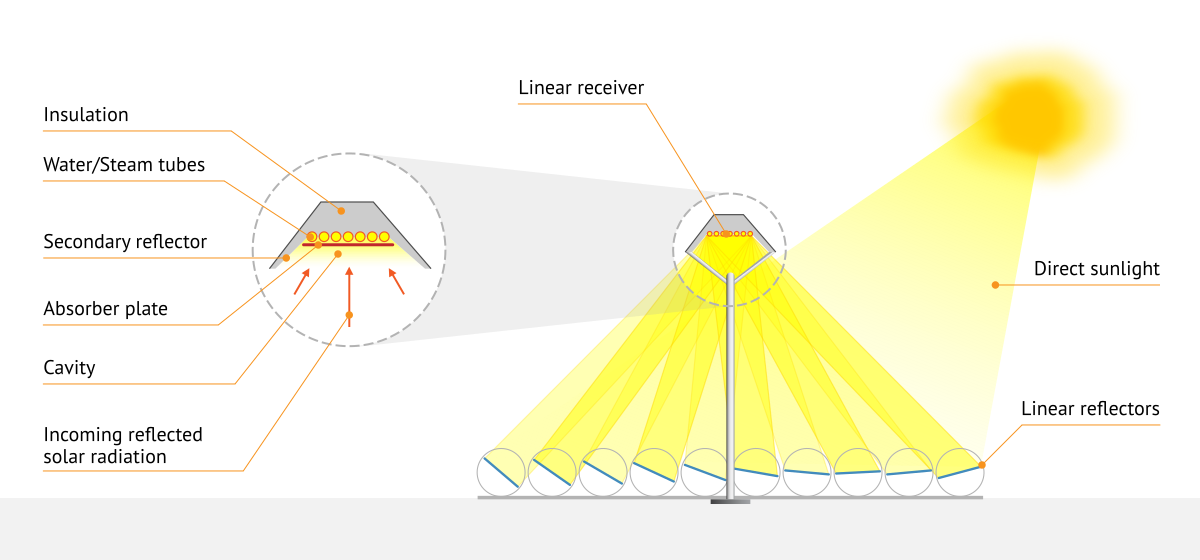
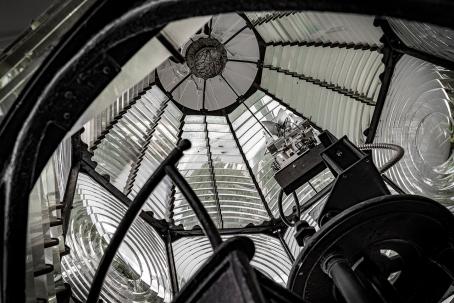
A parabolic reflector can be replaced by several rows of linear reflectors that exploit the Fresnel lens principle. Each row of mirrors has a slightly different inclination so that all of them cast the reflected sunlight on the bottom part of the absorber. The irradiation of the absorber is about 30 times higher than natural. The heat transfer medium is usually water which is heated to 300 °C. The resulting steam directly powers a turbine.
The manufacturing costs of flat mirrors are significantly lower than the cost of parabolic mirrors. Since they are close to the ground, there is little risk of wind damage and the output is about the same as with parabolic mirrors. A Fresnel solar power plant requires lower investment than a comparable parabolic trough thermal solar power plant. Reflector rows follow a north-south axis and track the Sun. Compact linear Fresnel reflectors use two absorbers for one batch of mirrors. Each absorber runs along one side of a reflector row. Thus, sunlight is used more effectively and the plant requires less space than a single, central absorber line Fresnel solar power plant.
History
The linear Fresnel reflector was designed by Giorgio Francia in 1961 in Italy but the technology stayed undeveloped for a long time. The first Fresnel solar power plant was the Puerto Errado 1 Thermosolar Power Plant in Spain (map). It was commissioned in 2009, with an installed capacity of 1.4 MW. Another plant, the Kimberlina (map) was built in California and has an installed capacity of 5 MW. Further power plants with installed capacities over 100 MW are being planned.
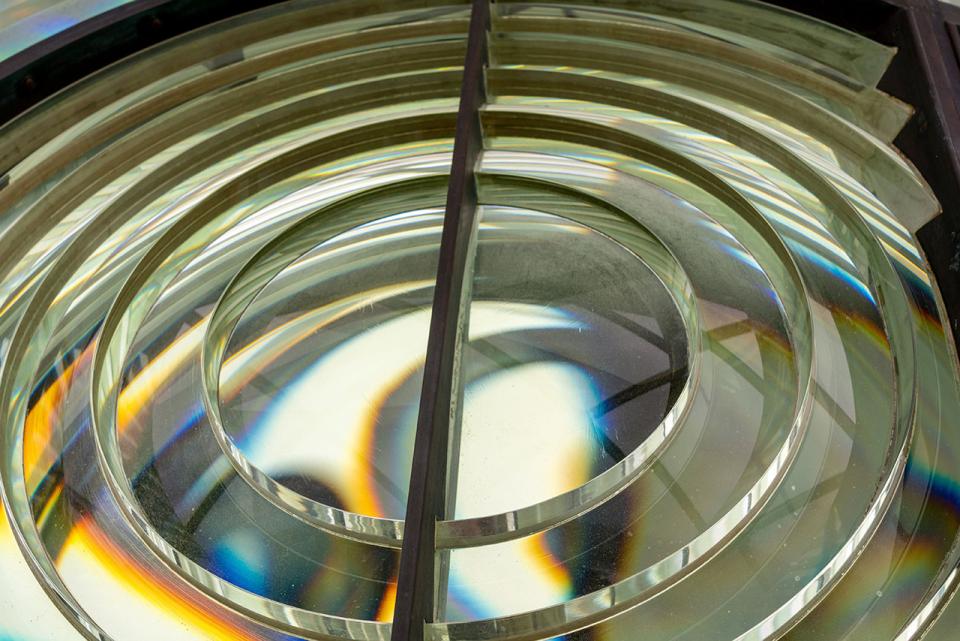
Fresnel lenses will probably be used in the field of concentrated photovoltaics where they will concentrate sunlight onto a new generation of powerful solar cells.
Keep reading
Articles
Solar Rays Energy
Solar energy comes from the Sun, where fusion reactions take place. Solar radiation falls on Earth. Part is reflected into space, the rest is absorbed.
5 min read
Ways to Use Solar Heat
Solar rays can heat greenhouses or water in thermal collectors. The energy from the parabolic trough collector can drive machinery or produce electricity.
8 min read
Solar Collectors
Solar thermal collectors can use air or water (flat-plate collectors) as a heat transfer medium. Vacuum insulation is used in evacuated tube collectors.
5 min read
Solar Concentrators
A parabolic dish collector concentrates sun rays into one focal point. A temperature of up to 700°C could be reached and used by the Stirling engine.
3 min read
Central Tower Solar Power Plants
In the central tower solar power plant, flat mirrors, heliostats, concentrate sun rays on the top of the tower where heat-transfer medium is heated.
3 min read
The Largest Solar Power Plants
The largest thermal solar power plant is the parabolic trough collector type farm SEGS in the Mohave Desert, USA, with 354 MW of installed capacity.
3 min read
The Energy Use of the Photovoltaic Effect
When a photon with an energy of up to 1.12 eV hits a semiconductor, an electron is released. This photovoltaic effect is used in solar panels.
5 min read
Photovoltaic Farms
Photovoltaic farms produce electricity from sunlight in many solar panels. The largest photovoltaic farm is Montalto di Castro, Italy (84.2 MW output).
3 min read
Solar Energy and the Environment
The solar farm produces electricity without noise or pollutants. The negative impact is the high energetic and financial costs of solar cell production.
3 min read
Solar Energy and Solar Power Systems Summary
The energy coming from the Sun is vital for life on Earth and can be used in various ways for electricity and heat production.
20 min read