The Largest Solar Power Plants
3 min read · Energy Atlas Editorial
The largest thermal solar power plant is the parabolic trough collector type farm SEGS in the Mohave Desert, USA, with 354 MW of installed capacity.
Electric Energy Production
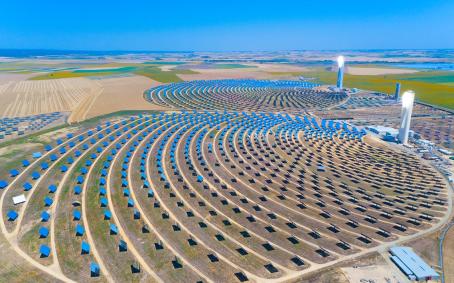
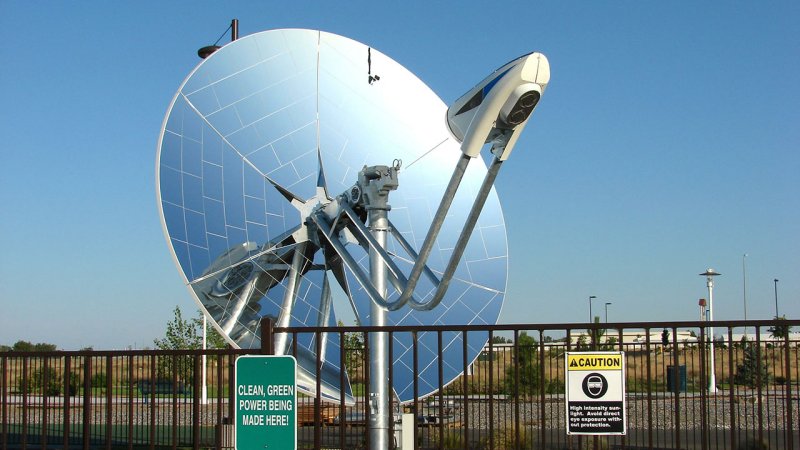
In most concentrating solar power plants, concentrated solar radiation is used to produce thermal energy at temperatures of several hundred degrees Celsius. This energy is then used to generate steam, which drives a turbine in a conventional Rankine cycle. In some systems, a heat-transfer fluid transfers the collected heat to water in a heat exchanger, while others generate steam directly in the solar receiver. This system requires cooling, which can be difficult to provide in desert regions. Wet-cooled parabolic trough power plants typically consume around 3,000 litres of water per MWh of electricity generated. Dry cooling can greatly reduce this consumption, although at the cost of somewhat lower efficiency. Parabolic dish systems are generally air-cooled.
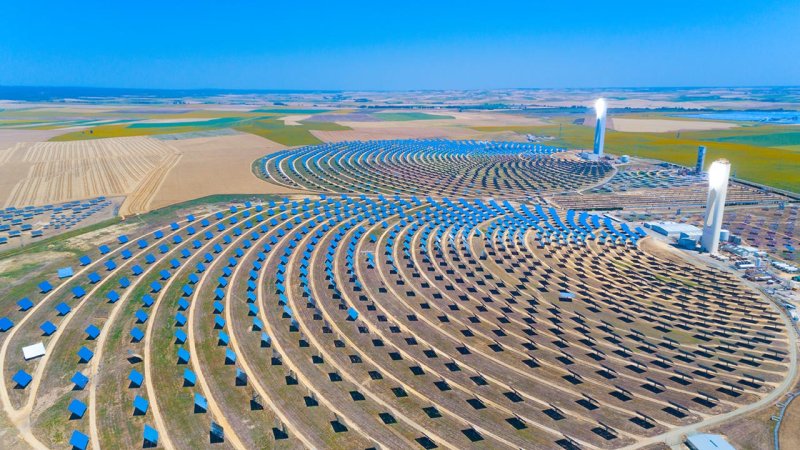
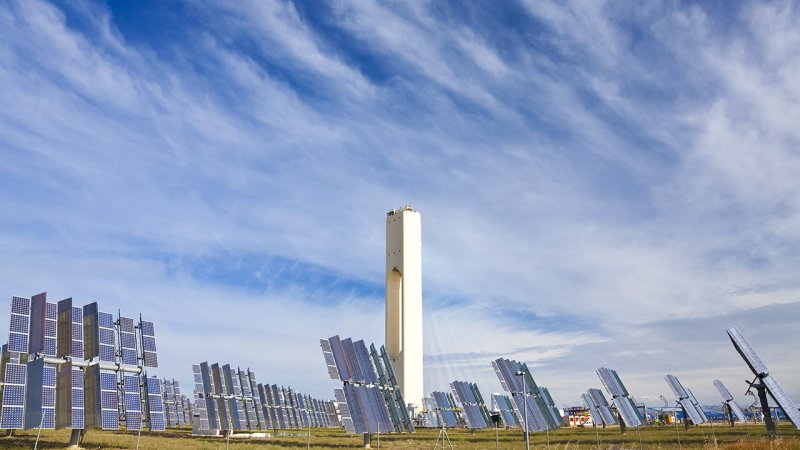
Some concentrating solar power plants are equipped with thermal energy storage, allowing surplus heat collected during periods of high solar irradiation to be stored for later use. The storage medium can be solid material, thermal oil or, most commonly, molten salts. The stored heat can be used to generate electricity after sunset or during periods of reduced solar radiation, making the power output less dependent on instantaneous sunlight than that of photovoltaic systems. A central tower solar power plant without thermal energy storage may have an annual capacity factor of around 25%, while plants with large thermal storage systems can achieve around 65% or more.
Some concentrating solar power plants are designed as hybrid systems in which natural gas or biomass can provide additional heat when insufficient solar energy is available. Other plants rely solely on solar energy combined with thermal energy storage.
Depending on grid requirements, CSP plants with thermal energy storage can be operated in several ways:
- A power plant has little or no thermal energy storage and generates electricity mainly when the Sun is shining.
- A power plant has a large thermal energy storage system and a medium-output turbine. Part of the collected heat is stored during the day, allowing electricity generation to continue for several hours after sunset and to be shifted towards periods of higher demand.
- A power plant has a large thermal energy storage system and a relatively low-output turbine, allowing it to generate electricity continuously for extended periods.
- A power plant has a large thermal energy storage system and a high-output turbine, allowing stored energy to be used to generate high power during periods of peak demand.
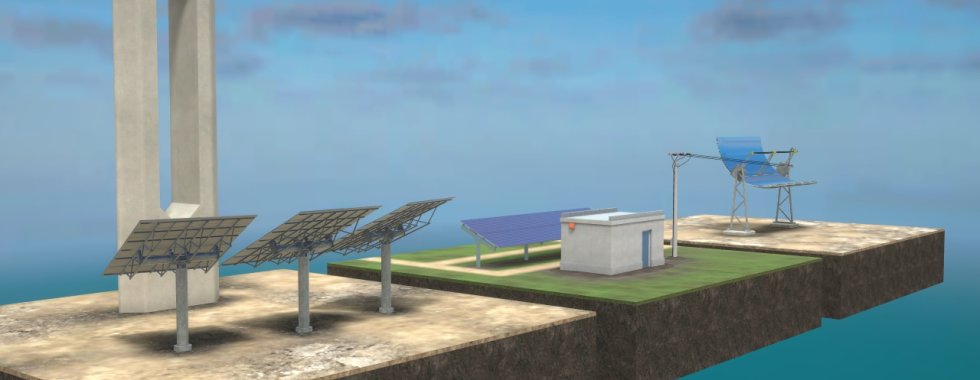
Solar Power Plants On-line interactive 3D model
The Largest Concentrating Solar Power Plants in the World
The table lists some of the world's largest operating concentrating solar power plants and complexes by installed CSP capacity. Photovoltaic capacity in hybrid solar projects is not included.
Power plant / complex · CSP capacity · Location · Technology · Commissioned Noor Energy 1 (MBR Solar Park Phase IV) · 700 MW · Dubai, United Arab Emirates · 600 MW parabolic trough + 100 MW central tower · 2023—2024 Noor Ouarzazate Solar Complex · 510 MW · Ouarzazate, Morocco · 360 MW parabolic trough + 150 MW central tower · 2016—2018 Ivanpah Solar Electric Generating Systém * · 386 MW · California, USA · Central tower · 2013 Mojave Solar Project · 250 MW net · California, USA · Parabolic trough · 2014 Solana Generating Station · 250 MW · Arizona, USA · Parabolic trough · 2013 Genesis Solar Energy Project · 250 MW · California, USA · Parabolic trough · 2014 Solaben Solar Power Station · 200 MW · Extremadura, Spain · Parabolic trough · 2012—2013 Andasol Solar Power Station · 150 MW · Andalusia, Spain · Parabolic trough · 2008—2011 Extresol Solar Power Station · 150 MW · Extremadura, Spain · Parabolic trough · 2009—2012 Solnova Solar Power Station · 150 MW · Andalusia, Spain · Parabolic trough · 2010
* Scheduled for closure in 2026

Keep reading
Articles
Solar Rays Energy
Solar energy comes from the Sun, where fusion reactions take place. Solar radiation falls on Earth. Part is reflected into space, the rest is absorbed.
5 min read
Ways to Use Solar Heat
Solar rays can heat greenhouses or water in thermal collectors. The energy from the parabolic trough collector can drive machinery or produce electricity.
8 min read
Solar Collectors
Solar thermal collectors can use air or water (flat-plate collectors) as a heat transfer medium. Vacuum insulation is used in evacuated tube collectors.
5 min read
Solar Concentrators
A parabolic dish collector concentrates sun rays into one focal point. A temperature of up to 700°C could be reached and used by the Stirling engine.
3 min read
Central Tower Solar Power Plants
In the central tower solar power plant, flat mirrors, heliostats, concentrate sun rays on the top of the tower where heat-transfer medium is heated.
3 min read
Solar Farms
A parabolic trough collector is a parabolic mirror concentrating sun rays onto a tube with heat-transfer medium. Collectors are connected to large farms.
3 min read
The Energy Use of the Photovoltaic Effect
When a photon with an energy of up to 1.12 eV hits a semiconductor, an electron is released. This photovoltaic effect is used in solar panels.
5 min read
Photovoltaic Farms
Photovoltaic farms produce electricity from sunlight in many solar panels. The largest photovoltaic farm is Montalto di Castro, Italy (84.2 MW output).
3 min read
Solar Energy and the Environment
The solar farm produces electricity without noise or pollutants. The negative impact is the high energetic and financial costs of solar cell production.
3 min read
Solar Energy and Solar Power Systems Summary
The energy coming from the Sun is vital for life on Earth and can be used in various ways for electricity and heat production.
20 min read