Solar Concentrators
3 min read · Energy Atlas Editorial
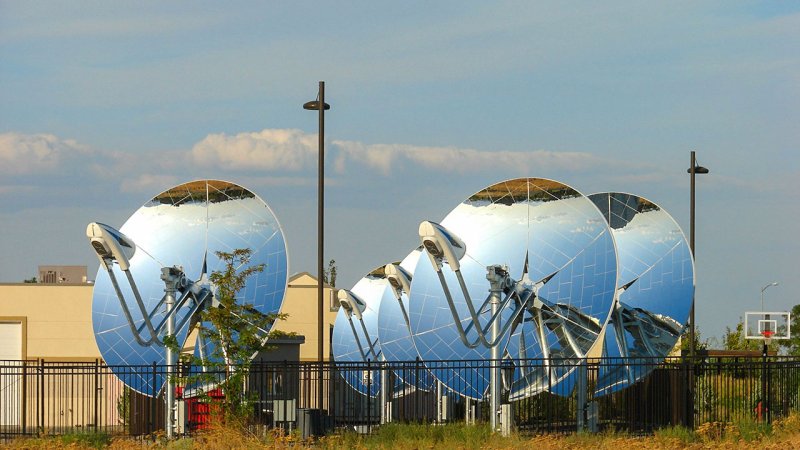
A parabolic dish collector concentrates sun rays into one focal point. A temperature of up to 700°C could be reached and used by the Stirling engine.
Parabolic Dish Collectors
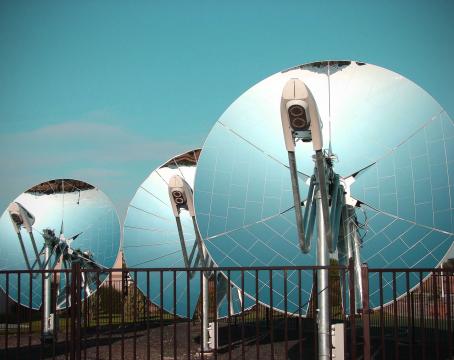
The parabolic dish collector (or concentrator) is a solar system that concentrates direct solar radiation falling on its reflective surface onto a single focal point. The high concentration of solar radiation allows temperatures of around 700 °C to be reached at the receiver. Dish/engine systems have achieved some of the highest solar-to-electric conversion efficiencies among concentrating solar power technologies, with record efficiencies exceeding 30%.
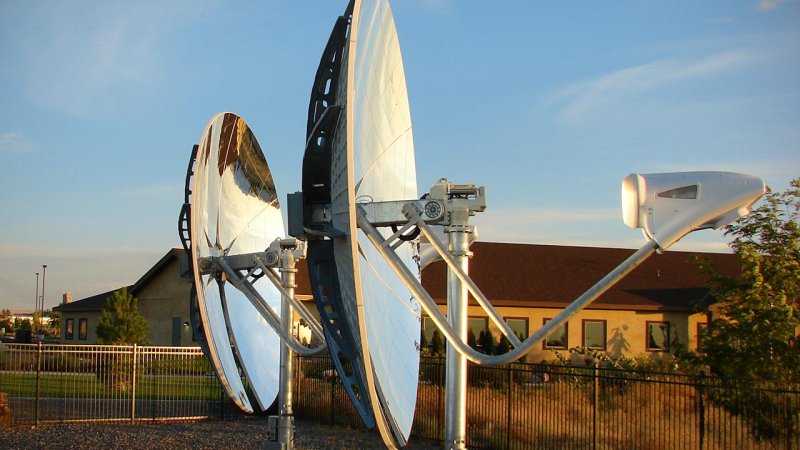
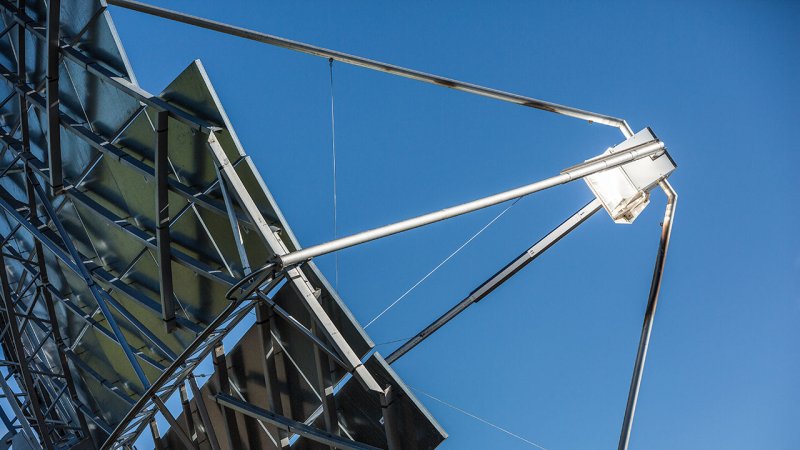
Manufacturing large parabolic mirrors several metres in diameter is technically demanding. Larger and more powerful units are therefore usually assembled from smaller mirror facets which together form a parabolic reflecting surface. The disadvantage of this system is the need for two-axis tracking. The supporting structure must carry not only the weight of the dish but also the receiver located at its focal point.
The receiver absorbs the concentrated solar radiation and transfers the resulting heat to an engine, most commonly a Stirling engine. A fixed amount of working gas, usually hydrogen or helium, is enclosed in the engine and is alternately heated and cooled. The resulting pressure changes drive the pistons, producing mechanical work that is converted into electricity by a generator.
The size and mechanical complexity of parabolic dish collectors limit the practical output of individual units. Dish/engine systems typically produce several to about 25 kW of electricity. Larger installations can consist of dozens or hundreds of individual units. Because each dish requires a tracking mechanism and other moving components, such installations have relatively high maintenance requirements.
The reflecting surface is usually made of a thin layer of highly reflective metal, such as silver or aluminium, protected by a transparent layer of glass or plastic. The solar reflectance of silver-glass mirrors can exceed 90%.
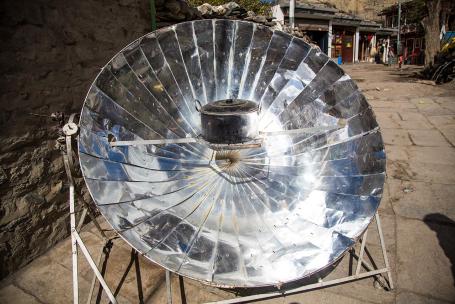
Dish/Stirling systems have achieved solar-to-electric conversion efficiencies of around 30%. Temperatures exceeding 1,000 °C can be reached at the focal point of parabolic dish collectors. At a direct normal irradiance of 1,000 W/m2, a parabolic dish collector 10 metres in diameter can power a 25 kW engine.

Keep reading
Articles
Solar Rays Energy
Solar energy comes from the Sun, where fusion reactions take place. Solar radiation falls on Earth. Part is reflected into space, the rest is absorbed.
5 min read
Ways to Use Solar Heat
Solar rays can heat greenhouses or water in thermal collectors. The energy from the parabolic trough collector can drive machinery or produce electricity.
8 min read
Solar Collectors
Solar thermal collectors can use air or water (flat-plate collectors) as a heat transfer medium. Vacuum insulation is used in evacuated tube collectors.
5 min read
Central Tower Solar Power Plants
In the central tower solar power plant, flat mirrors, heliostats, concentrate sun rays on the top of the tower where heat-transfer medium is heated.
3 min read
Solar Farms
A parabolic trough collector is a parabolic mirror concentrating sun rays onto a tube with heat-transfer medium. Collectors are connected to large farms.
3 min read
The Largest Solar Power Plants
The largest thermal solar power plant is the parabolic trough collector type farm SEGS in the Mohave Desert, USA, with 354 MW of installed capacity.
3 min read
The Energy Use of the Photovoltaic Effect
When a photon with an energy of up to 1.12 eV hits a semiconductor, an electron is released. This photovoltaic effect is used in solar panels.
5 min read
Photovoltaic Farms
Photovoltaic farms produce electricity from sunlight in many solar panels. The largest photovoltaic farm is Montalto di Castro, Italy (84.2 MW output).
3 min read
Solar Energy and the Environment
The solar farm produces electricity without noise or pollutants. The negative impact is the high energetic and financial costs of solar cell production.
3 min read
Solar Energy and Solar Power Systems Summary
The energy coming from the Sun is vital for life on Earth and can be used in various ways for electricity and heat production.
20 min read