
The Energy of Flowing Air
3 min read · Energy Atlas Editorial
The movement of air masses between two differently warm places is called a wind. Most wind turbines reach their maximum output at a wind speed of 15 m/s.
The Origin of Wind Energy

The origin of wind energy can be found in the uneven heating of the Earth's surface by solar radiation. Lower layers of air are heated by the surface and rise due to their lower density, allowing colder air masses to move in. Differences in atmospheric pressure develop, causing air to move from areas of higher pressure towards areas of lower pressure and creating wind.
Parameters Influencing the Wind Energy Utilisation
From an energy point of view, wind turbines provide an opportunity to capture the kinetic energy of flowing air. The most important factor for harnessing wind energy is wind speed. The kinetic energy of a moving air mass is proportional to the square of its speed, while the power available in the wind is directly proportional to air density, the area through which the air flows and the cube of wind speed. From this we can deduce that when wind speed doubles, the power available in the wind increases by a factor of eight. Wind turbines, however, reach their rated output at a certain wind speed, above which their power is controlled and no longer increases with the cube of wind speed. Suitable locations therefore require favourable and sufficiently consistent wind conditions.
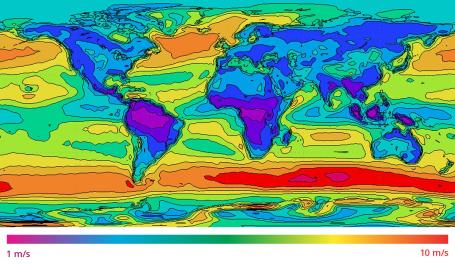
A wind turbine can extract only part of the kinetic energy of the air flowing through its rotor. According to the Betz limit, the theoretical maximum fraction of wind power that an ideal turbine can extract is 59.3%. At this optimum condition, the wind speed far downstream of the turbine is reduced to one third of its original value. Real wind turbines achieve lower power coefficients due to aerodynamic and mechanical losses and other design limitations.
Another important parameter of wind turbine performance is the capacity factor, which is the ratio of the actual energy generated over a given period to the energy that would have been generated if the turbine had operated continuously at its rated power. The capacity factor depends strongly on wind conditions, turbine design and location.
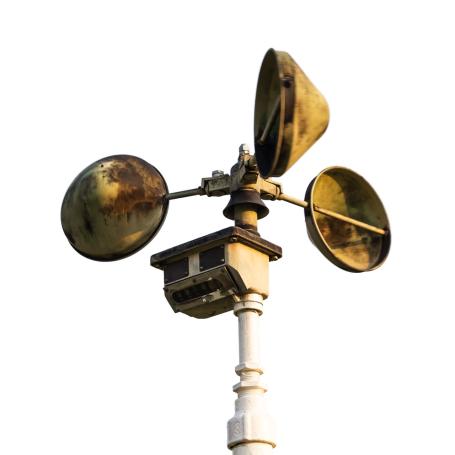
The power output of a wind engine can be determined using the following formula:
Pm = 0.125 × Cp × ρ × v3 × π × D2
where:
Pm · useful power (W) Cp · power coefficient (efficiency) ρ · air density (kg/m3) v · wind speed (m/s) D · rotor diameter (m)


Keep reading
Articles
The Beaufort Wind Force Scale
The Beaufort Wind Force Scale, originally from 0 to 12, helps to estimate the force of the wind by observation of its effects.
3 min read
The History of Wind Power Utilization
The ancient wind mills powered irrigation pumps or ground grain. Since 1887, wind power has been used for electricity production in wind turbines.
3 min read
Wind Power Plants
The wind power plants are on the drag principle (historic windmills) or the lift principle (modern turbines). A horizontal or vertical axis is used.
3 min read
Wind Turbine and its Working Principle
The wind turbine transforms the kinetic energy of the flowing air into rotational movements of the rotor blades, which turns the generator.
3 min read
The Largest Wind Farms
The largest onshore wind farm is Roscoe, Texas, USA, with 627 turbines, while the largest offshore wind farm is Thanet, UK, with 100 turbines.
3 min read
Types of Wind Turbines
The wind turbines can have a vertical axis, which is the majority of installations, or a horizontal axis like the Darrieus or Savonius turbines.
5 min read
Wind Turbines and the Environment
A wind power plants produce no emissions or waste, could be a source of noise or strobe effect, are a distinctive landmark, and require large areas.
3 min read