Nuclear Energy
Pressurized Water Reactor Plant
The world's most common power-reactor type: water under high pressure cools the core and transfers heat to a secondary steam cycle.
Related source: Nuclear fission · Compare sources
Labelled system
Explore in 3D
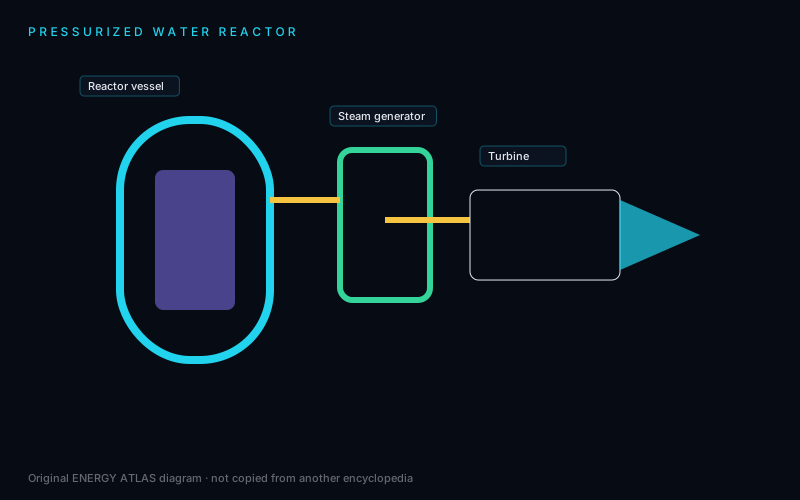
Original ENERGY ATLAS schematic. Interactive 3D is opt-in on this page.
Steel vessel holding the core.
Overview
In a PWR, the primary coolant is kept below boiling by high pressure. Heat moves through steam generators into a separate secondary loop that drives the turbine. This two-circuit arrangement keeps turbine steam isolated from the reactor coolant.
How it works
Enriched uranium dioxide pellets sit in zirconium-alloy cladding, bundled into assemblies. Water is both moderator and coolant. Control rods and dissolved boron help regulate reactivity. Containment surrounds the nuclear island.
Components
Reactor pressure vessel
Steel vessel holding the core.
Steam generators
Transfer heat to the secondary circuit.
Pressurizer
Controls primary pressure.
Containment
Final major barrier against releases.
Keep exploring
Articles
Pressurized Water Reactor (PWR)
The pressurized water reactor (PWR) uses light water at a pressure of 15.7 MPa as a coolant. Steam in the secondary circuit propels the turbine.
3 min read
Principle of Operation
The binding energy that holds nucleons together is different for each isotope. When fusing light nuclei or splitting heavy nuclei, energy is released.
3 min read
Fuel Assembly
There are different types of nuclear fuel. A typical fuel assembly for PWR consists of fuel rods, long cylinders of zircaloy filled with UO2 pellets.
4 min read