Material for Magnetic Coils
5 min read · Energy Atlas Editorial
The word "tokamak" is of Russian origin and means "toroidal chamber and magnetic coils." This magnetic confinement system holds plasma in magnetic fields of toroidal shape. The first tokamak, the T-1, started operation in 1958 in Russia, and since then the greatest advances in th
Copper
The typical material for coil winding is copper, but it can overheat easily when a long-lasting and strong magnetic field is required.
Superconductors
For this reason, superconducting coils have started to be used since the 80s. The quantum effect of superconductivity causes electrical resistance to vanish, and magnetic flux fields are expelled from the material. Therefore, superconductive magnets carry higher current and produce stronger magnetic fields, consume less power, and therefore are cheaper to operate than their conventional counterparts. To achieve superconductivity, the material has to be cooled below a critical temperature of around 4 kelvin (−269 °C).
Niobium-Titanium
Niobium-titanium (NbTi) is a superconductor that is easy to work with but loses its superconductivity in magnetic fields exceeding 10 Tesla.
Niobium-Tin
For higher magnetic fields, niobium-tin (Nb3Sn) is more suitable as it keeps superconductivity up to 30 Tesla, but it is a very brittle material. The coil has to be made from separate tin and niobium wires. The heat is then applied to cause the tin to diffuse into the niobium.
ReBCO
Another possibility is high temperature superconductors called ReBCO (Rare-earth Barium Copper Oxide) that can maintain superconductivity in high magnetic fields and at temperatures of about 77 kelvin. Since 2010, it has been possible to manufacture ReBCO superconductors in bendable tapes. This material was tested for poloidal coils of the "school" tokamak Golem and then used for both toroidal and poloidal winding of the small spherical tokamak ST25.
5 pictures 3Sn wire from the ITER fusion reactor. (Source: Charlie Sanabria, Wikipedia.org)" class="d-flex">3Sn wire from the ITER fusion reactor. (Source: Charlie Sanabria, Wikipedia.org)" class="" width="800" height="450" > 5 pictures
Central Solenoid
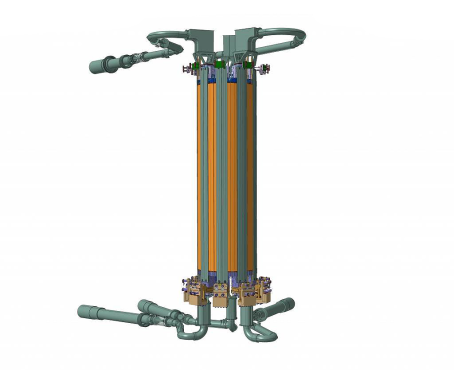
A transformer is a device that is capable of either increasing or decreasing the voltage and current levels of its supply. It consists of two coils, called primary winding and secondary winding, wrapped around a common core. Pulse of current in the primary winding induce current in the secondary winding. This principle is used in tokamaks where the secondary winding is plasma itself and the current in it is induced by the pulse in the primary winding. Mostly, the primary winding is located in the centre of tokamak torus, in the "donut hole", and consists of coils wrapped around a ferromagnetic or air core; the structure is called the central solenoid. It is composed of several coils (modules) stacked together. As the central solenoid produces a strong magnetic field, it is subject to large electromagnetic forces that try to tear the solenoid apart. Coils of solenoid are therefore usually placed in some kind of support structure that holds them in position during a plasma pulse. The energy necessary for such a pulse mostly cannot be taken directly from the grid and is stored in an array of condensers or in the flywheel generators and then released in short pulse into the coils of the central solenoid. In the ITER, the largest tokamak in the world now under construction, the central solenoid is 13 metres tall, 4 metres wide and weighs one thousand tonnes. In the centre of the stacked modules, a maximum field of 13 Tesla will be reached.
Spherical Tokamaks
In spherical tokamaks, the central "donut hole" is reduced as much as possible, so the shape of confined plasma resembles a sphere. In some of them, the central solenoid is omitted, and the experiments are trying to induce plasma current at the beginning of a plasma pulse by a combination of electron cyclotron heating and current drive. The possibility of tokamak operation without a central solenoid could reduce cost and energy demands and bring the tokamak steady state operation nearer.
Toroidal Field
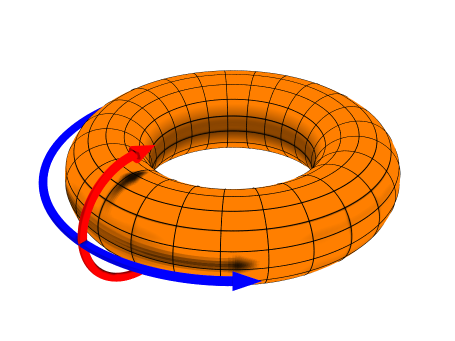
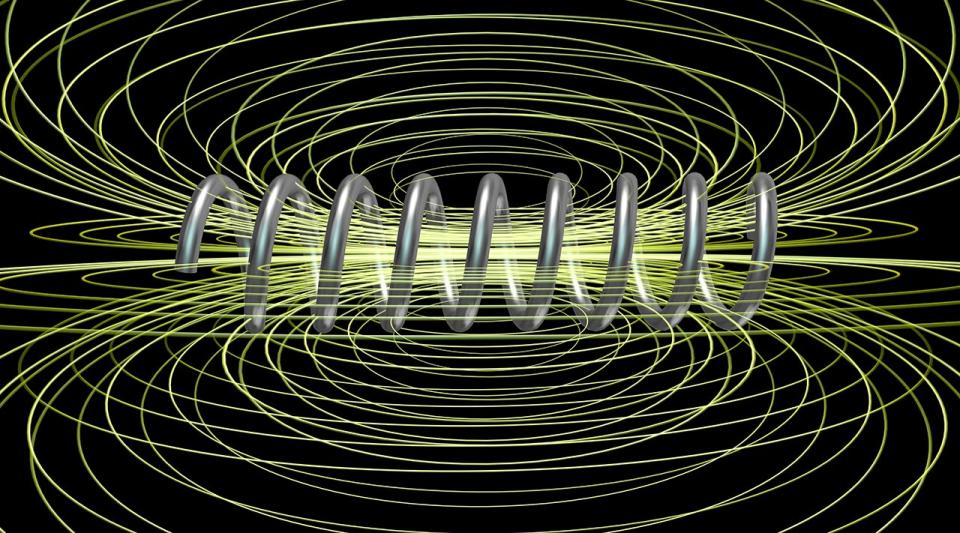
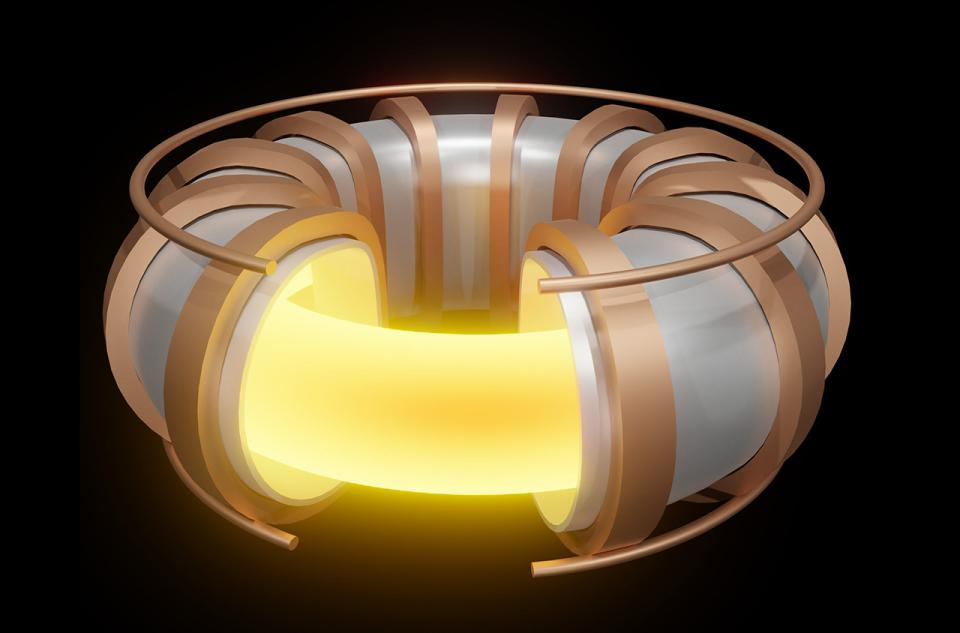
The ideal magnetic cage for hot plasma is an infinitely long solenoid. As for practical use, the machine of finite size is better, so the solenoid is bent into the shape of a torus. If you imagine a donut, which has also the shape of a torus, then the rings on the donut corpus are toroidal coils. These provide the toroidal part of the magnetic field for magnetic confinement.
Toroidal Coils
Each tokamak has its own unique configuration of toroidal coils with varying number, size and shape. More toroidal coils around the torus means a smoother and thus better magnetic field, but their number is limited for several reasons. The first one is space — all coils have to go through the central part of the torus (donut hole) where they are packed close together. In spherical tokamaks, the central part of toroidal coils is reduced to as thin as possible. Some space has to be left between the coils to allow access to the chamber for diagnostics, maintenance, vacuum pumps, or fuelling.
Toroidal Coils of Current Tokamaks
The largest operating tokamak, JET, has 32 toroidal coils. Early tokamaks had circular toroidal coils with about 10 cm in diameter; modern tokamaks have them elongated into a "D" shape. ITER, the largest tokamak in the world now under construction, will have 18 toroidal field coils, each 17 metres high and 9 metres wide, capable of producing a magnetic field of up to 11 Tesla. Most experimental tokamaks around the world produce magnetic fields of about 3 Tesla.
2 pictures 2 pictures
Poloidal Field
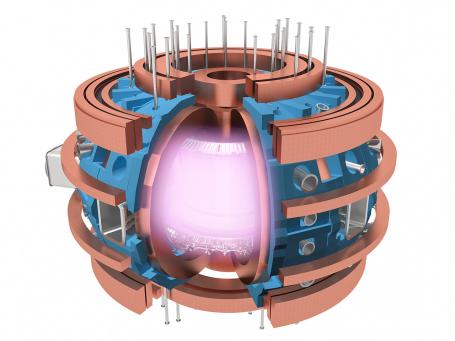
In tokamaks, the magnetic cage has the shape of a donut and is created by the combination of magnetic fields generated by toroidal coils and current flowing through the plasma column. For greater stability, the vertical magnetic field is needed. This is provided by poloidal coils — large rings encircling the whole torus, including its toroidal coils. A set of several poloidal coils with different diameters pushes expanding plasma back to the centre of the torus, providing better stability of the plasma column and is usually used for positioning and shaping the plasma. They are sometimes quite large structures — in ITER, the largest tokamak in the world now under construction, the biggest poloidal coil has a diameter of 24 metres and is so big that it cannot be transported, so a special winding facility was built on-site for its construction.
Keep reading
Articles
Tokamaks
The word "tokamak" is of Russian origin and means "toroidal chamber and magnetic coils." This magnetic confinement system holds plasma in magnetic fields of toroidal shape. The first tokamak, the T-1, started operation in 1958 in Russia, and since then the greatest advances in th
16 min read
Divertor
The word "tokamak" is of Russian origin and means "toroidal chamber and magnetic coils." This magnetic confinement system holds plasma in magnetic fields of toroidal shape. The first tokamak, the T-1, started operation in 1958 in Russia, and since then the greatest advances in th
5 min read
External Heating
The word "tokamak" is of Russian origin and means "toroidal chamber and magnetic coils." This magnetic confinement system holds plasma in magnetic fields of toroidal shape. The first tokamak, the T-1, started operation in 1958 in Russia, and since then the greatest advances in th
5 min read
Most Important Tokamaks in the World
The word "tokamak" is of Russian origin and means "toroidal chamber and magnetic coils." This magnetic confinement system holds plasma in magnetic fields of toroidal shape. The first tokamak, the T-1, started operation in 1958 in Russia, and since then the greatest advances in th
12 min read
Questions
Tokamak or stellarator — what is the difference?
Both confine plasma in a torus. Tokamaks use plasma current; stellarators use twisted coils.