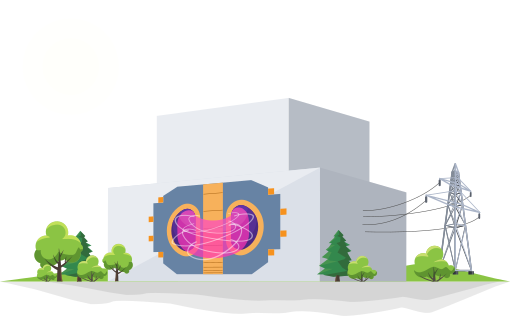
Most Important Tokamaks in the World
12 min read · Energy Atlas Editorial
The word "tokamak" is of Russian origin and means "toroidal chamber and magnetic coils." This magnetic confinement system holds plasma in magnetic fields of toroidal shape. The first tokamak, the T-1, started operation in 1958 in Russia, and since then the greatest advances in th
- LearningNuclear Fusion Courses
- Nuclear Energy Courses
- Renewable Energy Courses

- ITER Tokamak Interactive 3D Model
- Stellarator Interactive 3D Model
- ITER Tokamak and Stellarator Models for 3D Printing
- Thermonuclear Fusion
- Tokamaks
- Stellarators
- Inertial Confinement Fusion
- ITER
- History
- Thermonuclear Fusion Power Plant
- Nuclear Fusion Summary
- Nuclear Power Plant Interactive 3D Model
- Nuclear Power
- The Nuclear Power Industry
- Nuclear Fuel
- The Nuclear Reactors
- Radioactive Waste
- The Safety of Nuclear Power Plants



- Online 3D
- 3D Printing
- Images
- Videos
- Animations
- LearningNuclear Fusion CoursesHow Does Thermonuclear Fusion Work?
- Construction and Working Principle of Tokamaks
- Construction and Working Principle of Stellarator
- Inertial Confinement Fusion
- ITER — a Major Step Towards Thermonuclear Fusion
- Fusion Power Plant as a Clean Energy Source
- Basic principles
- Magnetic confinement
- Inertial and electrostatic confinement
- Summative, cross-sectional test — Light version
- Radioisotopes as Sources of Ionizing Radiation
- Interaction of Atomic Nuclei with Particles
- Nuclear Fuel and the Nuclear Fuel Cycle
- The Principles of Operating a Nuclear Power Plant
- The First Reactor and the First Nuclear Power Plant
- The Most Used Nuclear Reactors: PWR and BWR
- Sources, Processing, and Storage of Radioactive Waste
- Nuclear Power Plant Safety
- Nuclear fuel
- Nuclear fuel and nuclear reactors
- Nuclear power industry
- Nuclear reactors
- Radioactive waste
- Radioactive waste and safety of nuclear power plants
- Nuclear power
- Summative, cross-sectional test — Light version
- Summative, cross-sectional test — PRO version
- Types of RES and the Use of Renewable
- Comparison of Renewable Energy Source
- Characteristics of Hydropower
- Water Turbines in Hydroelectric Power Plants
- Wind Power Plants
- Solar Energy
- Solar Power Plants
- Biomass energy
- Geothermal energy
- Solar energy
- Water energy
- Wind energy
- ITER Tokamak Interactive 3D Model
- Stellarator Interactive 3D Model
- ITER Tokamak and Stellarator Models for 3D Printing
- Thermonuclear FusionWhy it Works?
- How it Works?
- Fusion Fuel
- Fusion in Stars
- Lawson Criterion
- Plasma
- How to Measure the Temperature in the Core of the Sun? or Diagnostics
- Artificial Fusion Principles
- Main Principles
- Material for Magnetic Coils
- Central Solenoid
- Toroidal Field
- Poloidal Field
- Vacuum Chamber
- Divertor
- External Heating
- Fuel
- Problems
- Most Important Tokamaks in the World
- Milestones
- Main Principles
- Magnetic Coils
- Vacuum Chamber
- Divertor
- Problems
- Most Important Stellarators in the World
- Milestones
- Main Principles
- Lasers
- Target
- Chamber
- Most Important Inertial Fusion Facilities in the World
- Milestones
- The Next Step on the Way Toward a Thermonuclear Fusion Power Plant
- Main Parameters
- Timeline
- Record Breakers
- Magnets
- Vacuum Vessel
- Blanket
- Divertor
- Cryostat
- Tritium Production
- Cooling
- Diagnostics
- External Heating
- The ITER Site
- Disruptions and Instabilities
- Early Fusion Research
- Thermonuclear Bomb
- Pinch
- Stellarator Concept
- Tokamak Invention
- Inertial Fusion Proposal
- ITER Organisation
- Fusion Today
- Clean Energy Source
- Dates and Locations
- Challenges
- Safety
- How it Will Look Like
- Fuel
- Waste
- Best Fusion Reactor for Power Plant
- Nuclear Power Plant Interactive 3D Model
- Nuclear PowerRadioactivity
- Ionising Radiation
- Natural Sources
- Man-made Sources
- Half-life
- Decay Series
- Quantities and Units
- Effects of Ionising Radiation
- Radiation Doses and Activities
- Nuclear Power Summary
- Principle of Operation
- Types of Nuclear Reactions
- Fission Chain Reaction
- Control and Reaction States
- Moderator
- Absorber
- Coolant
- Fission Products
- The Largest Nuclear Power Plants
- Fuel Production
- Fuel Enrichment
- Fuel Assembly
- Fuel Cycle
- Interim Storage
- Transportation
- Reprocessing
- Final Repositories
- The Nuclear Power Plant — How it Works
- The First Reactor
- Pressurized Water Reactor (PWR)
- Boiling Water Reactor (BWR)
- Heavy Water Reactor (PHWR)
- Gas-cooled Reactor (GCR) and Advanced Gas-cooled Reactor (AGR)
- RBMK Type Reactor
- High Temperature Reactor (HTGR)
- Reactor Using Fast Neutrons (FR)
- Small Modular Reactors
- The Future of Fission Reactors
- NPP PWR Interactive 3D Model
- NPP BWR Interactive 3D Model
- NPP Small Modular Reactors Interactive 3D Model
- AGR Reactor Interactive 3D Model
- CANDU Reactor Interactive 3D Model
- HTGR Reactor Interactive 3D Model
- Superphénix Interactive 3D Model
- Production of Radioactive Waste
- Types of Radioactive Waste
- The Processing of Radioactive Waste
- The Disposal of Radioactive Waste
- Nuclear Safety
- Safety Systems
- External Hazards
- INES Scale
- Nuclear Accidents
- International Nuclear Organizations
- Nuclear Power Plants and the Environment
- WATER energyHydroelectric Power Plant Interactive 3D Model
- The Physical Properties of Water
- The Origin of Water Energy
- History of Water Energy Utilization
- Water Energy and Its Uses
- Dams and Reservoirs
- The Highest Dams and Largest Reservoirs
- The Segner Wheel
- Francis Turbine
- Kaplan Turbine
- Pelton Turbine
- Choosing a turbine (Turbine selection graph)
- Hydroelectric Power Plant Operating Principles
- Types of Hydroelectric Power Plants
- The Largest Hydroelectric Power Plants in the World
- Tidal Energy and Sea Wave Power
- Marine Current Power and Ocean Thermal Energy
- Environmental Impact of Hydropower
- Wind Turbine Interactive 3D Model
- The Energy of Flowing Air
- The Beaufort Wind Force Scale
- The History of Wind Power Utilization
- Wind Power Plants
- Wind Turbine and its Working Principle
- The Largest Wind Farms
- Types of Wind Turbines
- Wind Turbines and the Environment
- Solar Power Plant Interactive 3D Model
- Solar Rays Energy
- Ways to Use Solar Heat
- Solar Collectors
- Solar Concentrators
- Central Tower Solar Power Plants
- Solar Farms
- The Largest Solar Power Plants
- The Energy Use of the Photovoltaic Effect
- Photovoltaic Farms
- Solar Energy and the Environment
- Solar Energy and Solar Power Systems Summary
- Hot Dry Rock (HDR) Geothermal Energy Interactive 3D Model
- Heat from the Earth’s Core
- Geothermal Phenomena
- Mankind and the Energy from the Earth
- Geothermal Systems
- Geothermal Power Plant
- Environmental Impact
- Biomass Energy Interactive 3D Model
- Biomass
- Types and Processing of Biomass
- Available Technology of Biomass
- Biofuels
- Biomass Power Plants
- Biomass and the Environment
- Rapid development of energy consumption
- The Future of Solar Energy
- The Future of Hydro Energy
- The Future of Renewable Energy Sources
- Development of Renewable Sources
- Online 3D
- 3D Printing
- Images
- Videos
- Animations
- Glossary
- Log-in
- Create new account
- ITER Tokamak Interactive 3D Model
- Stellarator Interactive 3D Model
- ITER Tokamak and Stellarator Models for 3D Printing
- Thermonuclear Fusion
- TokamaksMain Principles
- Material for Magnetic Coils
- Central Solenoid
- Toroidal Field
- Poloidal Field
- Vacuum Chamber
- Divertor
- External Heating
- Fuel
- Problems
- Most Important Tokamaks in the World
- Milestones
- Glossary
Since Lev Artsimovich's lecture in 1968, where he presented a successful reaching of temperature of 10 million kelvin in a T-3 tokamak, the tokamak principle has been perceived as a promising way to thermonuclear fusion. Rapid expansion of those experimental devices started all over the world and, to date, over fifty tokamaks have been built. A lot of them have been rebuilt and upgraded so they can keep pace with new scientific discoveries and bring new knowledge about plasma and fusion. Others are under construction or planned.
JET, Joint European Torus,
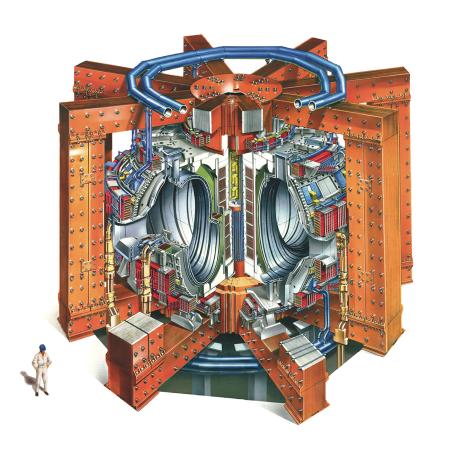
operated by Culham Centre for Fusion Energy, UK, is an old and big tokamak-although it is neither the longest operating one nor the biggest one in terms of plasma volume. Its first plasma was initiated in 1983, and since then, JET has brought many important discoveries to the fusion research field. The JET tokamak is a large machine with a plasma volume of about 80 m3, a major radius of 2.95 metres and a minor radius of about 1.25 metres. The magnetic cage is created by 32 copper-wound magnets, each one weighing 12 tonnes. It was one of the first tokamaks to be designed to use a D-shaped vacuum chamber. Because of it, it was easy to slightly change the magnetic configuration and add a divertor in 1991, which improved the quality of its plasma pulses. This was also the date from which experiments with the deuterium-tritium mixture started. At the time, JET was the only tokamak in the world that could work with the D-T fusion reaction. In 1997, it nearly reached scientific breakeven by generating 16.1 MW of fusion power. The Q (ratio between input and output power) was 0.67, so more energy was added than gained, but it was a success that has not been overcome by any other tokamak. Working with tritium gives a lot of valuable information but leads to a problem of how to access a vacuum vessel activated by neutron flux. A remote handling system was constructed with which, for the first time, it was possible to exchange certain components using artificial hands only. A lot of information gained by JET was used during the design and construction of ITER. In 2009, the beryllium/tungsten plasma facing wall, similar to that which will be used in ITER, was installed to be tested. Since the power requirements during the plasma pulse (up to 1,000 MW) are greater than the limited grid intake, two large flywheel generators were built to ensure power supply during experiments.
TFTR, Tokamak Fusion Test Reactor
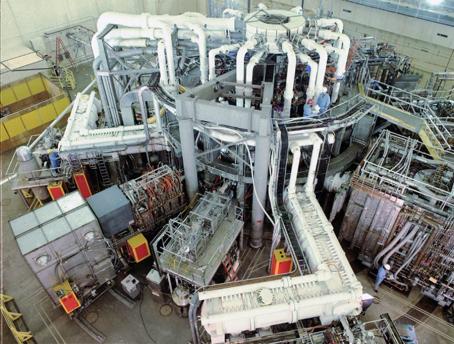
of Princeton Plasma Physics Laboratory, USA, was the second one designed to experiment with a deuterium-tritium mixture. It was built to achieve scientific breakeven, but for many reasons it fails to do so. Nevertheless, it breaks many records in confinement and plasma temperature. A world record of 510 million kelvin was reached in 1995. A triple fusion product (product of density, temperature, and confinement time) close to the goal for a practical reactor was also created at TFTR, unfortunately with a temperature far below what would be required for successful breakeven. In 1995, TFTR scientists explored a new fundamental mode of plasma confinement — enhanced reversed shear, to reduce plasma turbulence. The TFTR has a chamber with a circular cross-section, a major radius of about 2.6 meters and a minor radius of about 0.9 meters, with twelve copper toroidal coils. It was in operation from 1982 to 1997. Subsequent decommissioning gives a rare opportunity to closely inspect coil and vessel material irradiated by fusion neutrons.
JT-60SA, Japan Torus-60 Super, Advanced,
operated in Naka, Japan, could be called, with the plasma volume up to 130 m3, the largest tokamak in the world, although its first plasma was not ignited yet. It rose from upgrading its predecessor JT-60U, and this tokamak was upgraded from JT-60, which started operation in 1985. Both are record holders. To date, JT-60 has the world record for the hottest ion temperature ever achieved (522 million kelvin) and JT-60U holds the record for the highest value of the fusion triple product achieved. For JT-60SA, pulse lengths exceeding 100 seconds are expected. The device could work with deuterium or hydrogen gas (it is not designed for tritium use) and heat it with its powerful heating systems up to 200 million kelvin. It has a system of 18 D-shaped NbTi superconducting coils cooled by liquid helium to 4 kelvin. Each of the 18 coils is 7.5 meters high and 4.5 meters wide, and together they weigh 370 tonnes. The dimensions of JT-60SA are about half the size of ITER and it will be the most powerful tokamak in the world before ITER starts operation.
EAST, Experimental Advanced Superconducting Tokamak,
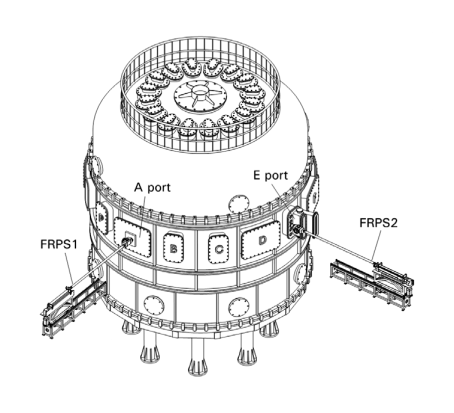
is a Chinese tokamak located in Hefei. It was upgraded from HT-7, which started operation in 1990. EAST had its first plasma in 2006 and since then has been working hard to beat several fusion records in temperature and plasma duration. For example, in 2011, it became the first tokamak to successfully sustain H-mode plasma for over 30 seconds at 50 million kelvin and in 2021, EAST reached a milestone of 120 million kelvin electron temperature for 101 seconds. EAST has both poloidal and toroidal coils made from superconducting material. It has a major radius of 1.7 meters and a minor radius of 0.4 meters. The plan of its operators is to maintain 100 million kelvin of hot plasma for 1,000 seconds (about 17 minutes).
WEST is an Acronym for "W Environment in Steady-state Tokamak"
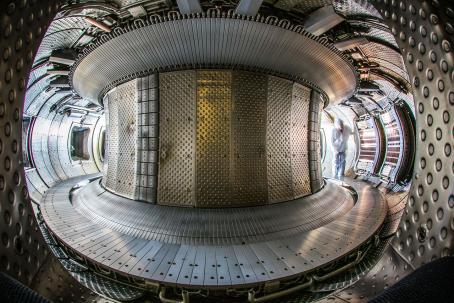
where W is the chemical symbol for tungsten. Tokamak WEST, located near Cadarache, France, is the successor of the ToreSupra tokamak that started operation in 1988 and holds the record for the longest plasma duration time for a tokamak (6 minutes 30 seconds). After modernisation, WEST reached first plasma in 2016 and serves as a test bed for ITER and DEMO. With the help of new magnetic coils, its magnetic configuration was changed from circular to an ITER-like "D" shape, and a tungsten divertor was added. Unlike ITER, it has a tungsten first wall, not beryllium, more in anticipation of the planned first demonstration fusion power plant, DEMO. WEST is equipped with superconducting magnets and some of its plasma facing components are actively cooled. Pulses as long as 1,000 seconds are expected from this tokamak.
3 pictures 3 pictures
Milestones
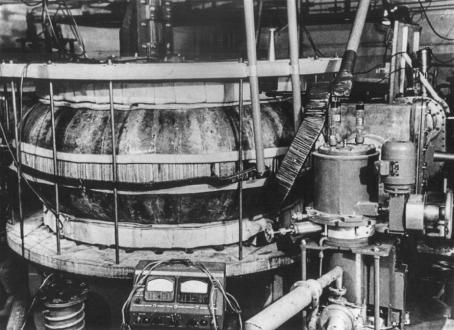
First Tokamak
In the early years of electromagnetic confinement research, various magnetic devices such as pinches, stellarators, or magnetic traps evolved together. In the Soviet Union (now Russia), scientists explored the tokamak principle first in small, table-top experiments, toroids with ceramic vessels. As the material used caused plasma contamination, a tokamak with steel chamber T-1 was constructed. This first tokamak started operation in 1958 and proved that its design is suitable for plasma confinement. The name stands for "TOroidalnaja KAmera i MAgnitnyje Katushki" — toroidal chamber and magnetic coils — and was probably suggested by Igor Nikolaevich Golovin, the vice-director of the Laboratory of Measuring Apparatus of the Academy of Science, today's Kurchatov Institute. A series of tokamaks have been built recently, the bigger ones as well as the smaller ones. One of the small ones, TM-1 (TM stands for tokamak malyj-small tokamak), has been functioning since 1963, making it the oldest tokamak in the world. After many upgrades, reconstructions, and movings, it is now serving as a school tokamak in the Czech Republic.
Temperature Record at T-3
Great success was achieved with the greater tokamak T-3, where incredible temperature of 10 million kelvin was reached and maintained for several milliseconds. British scientists from Culham University confirmed the results by a Thompson scattering diagnostic laser in 1968. Fusion researchers were so amazed by T-3 achievements that the Princeton Plasma Physics Laboratory's stellarator "Model C" was rebuilt in 1969 to ST tokamak, which confirmed T-3 results. The tokamak boom started.
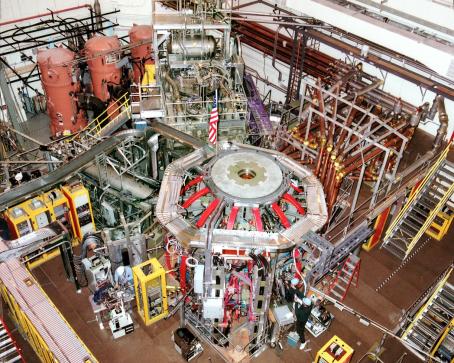
Tokamak Boom
CLEO (1971), built in Culham, UK, begins to experiment with plasma stabilisation via magnetic coils. This tokamak was soon followed by others, for example, the Russian TO-2 (1972), Japan's JFT-2 (1973), or the French TFR (1973). This tokamak discovered dangerous runaway electrons accelerated nearly to the speed of light during an event called "disruption". This occurs when the plasma is released from magnetic confinement due to some kind of instability and dumped on the vessel wall.
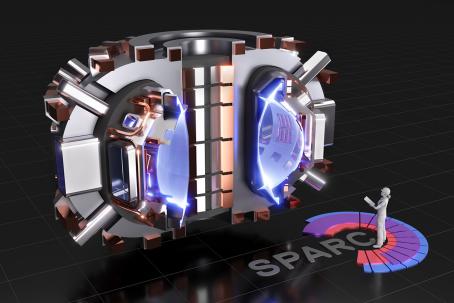
External Heating
Heating plasma with neutral particles accelerated to high velocities by an electric field was proposed in the Princeton Plasma Physics Laboratory in 1964 and used in the tokamak ORMAK (Oak Ridge Laboratory, 1971). Since then, essentially all tokamaks have been equipped with this kind of heating. Another type of heating by microwaves, aimed to add energy to electrons or ions (Electron Cyclotron Resonance Heating and Ion Cyclotron Resonance Heating, respectively), was added soon.
H-mode
Despite success in external heating, PLT (Princeton Large Torus, 1975) found out that confinement time decreases with increasing heating. Steep temperature gradients lead to turbulence that mixes and cools the plasma. A solution to this problem arises in 1982 when the German tokamak ASDEX reaches a mode of better confinement. This was called H-mode (High Confinement), and the previous regime was named L-mode (Low Confinement). During H-mode, a sharp gradient called a transport barrier is established on the plasma edge and cooling due to convectional turbulence is minimized. This mode appears to be a very promising way to reach breakeven, but it also brings with it dangerous ELMs. This term stands for Edge Localised Modes and was discovered also in ASDEX. They are short, repetitive, intensive bursts of energy toward the vessel wall, threatening to damage it. Quiescent H-mode without ELM was later discovered on the DIII-D tokamak, but it was realised that ELMs could also bring good when managed properly. They help to lead unwanted particles (impurities) towards the region between the plasma edge and vessel wall, from where they can be led toward the divertor and exhausted, so the plasma can be kept clean. Researchers invented a magnetic resonance perturbation method that changes one big, dangerous ELM to a set of smaller ELMs.
Divertor
The edge of plasma was initially defined by a limiter, a piece of metal, usually a ring, protruding a bit from the vessel wall into the plasma. But the material of the limiter used to contaminate the plasma, so the divertor concept was soon invented. The edge plasma is led toward the divertor by the magnetic field created by an additional poloidal coil. The first time it was used in stellarators. Since the 70s, it could be found in tokamaks, for example in DITE (Divertor Injection Tokamak Experiment, Culham, 1979) or TO-2 (Russia, 1972). This leads to better confinement and helps to keep plasma purity.
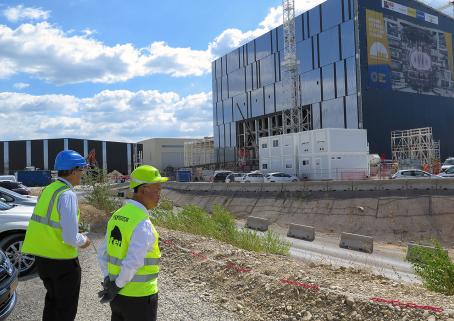
Joint European Torus
Already in the early 70s, it became clear that reasonable power plant reactor on the tokamak principle have to be big. It is simply because you need to put more than 1 metre of shielding between the plasma and the coils to protect them from neutrons and heat. The knowledge that the larger the plasma volume, the better the confinement confirmed it later. So, the project for the big tokamak started, and in 1983, the JET (Joint European Torus) was commissioned in Culham, UK. With a plasma volume of about 80 m3, it was the largest tokamak in the world since the Japanese JT-60U, with a plasma volume of 100 m3, began operation in 1991. JET was the first tokamak with an elongated "D" shape chamber cross-section and the first one that could handle the D-T reaction. Because of the presence of radioactive tritium and later activation of chamber material by fusion neutrons, maintenance in the vacuum vessel could not be done by humans. A remote handling system was constructed with which, for the first time, it was possible to exchange certain components using artificial hands only. In 1997, JET generated 16.1 MW of fusion power. The Q (ratio between input and output power) was 0.67, so more energy was added than gained, but it was a success that has not been overcome by any other tokamak yet.
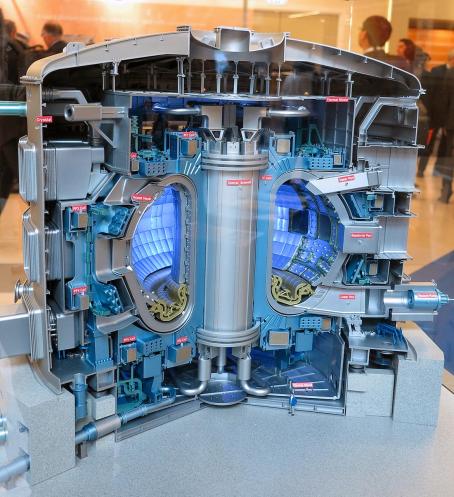
Tokamak Fusion Test Reactor
Another tokamak capable of experiments with D-T reactions was the American TFTR (1982). Although designed to reach a scientific breakeven, it never did. In 1986, it achieved a plasma temperature of 200 million kelvin, and in 1995, a world record of 510 million kelvin was obtained. The temperature record was beaten by JT-60 in 1996 with 522 million kelvin, the hottest ion temperature ever achieved. The longest pulse was held on ToreSupra (6 minutes 30 seconds) and the record for hottest plasma for the longest time was held by EAST tokamak, which in 2021 reached a milestone of 120 million kelvin electron temperature for 101 seconds. For successful fusion ignition, the combination of temperature, plasma density, and confinement time is needed. This is known as a fusion triple product, and JT-60U has held the highest value record since 2018.

Superconductors
The first magnetic coils used were made from copper, but with requests for longer pulses, the necessity to use superconducting materials arises as the copper quickly overheats. Not to mention energy consumption. The first tokamak with superconducting toroidal coils was the Russian T-7, commissioned in 1979, and the French ToreSupra, with the first plasma in 1988. The first two tokamaks with toroidal and poloidal coils made of superconducting materials were the Chinese EAST and the Korean KSTAR, both of which began operation in 2008. The typical superconductor used is niobium-titanium (NbTi), but where a high magnetic field is required, extremely brittle and hard-to-work-with niobium-tin (Nb3Sn) is used. The coils for ITER will be made from Nb3Sn. New superconductors called ReBCO (Rare-earth Barium Copper Oxide) that can maintain superconductivity in high magnetic fields and at temperatures of about 77 kelvin are being tested, for example at the small spherical tokamak ST25.
International Thermonuclear Experimental Reactor
Knowledge learned about thermonuclear fusion and plasma behaviour so far was used for the project of the greatest tokamak ever built, the experimental machine ITER. The construction work started in 2007 and the first plasma is anticipated for 2026. The ITER is designed to reach scientific breakeven and even encompass it ten times by producing 500 MW of fusion power.
Keep reading
Articles
Tokamaks
The word "tokamak" is of Russian origin and means "toroidal chamber and magnetic coils." This magnetic confinement system holds plasma in magnetic fields of toroidal shape. The first tokamak, the T-1, started operation in 1958 in Russia, and since then the greatest advances in th
16 min read
Material for Magnetic Coils
The word "tokamak" is of Russian origin and means "toroidal chamber and magnetic coils." This magnetic confinement system holds plasma in magnetic fields of toroidal shape. The first tokamak, the T-1, started operation in 1958 in Russia, and since then the greatest advances in th
5 min read
Divertor
The word "tokamak" is of Russian origin and means "toroidal chamber and magnetic coils." This magnetic confinement system holds plasma in magnetic fields of toroidal shape. The first tokamak, the T-1, started operation in 1958 in Russia, and since then the greatest advances in th
5 min read
External Heating
The word "tokamak" is of Russian origin and means "toroidal chamber and magnetic coils." This magnetic confinement system holds plasma in magnetic fields of toroidal shape. The first tokamak, the T-1, started operation in 1958 in Russia, and since then the greatest advances in th
5 min read
Questions
Tokamak or stellarator — what is the difference?
Both confine plasma in a torus. Tokamaks use plasma current; stellarators use twisted coils.