Fusion
ITER
The international tokamak under construction in Cadarache, France, designed to study burning plasma at reactor-relevant scale.
Labelled system
Explore in 3D
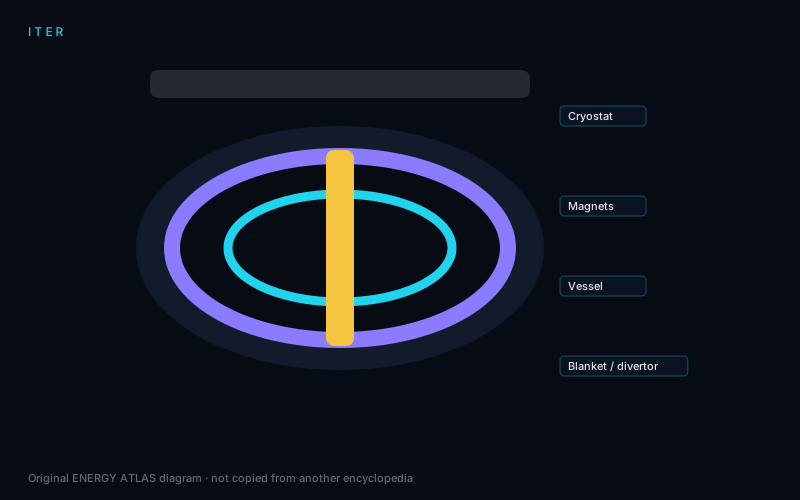
Original ENERGY ATLAS schematic. Interactive 3D is opt-in on this page.
Superconducting D-shaped coils around the vessel.
Overview
ITER is a collaboration among China, the European Union, India, Japan, Korea, Russia, and the United States. Its scientific mission is to produce a deuterium–tritium plasma in which fusion power substantially exceeds the external heating power, and to test technologies needed for a future demonstration plant.
How it works
Eighteen toroidal field coils, a central solenoid, and poloidal coils confine plasma in a D-shaped vacuum vessel inside a giant cryostat. Heating includes neutral beams and cyclotron systems. A tungsten divertor handles exhaust. Blanket modules face the plasma and will test tritium-breeding concepts.
Components
Toroidal field system
Superconducting D-shaped coils around the vessel.
Central solenoid
Stacked superconducting modules that drive plasma current.
Vacuum vessel
Double-walled stainless-steel torus.
Blanket
Shielding and test modules facing the plasma.
Cryostat
Vacuum thermal insulation for superconducting magnets.
Keep exploring
Articles
The Next Step on the Way Toward a Thermonuclear Fusion Power Plant
In the beginning of the 20th century, the potential energy of the atom was discovered.
3 min read
ITER Magnets, Vessel, and Blanket
ITER combines superconducting magnets, a massive vacuum vessel, a cryostat, and plasma-facing blankets.
5 min read