Jaroslav Kores, Ph.D.
Why is a black hole black?
We can determine the value of the force of gravity from Newton's law of gravity, from which we can also determine the value of the gravitational field intensity around each body. We all know from experience that if we throw something, it falls back to Earth, and the faster we throw it, the longer it takes for the thrown object to fall back to Earth. One might expect that if we throw something very fast, it will not fall back to Earth. This expectation is justified, as evidenced by various satellites and space stations orbiting the Earth. The speed at which we must throw such objects is called the first cosmic velocity or orbital velocity, and its value is almost 8 km/s (at the Earth's surface; the higher we are, the slower we need to throw). An object thrown at first cosmic velocity will orbit the Earth. If we want the object to leave the Earth's gravitational field, we will have to throw it even faster — at second cosmic velocity or escape velocity (which is just over 11 km/s).
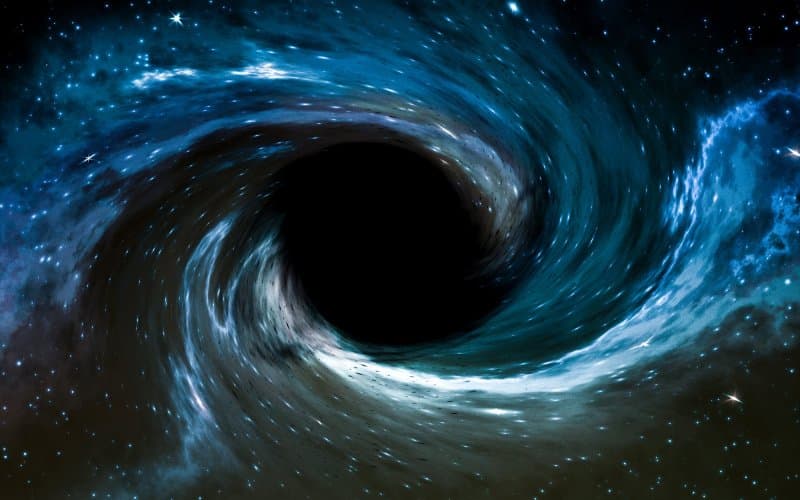
The values of the first and second cosmic velocities depend on the mass of the Earth and its radius. For each planet, there are different velocities at which we must throw a body in order for it to orbit around it (first cosmic velocity) or fly away from it (second cosmic velocity). As early as the 18th century, J. Mitchell wondered whether there could be a planet whose escape velocity (i.e., second cosmic velocity) was greater than the speed of light. He thus predicted black holes—or, as he called them, black planets, planets whose gravitational field is so strong that even light cannot escape from it. And if light cannot escape from them, they will appear black to observers.
More mysteries
Keep exploring questions other readers asked.

Jaroslav Kores, Ph.D.
Why shouldn’t you put hot food in the refrigerator?
Because food contains water, it evaporates. The rate of evaporation depends on the temperature, so if the temperature in the refrigerator increases, more water will evaporate from all the stored food. Water will also eva…
Read the answer
Edita Bromova
Can I see the stars when I look from the bottom of a deep well?
It was probably Aristotle who first stated that from the bottom of a deep enough well, even on a sunny day, the stars could be seen. This statement was later repeated many times. His assumption was that at the bottom of…
Read the answer
Edita Bromova
How has the development of teleportation progressed?
Surely you've thought many times, while stuck in traffic, squeezed in a crowded bus, or wracked by turbulence on a plane, how great it would be to be able to get from place to place without the hassle of travel. If you c…
Read the answerWant to ask something?
Send us an e-mail with the subject "Physics mysteries" to the address below, or use the contact form.
We can't wait to tackle your interesting questions!