Jaroslav Kores, Ph.D.
Why shouldn’t you put hot food in the refrigerator?
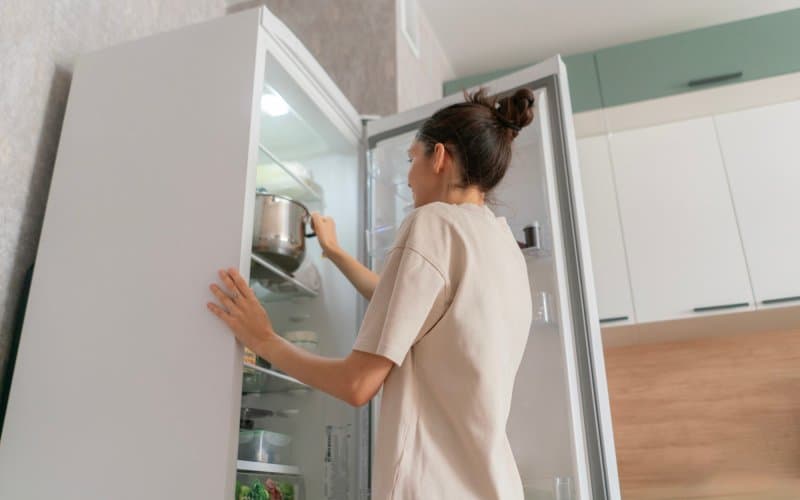
Because food contains water, it evaporates. The rate of evaporation depends on the temperature, so if the temperature in the refrigerator increases, more water will evaporate from all the stored food. Water will also evaporate from the warm food we put in the refrigerator. The increase in humidity in the refrigerator causes it to freeze — moisture will first condense on the cooling part of the refrigerator and then freeze. The frost then acts as an insulator — the refrigerator tries to cool, but because of the frost, the "cold" does not pass from the cooling circuit to the refrigerator. The temperature in the refrigerator will therefore not decrease, which the refrigerator's control system will interpret as a need for more cooling, leading to increased consumption. To prevent frost from forming in the refrigerator, refrigerators have a "defrost" function — the cooling circuit heats up for a while, which melts the frost and the resulting liquid flows out of the refrigerator. For the same reason, it is not recommended to keep the refrigerator door open for a long time — moist air will enter the refrigerator and may cause frost to form on the cooling parts of the refrigerator.
Another problem, although not directly physical, is that until food cools down completely, bacteria that thrive at temperatures above approximately 5 °C can multiply in it. If we put a large amount of food in the refrigerator, its surface will cool down, but because sauces or thick soups, for example, do not conduct heat well, the temperature inside will drop very slowly. Therefore, the temperature inside sauces will remain higher for a long time, which can lead to an increase in the number of bacteria and thus to food spoilage. The solution is to cool the food outside the refrigerator to room temperature and divide it into smaller portions. Then the whole meal will cool down easily and quickly, and bacteria will not cause it to spoil.
If we put anything hot in the refrigerator, the temperature in the entire refrigerator will rise, causing other foods to heat up and possibly spoil. By putting warm food in the refrigerator, we are not only endangering the food we put in it, but also other foods in the refrigerator.
More mysteries
Keep exploring questions other readers asked.
Edita Bromova
Can I see the stars when I look from the bottom of a deep well?
It was probably Aristotle who first stated that from the bottom of a deep enough well, even on a sunny day, the stars could be seen. This statement was later repeated many times. His assumption was that at the bottom of…
Read the answer
Edita Bromova
How has the development of teleportation progressed?
Surely you've thought many times, while stuck in traffic, squeezed in a crowded bus, or wracked by turbulence on a plane, how great it would be to be able to get from place to place without the hassle of travel. If you c…
Read the answer
Edita Bromova
Is there a black light?
To watch a movie, whether it's projected on a wall at home or on a big screen at the cinema, you need a movie projector that will project beams with information about the image. It will direct red beams to where the red…
Read the answerWant to ask something?
Send us an e-mail with the subject "Physics mysteries" to the address below, or use the contact form.
We can't wait to tackle your interesting questions!