Edita Bromova
How has the development of teleportation progressed?
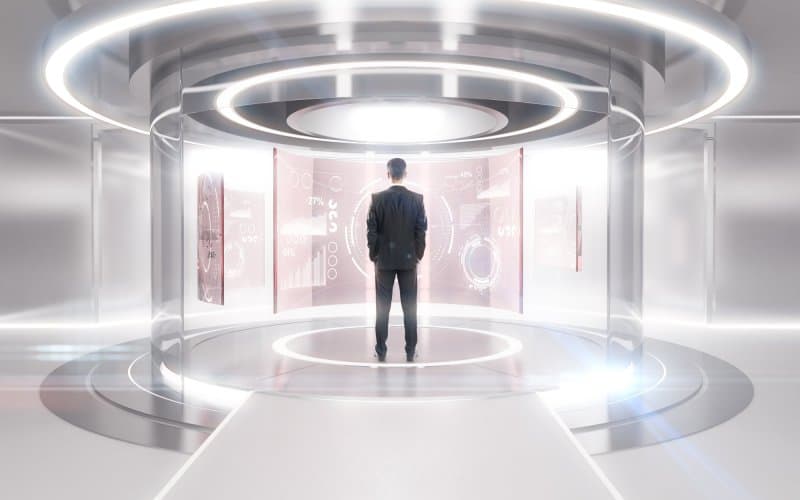
Surely you've thought many times, while stuck in traffic, squeezed in a crowded bus, or wracked by turbulence on a plane, how great it would be to be able to get from place to place without the hassle of travel. If you could walk through a magic door and find yourself in the Seychelles or Paris. If there was a teleport that could take you anywhere you wanted in the blink of an eye.
Teleportation has been around in science fiction for a long time. It allows intrepid spaceship crews to travel to the surface of planets where no one has gone before, and mad scientists to experiment with them. In reality, however, we have no choice but to get in a car, plane, or walk.
Teleportation is a tempting idea. It would make transportation immeasurably easier and allow the exploration of the Earth and near space. In purely theoretical terms, it could take two forms. The first would involve scanning the transmitted object down to the subatomic level, relaying that information to the target, and materializing the subject. The second would require the creation of some kind of space-time doorway through which we could pass from Sydney to Anchorage in a single step.
The first version already works. But don't celebrate, it's only for single particles for now. Quantum teleportation is for the transfer of information. It doesn't actually move any matter. It uses a phenomenon called entanglement. It creates a pair of particles that are quantum entangled. When the quantum state of one changes, the quantum state of the other changes immediately, even if it's at the other end of the universe.
We can think of entanglement as a coin divided into two halves. When a "heads" is flipped on one, a "tails" immediately appears on the other.
The entangled particles serve as carriers of key quantum state information during teleportation magic. Because subatomic particles are considered indistinguishable, if an electron is created somewhere in exactly the same quantum state as the original electron, in terms of physics the new electron is completely indistinguishable from the original. Moreover, when the quantum state of the original electron is destroyed during the measurement, it can be said that we have teleported the original electron, even though no mass transfer has taken place.
If we could teleport information about all the particles in our body in a fraction of a second and then reconstruct it, we would have teleportation. But our body contains about 7 × 1027 atoms, which requires an unimaginable amount of data to be sent. We can't do that yet with current technology.
More mysteries
Keep exploring questions other readers asked.
Edita Bromova
Is there a black light?
To watch a movie, whether it's projected on a wall at home or on a big screen at the cinema, you need a movie projector that will project beams with information about the image. It will direct red beams to where the red…
Read the answer
Edita Bromova
How fast do you have to run to turn into a black hole?
The term "black hole" was first used in 1967 by Frank Wheeler to describe a cosmic body, which until then had been called a "black star" or a "gravitationally completely collapsed body". It is a bizarre object that is so…
Read the answer
Jaroslav Kores, Ph.D.
Why does water in a kettle bubble before it reaches the boiling point (90° +) and when the kettle turns off and the thermometer reads 100 °C, it no longer does?
Boiling is a special case of evaporation — its peculiarity is that it occurs at a specific temperature (the boiling point) and at this temperature, evaporation takes place throughout the entire volume of water (which are…
Read the answerWant to ask something?
Send us an e-mail with the subject "Physics mysteries" to the address below, or use the contact form.
We can't wait to tackle your interesting questions!