Jaroslav Kores, Ph.D.
Why don’t airplanes flap their wings?
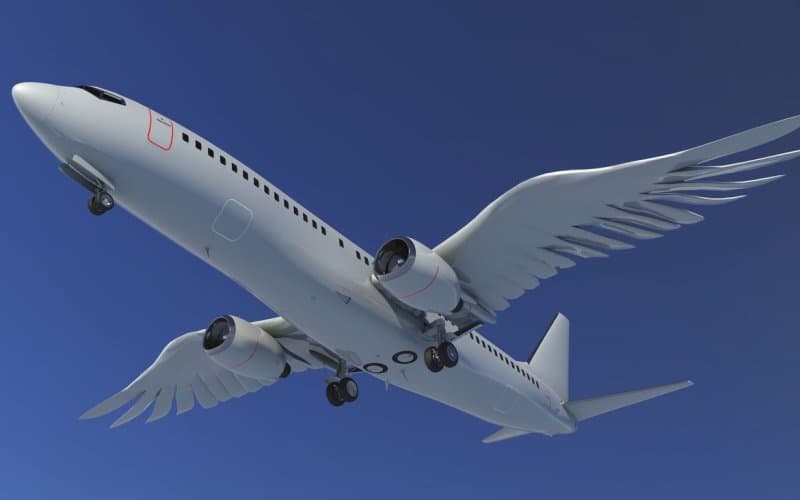
I have rather brief information about the history of flying but I think that the inspiration was based on the free flying of birds when they do not flap their wings (e.g. still used today by gliders). The principle of gliding (and therefore the flight of an aircraft) is different from flapping wings. When flapping its wings, a bird rises due to the fact that it bounces off the air. This requires a large wing area and at the same time the small weight of the bird. The force that we exert on the air is from Newton's 3rd law that it is the same as the force that air exerts on us. But the air is fluid and very well compressible. So the wings compress the air and the force that the air will exert on the wings is smaller than if we were flapping like that in water. It is quite good to see on diving fins. Thanks to them, we move in the water but the fins do not make us move in the air (e.g. on a skate). The solution would be to use much bigger fins, but that in turn would increase our weight and require more force to move. Therefore, aircraft use a hydrodynamic paradox (Bernoulli's equation) — the faster the air (generally a fluid) moves, the lower the pressure at a given location. The wing of an aircraft is shaped so that its upper part flows around the air significantly faster than the lower part. As a result, less pressure is exerted on the upper part of the wing than on the lower part, and this pressure difference raises the aircraft. I have described the whole matter only physically and even technically it is much easier to use a static forward drive than a complex system that moves the wings. From the speed of the propeller, we are able to relatively easily adjust the speed of the aircraft, and therefore the pressure difference acting on the wing of the aircraft.
More mysteries
Keep exploring questions other readers asked.

Jaroslav Kores, Ph.D.
Where does all the light go when I turn the lights off?
Like sound or waves in water, light is a wave, only in the case of light, it is an electromagnetic wave while sound is a mechanical wave. So if I describe the waves on the water surface, we can imagine the behavior of li…
Read the answer
Jaroslav Kores, Ph.D.
What is the shape of an electron?
Unfortunately, I am not a particle physicist, so I hope that I will not be fundamentally wrong in the fact that my answer is: we do not know. More precisely, we do not know and will not know. In our world (in terms of si…
Read the answer
Jaroslav Kores, Ph.D.
How many bananas can I eat so not to get radiation sickness?
Personally, I wouldn't be afraid that someone could die of a banana overdose. Although the "banana equivalent" is given as an auxiliary unit describing radiation, I do not think that its value reflects the real effect of…
Read the answerWant to ask something?
Send us an e-mail with the subject "Physics mysteries" to the address below, or use the contact form.
We can't wait to tackle your interesting questions!