Jaroslav Kores, Ph.D.
What is the shape of an electron?

Unfortunately, I am not a particle physicist, so I hope that I will not be fundamentally wrong in the fact that my answer is: we do not know. More precisely, we do not know and will not know. In our world (in terms of size) we are able to accurately measure, take pictures, and weigh anything. And as our technologies keep improving, we're able to measure more and more accurately. But this accuracy improvement does not go to infinity — in very small dimensions (such as electrons) we encounter the limits that nature gives us — specifically the principle of uncertainty (see the question Can I can go through the wall). To measure a ball accurately, we need it to stand. This is not a problem to arrange. But it doesn't work that way in the microworld — the more accurately we know where the electron is, the faster the electron will move. And on the contrary, the slower the electron, the wider the space in which it is. But the funny thing is, we are never able to say exactly where the electron is, but we are able to say exactly where it is not. And if we can't stop the electron and look at it at rest, it's hard to find out its shape. In my opinion, it is generally considered as a point. The problem with a point is that it has no dimension. And when it has no dimension, it has no shape. To complicate it a little bit further, the electron is not (just) a particle, the electron is (at the same time) a wave. Therefore, for an electron (perceived as a wave), there is no point in solving its shape. But since the behavior of an electron (at least in the context of general phenomena such as electric current or chemical bonds) has nothing to do with its real shape, we will do nicely by considering it a ball.
More mysteries
Keep exploring questions other readers asked.
Jaroslav Kores, Ph.D.
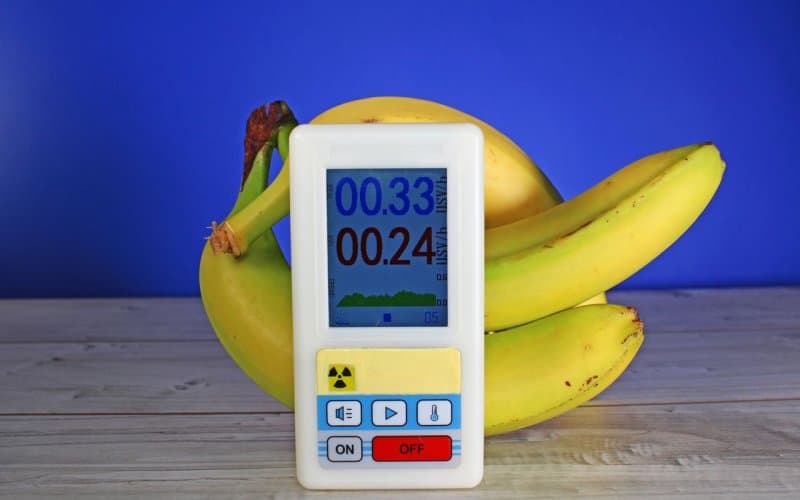
How many bananas can I eat so not to get radiation sickness?
Personally, I wouldn't be afraid that someone could die of a banana overdose. Although the "banana equivalent" is given as an auxiliary unit describing radiation, I do not think that its value reflects the real effect of…
Read the answer
Jaroslav Kores, Ph.D.
Why is a tidal wave at the opposite side of the Earth than the Moon?
You correctly describe that the tide is caused by the gravitational force of the Moon. The magnitude of the gravitational force depends, among other things, on the distances of the bodies. Therefore, gravity acts the mos…
Read the answer
Jaroslav Kores, Ph.D.
Can astronauts make tea?
The effect of atmospheric pressure on the boiling temperature can be imagined as water molecules trying to get out of the liquid. The higher the air pressure, the more air molecules are above the water surface and the mo…
Read the answerWant to ask something?
Send us an e-mail with the subject "Physics mysteries" to the address below, or use the contact form.
We can't wait to tackle your interesting questions!