Jaroslav Kores, Ph.D.
Why are satellite antennas pointed south?
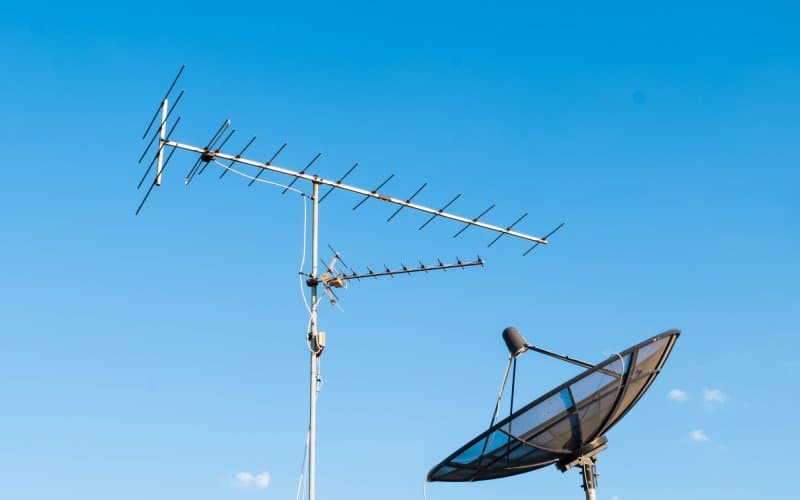
Why is this the case? Satellite reception is provided (unsurprisingly) by satellites — transmitters that orbit the Earth. One satellite that we are all familiar with is the Moon. It also orbits the Earth. Its period (the time it takes to orbit the Earth) is 27 days, which means that in 27 days it will be in the same place above the Earth. To avoid having to constantly reorient satellite antennas, we need their orbital period to be 24 hours — that is, they orbit the Earth in the same time it takes the Earth to rotate on its axis. For us, the satellite will therefore always be above the same place on Earth, and if we point the antenna at it, we will not have to keep repositioning it. In order for the satellite to orbit the Earth and always be above the same place, it must be at a certain altitude, in a so-called geostationary orbit. If we want to find out what this altitude is, we can calculate it (the centrifugal force is equal to the gravitational force, and the orbital period is 24 hours), or we can find it out here — satellites in geostationary orbit, orbit around the equator at an altitude of 36,000 km. Because geostationary satellites orbit above the equator, which is south of us, satellite dishes must be pointed in that direction. In Australia, for example, satellite dishes point north.
If the information on the internet is correct, there are currently more than 500 satellites in geostationary orbit.
More mysteries
Keep exploring questions other readers asked.

Jaroslav Kores, Ph.D.
Could the Earth be a black hole?
Gravitational force depends on the mass of Earth (6 × 1024 kg) and its radius (6,378 km), while centrifugal force depends on the radius of rotation (i.e., the radius of Earth) and the square of the speed—in the cas…
Read the answer
Jaroslav Kores, Ph.D.
Why is a black hole black?
We can determine the value of the force of gravity from Newton's law of gravity, from which we can also determine the value of the gravitational field intensity around each body. We all know from experience that if we th…
Read the answer
Jaroslav Kores, Ph.D.
Why shouldn’t you put hot food in the refrigerator?
Because food contains water, it evaporates. The rate of evaporation depends on the temperature, so if the temperature in the refrigerator increases, more water will evaporate from all the stored food. Water will also eva…
Read the answerWant to ask something?
Send us an e-mail with the subject "Physics mysteries" to the address below, or use the contact form.
We can't wait to tackle your interesting questions!