Most Important Stellarators in the World
8 min read · Energy Atlas Editorial
Wendelstein 7-X + Large Helical Device + Helically Symmetric eXperiment
- LearningNuclear Fusion Courses
- Nuclear Energy Courses
- Renewable Energy Courses

- ITER Tokamak Interactive 3D Model
- Stellarator Interactive 3D Model
- ITER Tokamak and Stellarator Models for 3D Printing
- Thermonuclear Fusion
- Tokamaks
- Stellarators
- Inertial Confinement Fusion
- ITER
- History
- Thermonuclear Fusion Power Plant
- Nuclear Fusion Summary
- Nuclear Power Plant Interactive 3D Model
- Nuclear Power
- The Nuclear Power Industry
- Nuclear Fuel
- The Nuclear Reactors
- Radioactive Waste
- The Safety of Nuclear Power Plants





- Online 3D
- 3D Printing
- Images
- Videos
- Animations
- LearningNuclear Fusion CoursesHow Does Thermonuclear Fusion Work?
- Construction and Working Principle of Tokamaks
- Construction and Working Principle of Stellarator
- Inertial Confinement Fusion
- ITER — a Major Step Towards Thermonuclear Fusion
- Fusion Power Plant as a Clean Energy Source
- Basic principles
- Magnetic confinement
- Inertial and electrostatic confinement
- Summative, cross-sectional test — Light version
- Radioisotopes as Sources of Ionizing Radiation
- Interaction of Atomic Nuclei with Particles
- Nuclear Fuel and the Nuclear Fuel Cycle
- The Principles of Operating a Nuclear Power Plant
- The First Reactor and the First Nuclear Power Plant
- The Most Used Nuclear Reactors: PWR and BWR
- Sources, Processing, and Storage of Radioactive Waste
- Nuclear Power Plant Safety
- Nuclear fuel
- Nuclear fuel and nuclear reactors
- Nuclear power industry
- Nuclear reactors
- Radioactive waste
- Radioactive waste and safety of nuclear power plants
- Nuclear power
- Summative, cross-sectional test — Light version
- Summative, cross-sectional test — PRO version
- Types of RES and the Use of Renewable
- Comparison of Renewable Energy Source
- Characteristics of Hydropower
- Water Turbines in Hydroelectric Power Plants
- Wind Power Plants
- Solar Energy
- Solar Power Plants
- Biomass energy
- Geothermal energy
- Solar energy
- Water energy
- Wind energy
- ITER Tokamak Interactive 3D Model
- Stellarator Interactive 3D Model
- ITER Tokamak and Stellarator Models for 3D Printing
- Thermonuclear FusionWhy it Works?
- How it Works?
- Fusion Fuel
- Fusion in Stars
- Lawson Criterion
- Plasma
- How to Measure the Temperature in the Core of the Sun? or Diagnostics
- Artificial Fusion Principles
- Main Principles
- Material for Magnetic Coils
- Central Solenoid
- Toroidal Field
- Poloidal Field
- Vacuum Chamber
- Divertor
- External Heating
- Fuel
- Problems
- Most Important Tokamaks in the World
- Milestones
- Main Principles
- Magnetic Coils
- Vacuum Chamber
- Divertor
- Problems
- Most Important Stellarators in the World
- Milestones
- Main Principles
- Lasers
- Target
- Chamber
- Most Important Inertial Fusion Facilities in the World
- Milestones
- The Next Step on the Way Toward a Thermonuclear Fusion Power Plant
- Main Parameters
- Timeline
- Record Breakers
- Magnets
- Vacuum Vessel
- Blanket
- Divertor
- Cryostat
- Tritium Production
- Cooling
- Diagnostics
- External Heating
- The ITER Site
- Disruptions and Instabilities
- Early Fusion Research
- Thermonuclear Bomb
- Pinch
- Stellarator Concept
- Tokamak Invention
- Inertial Fusion Proposal
- ITER Organisation
- Fusion Today
- Clean Energy Source
- Dates and Locations
- Challenges
- Safety
- How it Will Look Like
- Fuel
- Waste
- Best Fusion Reactor for Power Plant
- Nuclear Power Plant Interactive 3D Model
- Nuclear PowerRadioactivity
- Ionising Radiation
- Natural Sources
- Man-made Sources
- Half-life
- Decay Series
- Quantities and Units
- Effects of Ionising Radiation
- Radiation Doses and Activities
- Nuclear Power Summary
- Principle of Operation
- Types of Nuclear Reactions
- Fission Chain Reaction
- Control and Reaction States
- Moderator
- Absorber
- Coolant
- Fission Products
- The Largest Nuclear Power Plants
- Fuel Production
- Fuel Enrichment
- Fuel Assembly
- Fuel Cycle
- Interim Storage
- Transportation
- Reprocessing
- Final Repositories
- The Nuclear Power Plant — How it Works
- The First Reactor
- Pressurized Water Reactor (PWR)
- Boiling Water Reactor (BWR)
- Heavy Water Reactor (PHWR)
- Gas-cooled Reactor (GCR) and Advanced Gas-cooled Reactor (AGR)
- RBMK Type Reactor
- High Temperature Reactor (HTGR)
- Reactor Using Fast Neutrons (FR)
- Small Modular Reactors
- The Future of Fission Reactors
- NPP PWR Interactive 3D Model
- NPP BWR Interactive 3D Model
- NPP Small Modular Reactors Interactive 3D Model
- AGR Reactor Interactive 3D Model
- CANDU Reactor Interactive 3D Model
- HTGR Reactor Interactive 3D Model
- Superphénix Interactive 3D Model
- Production of Radioactive Waste
- Types of Radioactive Waste
- The Processing of Radioactive Waste
- The Disposal of Radioactive Waste
- Nuclear Safety
- Safety Systems
- External Hazards
- INES Scale
- Nuclear Accidents
- International Nuclear Organizations
- Nuclear Power Plants and the Environment
- WATER energyHydroelectric Power Plant Interactive 3D Model
- The Physical Properties of Water
- The Origin of Water Energy
- History of Water Energy Utilization
- Water Energy and Its Uses
- Dams and Reservoirs
- The Highest Dams and Largest Reservoirs
- The Segner Wheel
- Francis Turbine
- Kaplan Turbine
- Pelton Turbine
- Choosing a turbine (Turbine selection graph)
- Hydroelectric Power Plant Operating Principles
- Types of Hydroelectric Power Plants
- The Largest Hydroelectric Power Plants in the World
- Tidal Energy and Sea Wave Power
- Marine Current Power and Ocean Thermal Energy
- Environmental Impact of Hydropower
- Wind Turbine Interactive 3D Model
- The Energy of Flowing Air
- The Beaufort Wind Force Scale
- The History of Wind Power Utilization
- Wind Power Plants
- Wind Turbine and its Working Principle
- The Largest Wind Farms
- Types of Wind Turbines
- Wind Turbines and the Environment
- Solar Power Plant Interactive 3D Model
- Solar Rays Energy
- Ways to Use Solar Heat
- Solar Collectors
- Solar Concentrators
- Central Tower Solar Power Plants
- Solar Farms
- The Largest Solar Power Plants
- The Energy Use of the Photovoltaic Effect
- Photovoltaic Farms
- Solar Energy and the Environment
- Solar Energy and Solar Power Systems Summary
- Hot Dry Rock (HDR) Geothermal Energy Interactive 3D Model
- Heat from the Earth’s Core
- Geothermal Phenomena
- Mankind and the Energy from the Earth
- Geothermal Systems
- Geothermal Power Plant
- Environmental Impact
- Biomass Energy Interactive 3D Model
- Biomass
- Types and Processing of Biomass
- Available Technology of Biomass
- Biofuels
- Biomass Power Plants
- Biomass and the Environment
- Rapid development of energy consumption
- The Future of Solar Energy
- The Future of Hydro Energy
- The Future of Renewable Energy Sources
- Development of Renewable Sources
- Online 3D
- 3D Printing
- Images
- Videos
- Animations
- Glossary
- Log-in
- Create new account
- ITER Tokamak Interactive 3D Model
- Stellarator Interactive 3D Model
- ITER Tokamak and Stellarator Models for 3D Printing
- Thermonuclear Fusion
- Tokamaks
- StellaratorsMain Principles
- Magnetic Coils
- Vacuum Chamber
- Divertor
- Problems
- Most Important Stellarators in the World
- Milestones
- Glossary
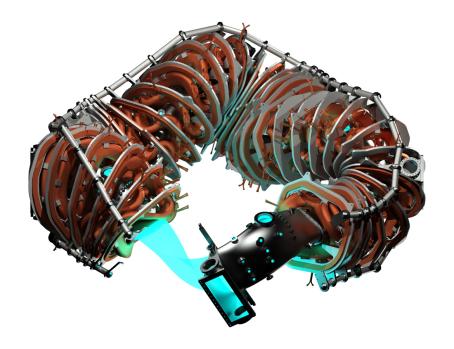
There are over ten stellarators operating around the world. The largest are Wendelstein 7-X in Germany, the Large Helical Device in Japan, and the Helically Symmetric eXperiment (HSX) in the USA.
Wendelstein 7-X, the bigger successor of Wendelstein 7-AS, is an experimental device of the Max Planck Institute for Plasma Physics located in Greifswald, Germany. It successfully ignited its first plasma at the end of 2015 and its aim is to investigate the properties of plasma held for 30 minutes with a maximum heating energy of 18 GJ. This means 10 MW over half an hour. Since then, Wendelstein 7-X has reached 20 million kelvin and discharge times of up to 100 seconds with a heating energy of 200 MJ. After large improvements, during which first wall carbon tiles will be replaced with water-cooled carbon-fibre-reinforced-carbon tiles for better heat removal, the desired half-hour long pulse is anticipated.
Wendelstein 7-X
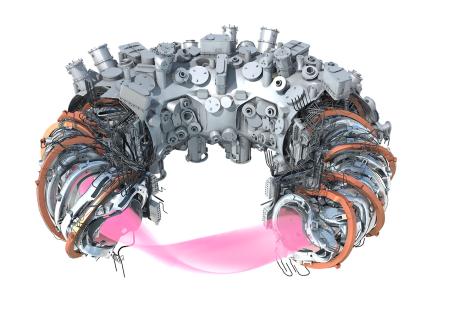
Wendelstein 7-X is a modular stellarator composed of a set of 50 non-planar superconducting coils surrounding the vacuum vessel and creating a twisted magnetic cage. Each coil made from niobium-titanium weighs about 6 tonnes and is about 3.5 metres high. They are cooled by liquid helium to 4 kelvin and are capable of producing magnetic fields of up to 3 Tesla. The magnetic field they generate has a five-fold symmetry. Hence, the plasma is therefore not exactly circular but resembles a pentagon. This is because the magnetic system is made up of five identical modules. Each module contains ten coils, two of which have the same shape but are arranged upside down. In total, the coil wreath is made up of only five different types of coils. The chamber has an outer diameter of 16 m, a height of about 4.5 m, and a nearly circular cross section of 4.5 m in diameter. The whole machine weighs 725 tonnes. A plasma volume of 30 m3 is heated by the combined effects of Neutral Beam Injection (NBI) and Electron Cyclotron Resonance Heating (ECRH), with a total heating power of 14 MW. Record stellarator values were achieved at Wendelstein 7-X for the energy stored in the plasma. With strong microwave heating, the energy content of the plasma exceeded one megajoule for the first time without the vessel wall becoming too hot.
Large Helical Device
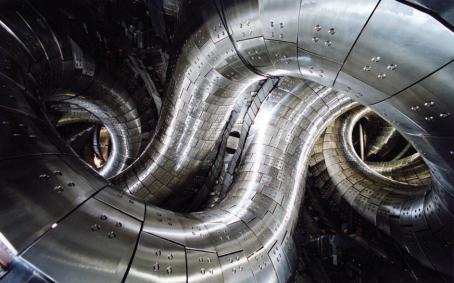
The Large Helical Device belongs to the Japan National Institute for Fusion Science and is located in Toki, Gifu prefecture, Japan. It is a stellarator record holder with a plasma temperature reaching 120 million kelvin and a pulse duration of nearly one hour. The magnetic cage for its heliotron configuration is created by a pair of helical external coils wrapped around a toroidal vacuum vessel. This configuration is completed by three pairs of poloidal coils. The resultant magnetic field gives plasma inside the shape of a twisted ribbon. The first plasma was ignited in March 1998. The major plasma radius is 3.9 metres and its volume is 30 m3. With a total heating power of 36 MW, various heating devices are used, such as neutral beam injection (NBI), ion cyclotron radio frequency heating (ICRF), and electron cyclotron resonance heating (ECRH). The device weighs approximately 1,500 tonnes and has an outer diameter of 13.5 metres and a height of 9.1 metres. One helical coil weighs 120 tonnes and is capable of generating a magnetic field of 3 Tesla. Since accuracy in constructing the helical coils was very important, it was decided that the plasma vacuum vessel should be assembled after the installation of the helical coils. Thus, the vacuum vessel was divided into 140 parts and welded after both helical coils had been placed.
Helically Symmetric eXperiment
The Helically Symmetric eXperiment is located in the Electrical and Computer Engineering department at the University of Wisconsin-Madison, USA. It is not as big as its German or Japanese counterparts, but it is the only device in the world that has a magnetic field structure that has been termed Quasi-Helically Symmetric. This means that its magnetic cage is axisymmetric and this provides great particle confinement, so particles escape less frequently and stay in the plasma so they can be heated up to thermonuclear temperatures easily. The magnetic field is generated by a set of 48 coils arranged into four-fold symmetry. Their shapes were designed by a computer to optimize them for the generation of quasi-helically symmetric fields. A plasma volume of 0.44 m3 is heated by two gyrotrons (ECRH — Electron Cyclotron Resonance Heating) with a total heating power of 200 kW. A maximal plasma temperature of up to 30 million kelvin was reached.
Milestones
Project Matterhorn
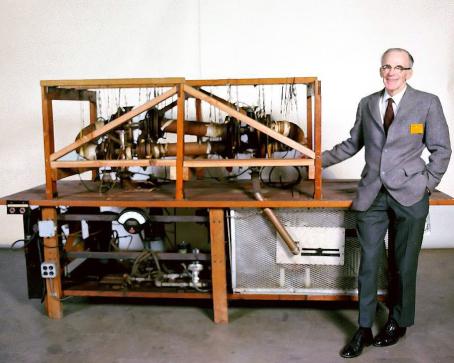
The idea of stellarators is older than that of tokamaks. Lyman Spitzer came up with it in 1951 (the word is out that it was while skiing in Aspen). His first construction of a stellarator was a tube of borosilicate glass bent into the "8" shape with magnetic winding around it. This Model A was built in 1953 in the Princeton Plasma Physics Laboratory (Project Matterhorn at the time) and demonstrated that plasma could be created and confined that way. A Model B series was then designed, still in "table-top" size. On B-1, ohmic heating was used to reach temperatures of about 100,000 kelvin, but the duration of the pulse was shorter than expected. Its successor has the shape of a figure "8" with squared corners, which leads to the cryptic name B-64 (8 squared is 82, which equals 64). This model, completed in 1955, was equipped with a divertor, which improves the purity of plasma and decreases heat loss. After the Model B series, the larger machine, Model C, was built in 1962. For the first time, the injection of neutral particles generated by a particle accelerator was used for heating in 1964. This method is now widely used and is known as Neutral Beam Injection (NBI). In 1969, the Model C reached about 5 million kelvin.
Diffusion Problems
Unfortunately, the larger the stellarator machines, the poorer the confinement. The particles were escaping at an even higher rate than was predicted by the Bohm formula. It seems that if the problem cannot be overcome, the stellarator will be of no use as a power plant. Because of the success of the tokamak concept, the decision was made in 1969 to rebuild Model C to tokamak ST (Symmetric Tokamak). But scientists believe that troubles with confinement time could be solved and research on stellarators flourish in the 60s and 70s all over the world. A simpler design of torsatron was invented (helical winding around a toroidal chamber completed by poloidal coils) and the first device of this type, Saturn-1, started its operation in 1970 at the Kharkov Institute of Physics and Technology, followed by several other devices, of which Uragan III was the first torsatron equipped with a divertor. A similar design of heliotron was explored at Kyoto University, Japan, in the Heliotron series, testing the combination of helical, toroidal, and vertical field coils. In Culham, the PROTO-CLEO device showed that stellarator confinement could be better than that given by the Bohm formula, and ohmically heated plasmas on CLEO showed that parameters similar to those of tokamaks could be obtained. Despite the progress, it was still clear that the magnetic configuration of stellarators is not perfect and should be improved. Advances in plasma theory, engineering, and supercomputing, in particular, were awaited.
Modular Stellarator
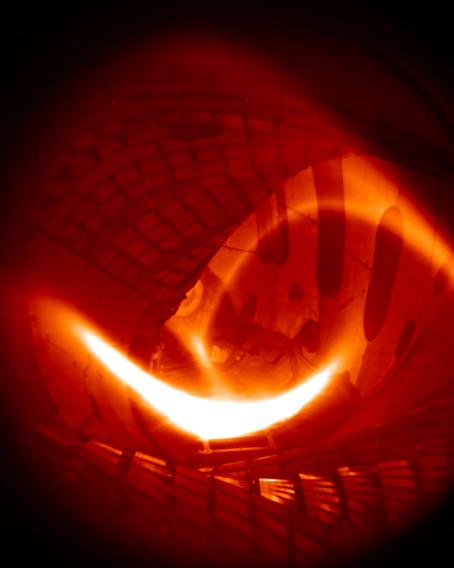
In 1988, the first stellarator with modular non-planar coils, Wendelstein 7-AS, started operation in Garching, Germany. A computer generated bizarre shaped magnetic coils bring the plasma shape of a twisted ribbon closer to an optimal magnetic configuration. It was still not perfect, but it showed the way to its successor, Wendelstein 7-X. It was also the first stellarator equipped with an island divertor.
Second Generation
In Japan, the Large Helical Device with heliotron configuration started operation in 1998 and one year later joined the stellarator family HSX (Helically Symmetric eXperiment), the first modular stellarator with a quasi-helically symmetric field and improved particle confinement. In 2006, a long-pulse plasma discharge of more than 30 min. duration was achieved on the Large Helical Device with total injected heating energy of 1.3 GJ. The first plasma in Wendelstein 7-X, a huge modular stellarator with superconducting coils located in Greifswald, Germany, was ignited in 2015. After two years of experiments, it broke the world record for fusion products. This is a product of ion temperature, plasma density, and energy confinement time and specifies how close one is getting to the reactor values needed to ignite a fusion.
Achievements
At an ion temperature of about 40 million kelvin and a density of 0.8 × 10²⁰ particles per cubic metre, Wendelstein 7-X has attained a fusion product affording a good 6 × 1026 kelvin per second per cubic metre. In 2017, Wendelstein 7-X reached a particle density of up to 2 × 10²⁰ particles per cubic meter — values that are sufficient for a future power station. Ion and electron temperatures exceeded 20 million kelvin, and plasma energy stored exceeded 1 megajoule. Its plasma pulses lasted over 100 seconds. In the same year, LHD exchanged hydrogen for deuterium and in deuterium plasma generated an ion temperature of 120 million kelvin. In 2018, it reached a record in pulse length of over three-quarters of an hour (2,859 seconds) and another record in energy injected into the plasma of 3.36 GJ.
Keep reading
Questions
Tokamak or stellarator — what is the difference?
Both confine plasma in a torus. Tokamaks use plasma current; stellarators use twisted coils.