Jaroslav Kores, Ph.D.
Why doesn’t the Moon fall to the Earth?
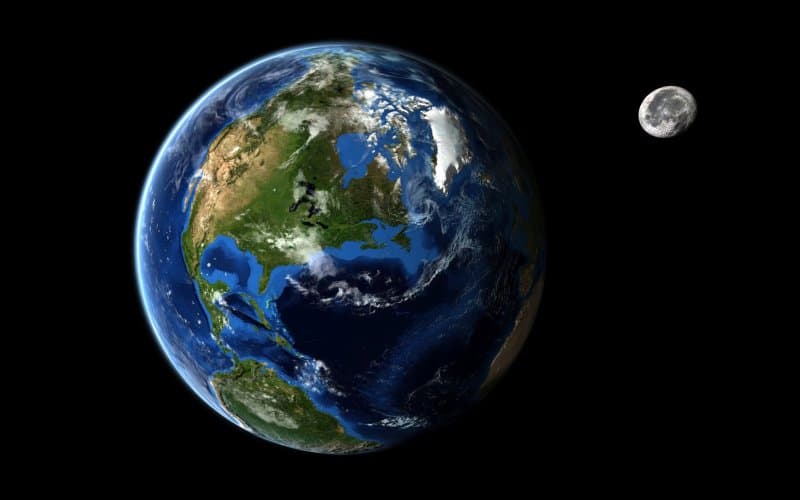
The fact that the Moon orbits the Earth, does not fall on it and does not fly away, and in fact, the fact that it has become our companion, is due to a suitable combination of the speed of the Moon and its distance. According to Newton's first law, bodies on which no force acts move in uniform rectilinear motion. If a force acts on a body, the body will move with acceleration. Acceleration has two different effects — increasing speed (which we probably all know) or changing the direction of movement. In the case of the Moon, the gravitational force that acts between the Moon and the Earth has an effect on changing the direction of movement. The Moon thus moves at the same speed but its movement is not in a straight line, but (in a simplified way) moves in a circle. The force that causes a change in the direction of motion and allows bodies to move in a circle is called centripetal force and its magnitude depends on the weight of the body, the speed of its movement and also on its distance from the center of rotation.
In this case, the originator of the centripetal force is gravity — it causes the Moon to move around the Earth in a circle.
Due to the fact that the Moon is as far away as it is and moves at its own speed, the gravitational and centripetal forces are equal in magnitude. If the Moon were to slow down for some reason or get closer to the Earth, the gravitational force would be greater than the centripetal force and the Moon would start (rather slowly) "falling" towards the Earth. On the contrary, if the speed of the Moon increased, it would begin to slowly move away from the Earth (the centripetal effect of the gravitational force would not be large enough).
If we solved the relevant equations, we would come to the conclusion that the mentioned phenomenon is not related to mass at all — if, instead of the Moon at the same height, we sent a passenger car at the same speed (for example a Fiat Multipla or a Tesla like Elon Musk), then it would move around the Earth with the period of 1 month.
More mysteries
Keep exploring questions other readers asked.

Jaroslav Kores, Ph.D.
Can anything be faster than light?
It can but it won't do us any good. I will not deal with hypothetical particles (tachyons), which in my opinion are more of a mathematical game resulting from the Theory of Relativity. It follows from the Theory of Relat…
Read the answer
Jaroslav Kores, Ph.D.
How is gravity produced on a spaceship?
Gravity is a property of all material bodies and cannot be directly "produced". Since the magnitude of the gravitational force depends on the mass and distance of the bodies acting on each other, we can make a smaller mo…
Read the answer
Jaroslav Kores, Ph.D.
Can water somehow be lost to space, i.e. decrease on the Earth?
It certainly can, and in my opinion, it happens to a very limited extent. If we want anything to leave the Earth's gravitational field, we have to give it the so-called 2nd escape velocity (or Ve). Everything we throw/fl…
Read the answerWant to ask something?
Send us an e-mail with the subject "Physics mysteries" to the address below, or use the contact form.
We can't wait to tackle your interesting questions!