Jaroslav Kores, Ph.D.
How is gravity produced on a spaceship?

Gravity is a property of all material bodies and cannot be directly "produced". Since the magnitude of the gravitational force depends on the mass and distance of the bodies acting on each other, we can make a smaller model of the Earth with the same gravitational effects on its surface. From Newton's law of gravity, it can be calculated that if we had a spaceship with a radius of 1 km (I'm just guessing, I don't know the parameters of the Empire's ships off the top of my head ?), it would have to have a weight of about 1,016 kg. That's quite a lot of material that would need to be transported into space.
Another option is to replace gravity with another force. In order to move on a spaceship, we need to be attracted to it by (any) force but we don't care what the origin of that force is. Therefore, we can replace the gravitational force with centrifugal force — if we make a spaceship circular and let it revolve around its axis, we will have a centrifugal force that will push us to the circumference of the spaceship. By choosing the appropriate rotation period, the centrifugal force will achieve the same magnitude as the effect that gravitational force has on us on the Earth. You just need to realize that we would be walking "upside down" — i.e. on the outer shell of the station and also that due to the small size of the spacecraft, the resulting "centrifugal" field would not be homogeneous (but the gravitational field would be equally inhomogeneous). Such a space station should have a spherical shape and at the given dimensions, it would rotate with a period of about 1 minute.
In both cases (heavy body or rotation) it is necessary to realize that due to the very small size of the spaceship there would be large differences in the value of gravitational/centrifugal force at different distances from the centre of the ship. Therefore, such a spaceship should ideally have only 1 floor, or maybe more precisely one deck. For example, at a depth of 500 m, the gravitational/centrifugal field would be 1.4x stronger, so an 80 kg person would feel like they weigh 110 kg!
More mysteries
Keep exploring questions other readers asked.

Jaroslav Kores, Ph.D.
Can water somehow be lost to space, i.e. decrease on the Earth?
It certainly can, and in my opinion, it happens to a very limited extent. If we want anything to leave the Earth's gravitational field, we have to give it the so-called 2nd escape velocity (or Ve). Everything we throw/fl…
Read the answer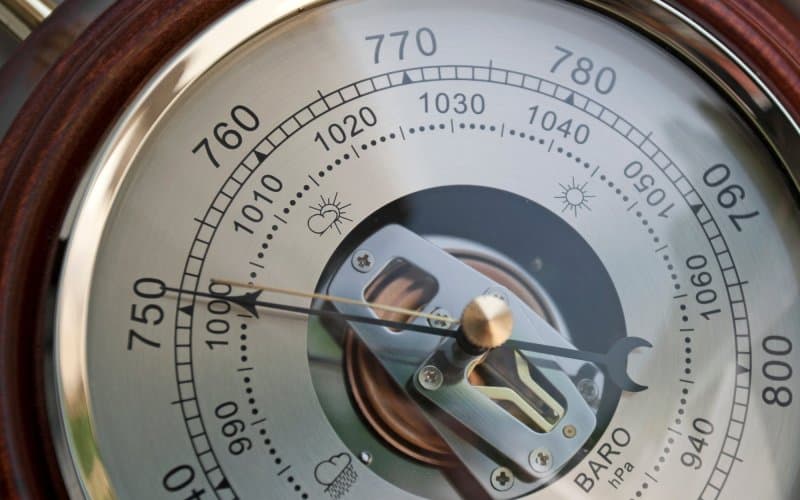
Jaroslav Kores, Ph.D.
Why does atmospheric pressure change and how does it affect humans?
Atmospheric pressure varies mainly with weather and also with altitude. Because atmospheric pressure is the pressure caused by the weight of the air column, the higher we are, the smaller the height of the air above us a…
Read the answer
Jaroslav Kores, Ph.D.
Why is the colour of photos of the countryside different in the morning and in the evening (the sun has a similar angle)?
I don't think that there would always be a difference between the photos in the morning and in the evening, I would rather expect that we can observe something similar from time to time. And I would guess especially in t…
Read the answerWant to ask something?
Send us an e-mail with the subject "Physics mysteries" to the address below, or use the contact form.
We can't wait to tackle your interesting questions!