Jaroslav Kores, Ph.D.
Why do the days get shorter and longer?
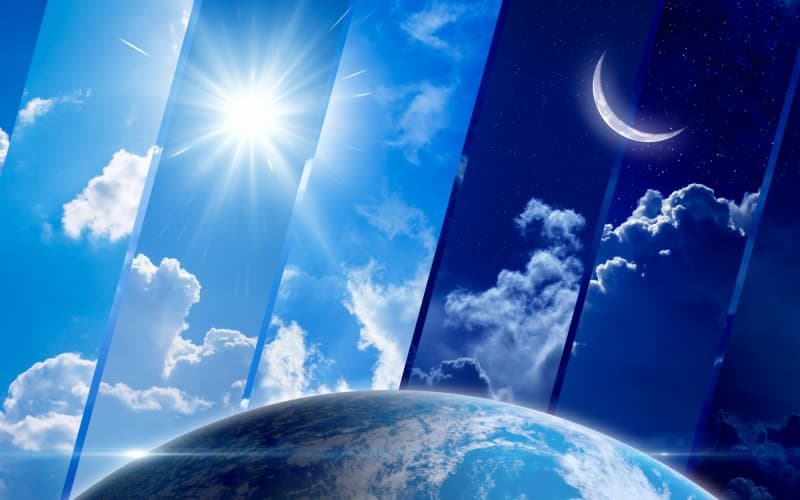
The very alternation of day and night is caused by the rotation of the Earth around its axis. But that's not the only movement the Earth makes, it also orbits the Sun. Orbiting around the Sun alone would not affect the length of the day, but the Earth's axis is tilted (about 23°) relative to the Sun. If this inclination was zero, the days and nights would still be the same — the Sun would always shine at the Earth at the same angle. However, because the Earth is tilted, part of the orbit (roughly half) of the northern hemisphere is tilted towards the Sun (therefore, the sun's rays fall on it longer) but the southern one is tilted away and the time when it is exposed to the sun's rays is shorter. It's good to realize that the tilted part of the Earth actually shadows the part that is not tilted, I think it's nicely explained in this video: https://www.youtube.com/…
Just as a matter of interest — the inclination of Uranus' axis of rotation is almost 90°, so its northern hemisphere is actually always in the shadow of the southern one — therefore it is always night in the north, while it is always day in the south. To be exact, I will add that the speed of the Earth's rotation around the Sun is not constant, therefore, in our hemisphere the days get longer faster in the winter than when they get shorter in the summer.
More mysteries
Keep exploring questions other readers asked.

Jaroslav Kores, Ph.D.
How is it that in a car accident, the speed of the cars do not add up and what is the resulting crash speed?
We probably intuitively know that there will be a difference when two small passenger cars collide and when a passenger car collides with a truck. It is obvious that the result of the collision is somehow related not onl…
Read the answer
Jaroslav Kores, Ph.D.
What phenomenon explains that I have much more power with a pulley and I can pull a heavier object than when I lift it normally?
Although it may seem that a pulley (or an inclined plane or a lever) are special machines, using some strange aspect of physics, the opposite is true — these machines (we call them collectively simple machines) prove tha…
Read the answer
Jaroslav Kores, Ph.D.
How is it possible to compose any colour from RGB (red, green and blue)?
Our eye has 2 types of light-sensitive cells — retinal rods and cones. While rods respond to less intense light but not to colours, cones are less sensitive to light intensity but respond to colours. That's why we see th…
Read the answerWant to ask something?
Send us an e-mail with the subject "Physics mysteries" to the address below, or use the contact form.
We can't wait to tackle your interesting questions!