Jaroslav Kores, Ph.D.
Can astronauts make tea?
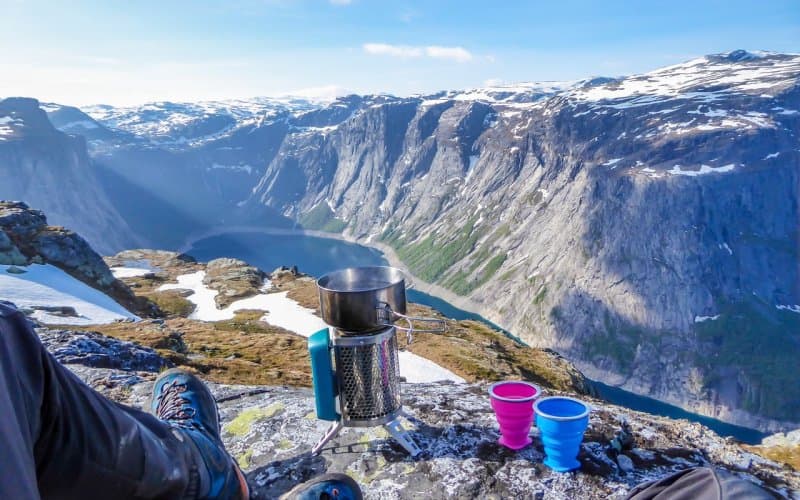
The effect of atmospheric pressure on the boiling temperature can be imagined as water molecules trying to get out of the liquid. The higher the air pressure, the more air molecules are above the water surface and the more difficult it is for the water molecules to penetrate the air. So if the pressure is zero, water molecules could easily penetrate to the environment. Only the forces which water molecules act on neighbouring molecules (surface tension) will prevent this leakage. The dependence of the boiling temperature on the pressure is described by a phase diagram — we can determine from it at what temperature the water will boil at a given pressure. When the pressure decreases we may even find that the water will only be in the gaseous or solid phase (which happens on Mars).
If we want to make water for tea (I assume that we are not interested in the fact that the water is bubbling but that it will have a temperature of 100 °C), we have a simple solution — a pressure cooker. Or any closed container (ideally with a valve that prevents the pressure inside from rising to a dangerous level at which the container could rupture). It is used at higher altitudes when cooking meat or lentils (I'll leave it to everyone what they prefer). With the help of a pressure cooker, we can achieve the same boiling temperature of the water, regardless of the ambient pressure. It works by increasing the pressure inside the cooker by evaporating water molecules. Because the container is closed, the evaporated molecules have nowhere to escape, the number of particles in the gas increases and thus, the pressure increases. However, the pressure cooker will not solve the problem of boiling water in a zero gravity — conventional water heating would not work there. The first problem is that the water would not have to stick together and would disintegrate into individual drops. If we had a container full of water, there would be no disintegration. But we would have to reckon with thermal expansion, which is exponentially more distinct for liquids than for solids. The second problem would be that convective heat transfer would not work (warmer water has a lower density than colder water) — this effect would not occur without a gravitational field. We would only heat the molecules at the bottom but we would not be able to transfer this energy to other molecules. The same would be true for heating by a microwave oven.
Finally, I would like to draw your attention to the ambiguity of the word water — in this case I consider the H2O molecule in various states to be water (ice, water, water vapour) whereas we usually perceive the term water only as the H2O molecule in the liquid state. I consider this addition important to correctly understand the answer.
More mysteries
Keep exploring questions other readers asked.
Jaroslav Kores, Ph.D.
Are there green stars?
Purely theoretically, I can't see a problem with that. The colour of a star depends on its composition and temperature. The sun is yellow precisely because it consists mainly of hydrogen and also partly of helium and its…
Read the answerJaroslav Kores, Ph.D.
Can be anything colder than absolute zero?
The very definition of absolute zero says that 0 K (i.e. −273.15 °C) cannot be achieved. It is one example of the limitations that nature gives us. Why this is so (that is, why nature limits us in this way) is more…
Read the answer
Jaroslav Kores, Ph.D.
Why is my food heated in the microwave and not a plate?
The microwave oven is an example of an invention that was created not on the basis of a theoretical design, but happened by chance. While working on military radar components, Percy Spencer discovered that a chocolate ba…
Read the answerWant to ask something?
Send us an e-mail with the subject "Physics mysteries" to the address below, or use the contact form.
We can't wait to tackle your interesting questions!