Jaroslav Kores, Ph.D.
What color is the atom?
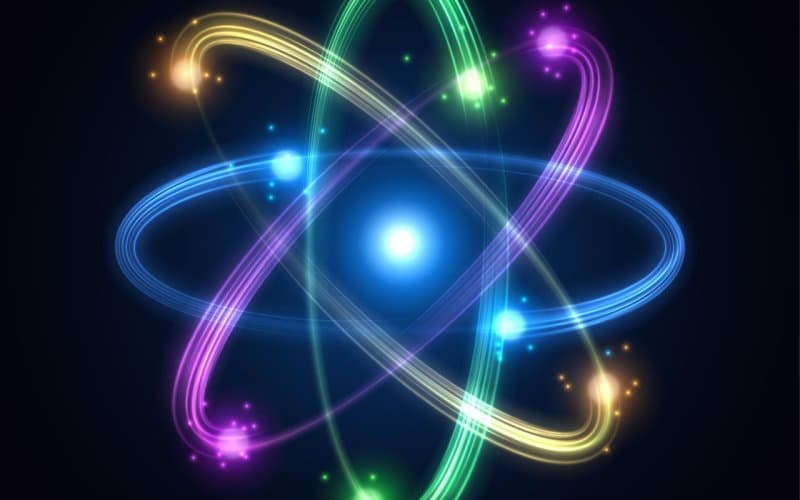
The first possibility is that the thing (the Sun, a bulb, fire) emits light. In this case, the colour of light is determined by the material of the body and its temperature (so the Sun is yellow just because it consists of hydrogen and has a temperature of about 6,000 °C). Iron is orange during the casting just because it has a certain temperature and because it consists of iron. The second way bodies can get their colour is reflection and light absorption. The body that reflects light is for example, red because it reflects red but absorbs other colours. So if we shine blue or green on a red body, it will be black. Black bodies are those that absorb all colours (that's why black heats up the most) and white bodies are those that reflect all colours. In both cases, therefore, it is mainly a property of the material of which the body consists of. And because every material is made up of atoms, there should be some connection between the colour of light and the atom. We know that an atom consists of a nucleus and electrons move around it. An electron is located at a certain place (state) in the atom, and if we supply it with energy, it can move to another place (state). It is not possible to use any amount of energy for this relocation, but specific values. And because light is energy, if we shine on the atom, for example, with white colour, the electrons of a given material will use, for example, the energy of blue light to jump to the next state.
The energy of red light is less than the required energy, but the energy of purple light is too high. So the given atom will only absorb blue light and it will seem yellow to us. If we heat the atom, we will supply the electrons with energy to jump to a higher state. However, it will not last there for long and jump back to the original state, while emitting light, which will again have a colour corresponding to the energy emitted by the electron. In the previous case, the atom would shine blue.
Because there are many states that an electron can jump into and different atoms have different numbers of electrons, the question cannot be answered unambiguously. Also, in the case of light emitted by the atom, we are not limited only to visible colours, but also to, for example, infrared or ultraviolet radiation.
More mysteries
Keep exploring questions other readers asked.
Jaroslav Kores, Ph.D.
Is the electricity returning to the power plant?
I will try to explain the question with an analogy of the postal services. We use electricity to fulfil its work and the post office to send packages. In the case of the electricity, charged particles (especially electro…
Read the answer
Jaroslav Kores, Ph.D.
What would happen to a man inside a particle accelerator?
It could be expected that outside of sci-fi movies, we will not know how a human would end up if they were exposed to the current of really accelerated particles in the accelerator, but in the 1970s, something similar ha…
Read the answer
Jaroslav Kores, Ph.D.
How wide is the rainbow?
Light colour is made by its frequency and as you write correctly, light is a type of electromagnetic wave and is specific "only" by that it is about the frequencies we see. The frequency of the electromagnetic waves can…
Read the answerWant to ask something?
Send us an e-mail with the subject "Physics mysteries" to the address below, or use the contact form.
We can't wait to tackle your interesting questions!