Jaroslav Kores, Ph.D.
What are the chances of us discovering a previously undiscovered element?
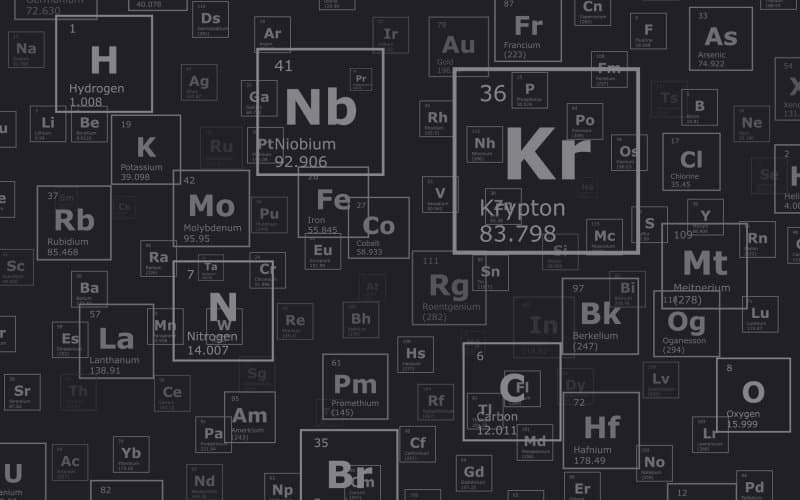
Rather than discovering a new element, it's more likely that we will create a new element. We have not observed all elements with an atomic number higher than 94 (i.e., with more protons in the nucleus than plutonium has) in nature and therefore have not discovered them, but rather, we have produced them.
The reason we haven't discovered these elements is that they have a short half-life, meaning they decay very quickly into other elements. For example, the last confirmed element with 188 protons in its nucleus (Oganesson) has a half-life of a thousandth of a second. So, in one second, half of the atoms decay into others a thousand times. So, in one second, it will undergo 2 to the power of 1000 decays to half (which is 1 followed by 300 zeros). Such Mendelevium (with 101 protons in its nucleus) has a half-life of almost 60 days, so after a year, 1/64 of the original amount will remain, and after 2 years, it will be only 1/4096.
For example, carbon-14 has a half-life of over 5,000 years, which is why we typically (originally) use it for dating living organism. But this method is only useful for determining ages up to approximately 50,000 years. In older measurements, for example, we use the potassium isotope K-40, which has a half-life of approximately 1 billion years.
If the question were, what is the chance of us creating an element that has not yet been discovered, I would say there is such a chance, and work is being done on the discovery of elements with 119 and 120 protons. But it's unlikely we could create an element with an arbitrary number of protons. If the nucleus were too large, several problems would arise. The nuclear forces wouldn't be able to hold the nucleus together even for a very short time and the nucleus's electron shell would likely collapse. According to our understanding of electron behavior based on quantum physics, electrons would have to move faster than the speed of light. Another limitation is that the larger the nucleus, the more it repels other nuclei/protons, which makes it impossible to increase the number of protons in that nucleus. Therefore, it is believed that the limit for the heaviest nucleus (and thus for new elements) is 125 protons.
More mysteries
Keep exploring questions other readers asked.

Jaroslav Kores, Ph.D.
What is the efficiency of different “power plants” (nuclear, coal, solar, wind, hydro, biomass, etc.)?
In every power plant, we convert a selected form of energy into electrical energy. In principle, we use 3 main forms of energy — kinetic energy, light energy, and thermal energy. We most often use thermal energy, both in…
Read the answer
Jaroslav Kores, Ph.D.
What are the costs of building, operating, and decommissioning a nuclear power plant versus the profit from selling the electricity and heat produced?
Using the example of the planned construction of new units at the Dukovany Nuclear Power Plant, it can be estimated that the investment made will return at least fourfold over the lifespan of the nuclear power plant, eve…
Read the answer
Jaroslav Kores, Ph.D.
Is it feasible to store spent nuclear fuel on an uninhabited planet, moon, or in space in the near future?
Technically, it already was and is feasible but the problem lies in the economic aspect. Simply put, radioactive waste can be disposed of quite safely by launching it into Earth's orbit and then "shooting" it out of the…
Read the answerWant to ask something?
Send us an e-mail with the subject "Physics mysteries" to the address below, or use the contact form.
We can't wait to tackle your interesting questions!