Edita Bromova
Scientists are said to have created a transparent mouse. How is that supposed to work?
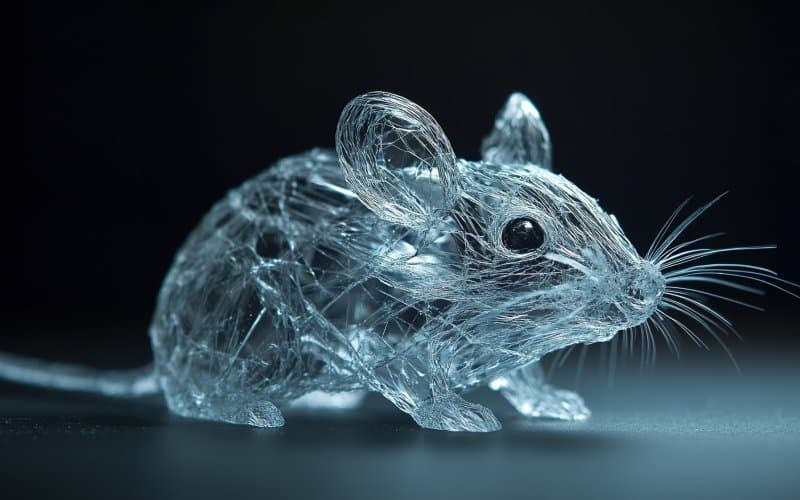
Human beings have always longed to be invisible. Fables and myths are full of potions, incantations and cloaks of invisibility. H. G. Wells attempted to grasp the idea of invisibility a little more scientifically in his novel The Invisible Man. In it, the hero invents a substance that makes all the cells of his body transparent.
Total invisibility is interesting for literary fiction; partial invisibility would be amazing for science. Biologists are eager to find out what's going on inside the organisms they study. They'd like to see neurons firing, hearts beating, muscle fibres contracting, or intestinal peristalsis working. But to see inside a living creature, they have to cut it open. A transparent animal could be studied completely non-invasively under normal conditions.
The opacity of the skin is due to its optical properties. Light falling on an object is partly absorbed and partly reflected by it. The reflected rays are then perceived as the colour of the object. A red ball is therefore not red — it just reflects red rays and absorbs rays of other colours. If the arrangement of molecules in the object is such that the ray can pass through without significant change, we perceive it as transparent. If the ray inside the object is reflecting in all directions, it cannot reach the other side and we perceive the object as opaque.
A complex object like skin is made up of many substances. There's water, fats, proteins, hemoglobin, and each molecule has a different refractive index. When light passes into a different environment, it changes its direction of propagation. It is different when it passes through water, and different when it passes through fat. As a result, the skin looks opaque and we can't see our internal organs.
More mysteries
Keep exploring questions other readers asked.

Edita Bromova
Did the dinosaurs measure the half-life?
The ability of dinosaurs to construct radiation detectors, take measurements, and record the results has not yet been proven, and it is quite likely that they did not actually do any such thing. Yet we know the half-live…
Read the answer
Edita Bromova
Do photons know the future?
Photons are particles with zero rest mass moving in a vacuum at the speed of light. As bosons, they are not constrained by the Pauli Exclusion Principle and can pass through each other or occupy the same quantum state ..…
Read the answer
Edita Bromova
Elements from the island of stability
The nucleus of each atom is made up of protons with the addition of more or less neutrons. It is thus theoretically possible for an element to exist with any number of protons in its nucleus. Perhaps a thousand or a mill…
Read the answerWant to ask something?
Send us an e-mail with the subject "Physics mysteries" to the address below, or use the contact form.
We can't wait to tackle your interesting questions!