Edita Bromova
Did the dinosaurs measure the half-life?
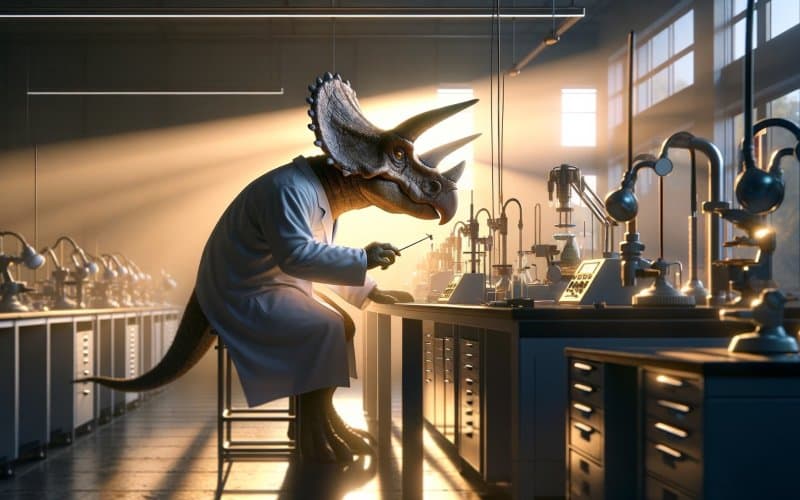
The ability of dinosaurs to construct radiation detectors, take measurements, and record the results has not yet been proven, and it is quite likely that they did not actually do any such thing. Yet we know the half-lives of elements that are longer than the time that dinosaurs ruled the Earth.
In order to explain how this is possible, it is first necessary to clarify what the half-life is. A radioactive isotope has an unstable atomic nucleus. Its number of protons and neutrons causes it not to hold together very well. Sooner or later, it will decay so the resulting structure will be more stable.
So-called radioactive decay can take many forms. For example, the nucleus expels an alpha particle, i.e. the nucleus of a helium atom made up of two protons and two neutrons. It can also change a proton into a neutron, or vice versa, and expel the excess electron or positron produced by this transformation. This is called beta decay. Or it simply breaks into several pieces in spontaneous fission.
Scientists try to theoretically calculate the half-life from the configuration of protons and neutrons, but this method is not always reliable. So they often choose a more precise method of measurement.
Although we have a lot of data about the nucleus of an atom, if we put one atom of a particular isotope on the table in front of us, we can't tell if it will decay now or after a thousand years. If we put a few billion of them in front of us and start measuring, we find that atoms decay gradually. Here one, there another. Over a period of time, half the atoms we've prepared will decay. And that time is called the half-life.
Naturally, no one sat by a pile of uranium-238 for four and a half billion years to watch half the atoms decay during that time.
The half-life can also be perceived in another way. As the probability that a given atom will decay, for example, in the next minute. For elements with a long half-life this probability is small, while elements with a short half-life have a high chance of decaying in the next minute. Then all you have to do is take a sufficiently large number of atoms of a given isotope and measure how many decay in a minute or hour. Then you can calculate the half-life of the isotope.
The matter is simplified by the fact that a mere gram of uranium contains about 6 × 10²³ atoms, so there are plenty of samples to measure. If we consider the aforementioned isotope 238, in that amount of atoms, about 45 million should decay in one hour. Which is already well measurable and then from such a measurement the half-life can be calculated. The help of dinosaur scientists is not necessary at all.
More mysteries
Keep exploring questions other readers asked.

Edita Bromova
Do photons know the future?
Photons are particles with zero rest mass moving in a vacuum at the speed of light. As bosons, they are not constrained by the Pauli Exclusion Principle and can pass through each other or occupy the same quantum state ..…
Read the answer
Edita Bromova
Elements from the island of stability
The nucleus of each atom is made up of protons with the addition of more or less neutrons. It is thus theoretically possible for an element to exist with any number of protons in its nucleus. Perhaps a thousand or a mill…
Read the answer
Edita Bromova
Where does the “first neutron” that starts a fission chain reaction in a nuclear reactor come from?
The fission chain reaction in a nuclear reactor takes place when a neutron flies to a uranium-235 atom and collides with it, splitting the nucleus into two or three fragments. Several neutrons fly out of the whole proces…
Read the answerWant to ask something?
Send us an e-mail with the subject "Physics mysteries" to the address below, or use the contact form.
We can't wait to tackle your interesting questions!