Jaroslav Kores, Ph.D.
Does temperature affect the rate of radioactive decay?
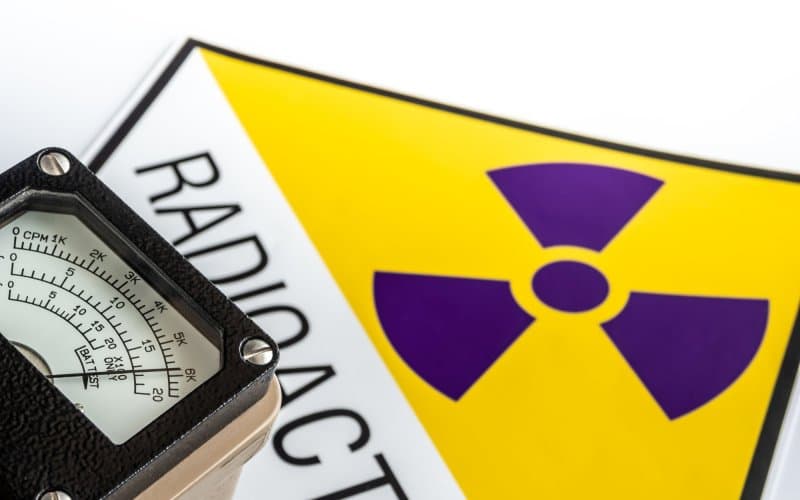
Temperature does have an effect on the speed of particle movement, but this effect is minimal compared to the influence of nuclear forces and therefore, (except under extreme conditions) the half-life of nuclei at different temperatures does not change. We know three basic types of radioactive radiation — alpha, beta, and gamma, with radioactive decay being observed in the case of the first two types of radiation — alpha and beta. Alpha radiation is the release of a helium nucleus from the nucleus of a radioactive element and beta radiation is the decay of a nucleon (proton or neutron) accompanied by the release of an electron or positron. Alpha radiation is a quantum phenomenon (which is not related to temperature), while beta radiation is associated with the weak nuclear force which has an effect on particle movement that is on the order of a million times greater than the effect of temperature.
Thanks to the fact that temperature does not affect the rate of radioactive decay, we can use the decay of selected particles to determine the age of biological (carbon 14C) or non-biological (uranium 238U) materials.
In conclusion, I would just add that the radioactive decay itself is a probabilistic matter — from the half-life, we are able to determine how long it will take for one particle to decay but that does not mean it will always happen. Thanks to the fact that there is a tremendous number of particles in every substance, the influence of chance (probability) is minimal.
More mysteries
Keep exploring questions other readers asked.

Jaroslav Kores, Ph.D.
How are calories burned in your body? How is it calculated how many calories I burn during various activities?
First, I need to clarify the difference between calories and units of energy, which are joules. Calories were previously used to determine the value of heat and it has been shown (for example in the First Law of Thermody…
Read the answer
Jaroslav Kores, Ph.D.
What is the efficiency, lower heating value and electrical generation capacity of different sources of energy?
I think that this question cannot be answered simply and briefly and I will rather try to explain why it cannot be answered. Perhaps it will then be clearer why the answer is fundamentally impossible. When producing elec…
Read the answer
Jaroslav Kores, Ph.D.
What force attracts electrons to the nucleus of an atom?
Of the four known types of forces, only two interact between an electron and a proton — gravitational and electrostatic. Both have a similar method of calculation, with gravitational force depending on the mass of the in…
Read the answerWant to ask something?
Send us an e-mail with the subject "Physics mysteries" to the address below, or use the contact form.
We can't wait to tackle your interesting questions!