Jaroslav Kores, Ph.D.
What force attracts electrons to the nucleus of an atom?
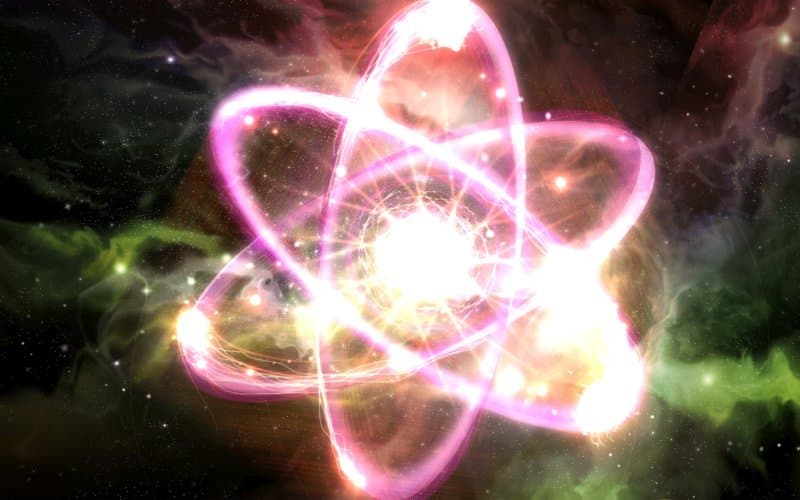
Of the four known types of forces, only two interact between an electron and a proton — gravitational and electrostatic. Both have a similar method of calculation, with gravitational force depending on the mass of the interacting bodies and electrostatic force depending on their charge. We determine the gravitational force from Newton's law of gravitation, and the electrostatic force from Coulomb's law.
After substitution, we find that the gravitational force is approximately 10—47 N and the electrostatic force is 10—8 N. It is therefore clear that electrons are held near the nucleus due to electrical attraction.
If we look at the value of the electrostatic force — 0.00000001 N, we see that it is very small. For reference — if we lift an apple, we exert a force of 1 N. It seems, therefore, that the force keeping electrons in motion around protons is very small. In our (large) world, this electrostatic force is indeed very small, but in the micro-world, it is an enormous force — if we wanted to compare it to lifting an apple, we would have to exert a force of 10,000,000,000,000,000,000,000 N (1 followed by 22 zeros) on the same apple, compared to the mentioned force of 1 N. The acceleration imparted by the electrostatic force on an electron moving around the nucleus is indeed 1022 times greater than the acceleration imparted by the Earth's gravitational field on everything on Earth.
More mysteries
Keep exploring questions other readers asked.

Jaroslav Kores, Ph.D.
What is the size of an atom and the ratio of the size of the nucleus to the electron cloud?
The size of an atom is in the tenths of nanometres (0.0000000001 m), and the nucleus is even 100,000 times smaller. From this ratio and the fact that the mass of protons is approximately 2,000 times greater than the mass…
Read the answer
Jaroslav Kores, Ph.D.
What is the speed of an electron orbiting around the nucleus of an atom?
In my opinion, the speed of an electron's movement in the electron cloud cannot be determined by direct measurement (electrons are too small for that), but we can use an analogy from astronomy — for example, the Moon orb…
Read the answer
Jaroslav Kores, Ph.D.
What is the temperature of electrons and protons?
Just like with everything in our surroundings, it is necessary to determine under what conditions we want to measure the temperature in. For example, water can be at 4 °C in the refrigerator, 95 °C in an electric kettle,…
Read the answerWant to ask something?
Send us an e-mail with the subject "Physics mysteries" to the address below, or use the contact form.
We can't wait to tackle your interesting questions!