Jaroslav Kores, Ph.D.
Are there green stars?
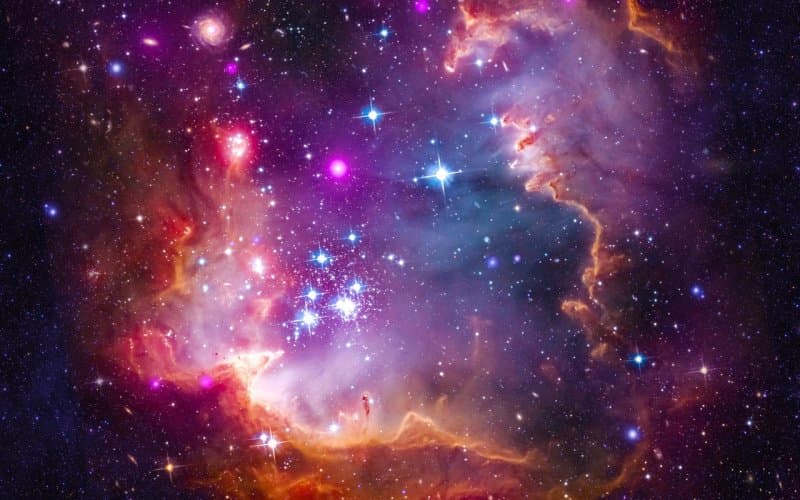
Purely theoretically, I can't see a problem with that. The colour of a star depends on its composition and temperature. The sun is yellow precisely because it consists mainly of hydrogen and also partly of helium and its surface temperature is about 6,000 °C. If we had hydrogen in a glass tube and heated it to the same temperature, it would glow yellow.
Light and its colour are caused by electron jumps from different energy levels. These levels and the specific colours of the light photons are precisely described (e.g. Balmer's hydrogen series). There are many combinations and not only in the visible part of the light spectrum. Lasers work on a similar principle — we force electrons to make a specific jump between two levels and so a photon of the desired frequency (or colour) is emitted.
That would be a theoretical view; now the practical one, I would like to say that I am not a professional astrophysicist. Stars are powered by a nuclear fusion which is the fusion of the nuclei of lighter elements. This produces heavier elements and a large amount of energy which is radiated in the form of electromagnetic radiation. This radiation has a different frequency (or colour) depending on the energy that is emitted. Light is only a narrow part of electromagnetic radiation — stars also emit infrared, ultraviolet, X-ray or gamma rays. However, nuclear fusion takes place only under certain conditions (it does not work on heavy elements at low pressures or temperatures). So there is a combination of elements, temperatures and pressures in which fusion will occur. And this combination means that the stars are yellow, blue, (ultraviolet) but not green. I am describing the "dominant" colour above — the Sun is yellow even though the light it emits contains other colours but not in the same intensity as the dominant yellow colour. This is due to the temperature of the Sun's surface. This, in turn, is caused by the energy produced by nuclear fusion, and that, in turn, is caused by the composition of the Sun, pressure and temperature.
More mysteries
Keep exploring questions other readers asked.
Jaroslav Kores, Ph.D.
Can be anything colder than absolute zero?
The very definition of absolute zero says that 0 K (i.e. −273.15 °C) cannot be achieved. It is one example of the limitations that nature gives us. Why this is so (that is, why nature limits us in this way) is more…
Read the answer
Jaroslav Kores, Ph.D.
Why is my food heated in the microwave and not a plate?
The microwave oven is an example of an invention that was created not on the basis of a theoretical design, but happened by chance. While working on military radar components, Percy Spencer discovered that a chocolate ba…
Read the answer
Jaroslav Kores, Ph.D.
What color is the atom?
The first possibility is that the thing (the Sun, a bulb, fire) emits light. In this case, the colour of light is determined by the material of the body and its temperature (so the Sun is yellow just because it consists…
Read the answerWant to ask something?
Send us an e-mail with the subject "Physics mysteries" to the address below, or use the contact form.
We can't wait to tackle your interesting questions!